Gold prices retreat after US JOLTS data hints at a resilient US labour market
- Gold prices extend losses as US Dollar gains on upbeat labour data.
- The US Dollar rebounds as the Fed digests the JOLTs data in the lead up to Friday's Nonfarm Payroll (NFP) report.
- US interest rate expectations continue to price in a rate cut in September, limiting the Greenback's losses.

Gold prices are experiencing a sharper correction against the US Dollar (USD) on Tuesday, JOLTS (Job Openings and Labor Turnover Survey) beat analyst forecasts, showing a 7.391 million increase in the number of job openings in April. The results came in above the estimated 7.1 million increase and higher than March's 7.2 million increase.
The release of the JOLTs data has helped ease fears surrounding a softening labour market in the United States, reducing pressure on the Federal Reserve (Fed) to deviate from its hawkish Monetary policy stance in the near term.
The JOLTS data is the first of a wide range of employment releases scheduled for this week. The main scheduled risk event this week for employment data and the US Dollar is Friday’s Nonfarm Payroll (NFP) report, which will include the latest unemployment rate for May, impacting the Fed’s interest rate trajectory.
Additionally, Chicago Fed President Austin Goolsbee and Fed Governor Lisa Cook will speak during the US session, offering further insights into the economic and interest rate outlook for the United States. Participants are eagerly awaiting any hints regarding when the Federal Reserve might begin to reduce interest rates again after keeping them unchanged for many months.
According to the CME FedWatch Tool, market participants are currently pricing in a 54% chance of a rate cut in September. For June and July meetings, the expectation is that the Fed will maintain its benchmark rate at the current range of 4.25%-4.50%.
This data and commentary are crucial in shaping expectations for future monetary policy moves, especially as the Fed navigates the delicate balance between combating inflation and supporting employment growth.
Gold daily digest: Softening ahead of employment data, Fed speakers, and trade developments
- US President Donald Trump and Chinese President Xi Jinping are expected to hold a call this week, as announced on Monday by White House Press Secretary Karoline Leavitt. The call aims to address ongoing tensions between the US and China, which came under renewed pressure over the weekend.
- Trade tensions intensified on Friday, when Trump accused China of violating the trade agreement reached in Geneva on May 12. During the Geneva talks, both countries agreed to reduce tariff rates for a period of 90 days. China agreed to reduce restrictions on rare earth exports to the US, which are critical for several industries, including Artificial Intelligence and defense.
- In an interview with CNBC, US Trade Representative Jamieson Greer said, "The Chinese are slow-rolling their compliance, which is completely unacceptable, and it has to be addressed." China responded by calling the allegations “groundless,” and there have been no reports of scheduled talks from Beijing this week.
- Trade negotiations between the US and China are critical for Gold’s valuation as the precious metal benefits from its safe-haven appeal during times of economic uncertainty. Thus, Gold is likely to benefit if there are increasing signs that talks are falling apart, while its price should decline if both countries are able to ease tensions.
- On Monday, Microsoft made headlines by announcing it would cut more than 300 jobs. This decision follows a previous announcement last month in which the tech giant revealed that it was trimming 6,000 positions as part of a broader cost-reduction initiative. These job cuts come days before May’s Nonfarm Payrolls (NFP) report, scheduled for Friday, where 130K jobs are expected to have been added in May, down from 177K in April.
Gold technical analysis: US Dollar recovery pushes prices below $3,350
Gold prices have fallen back below the psychological level of $3,350, which is providing near-term resistance for the precious metal.
Following a 2.80% gain on Monday, prices broke above the upper-bound of the symmetrical triangle on the daily chart, supporting a surge in bullish momentum.
However, failure to retest $3,400, the next significant level of resistance required for a potential retest of the April $3,500 all-time high (ATH), limited the upside move.
Gold daily chart
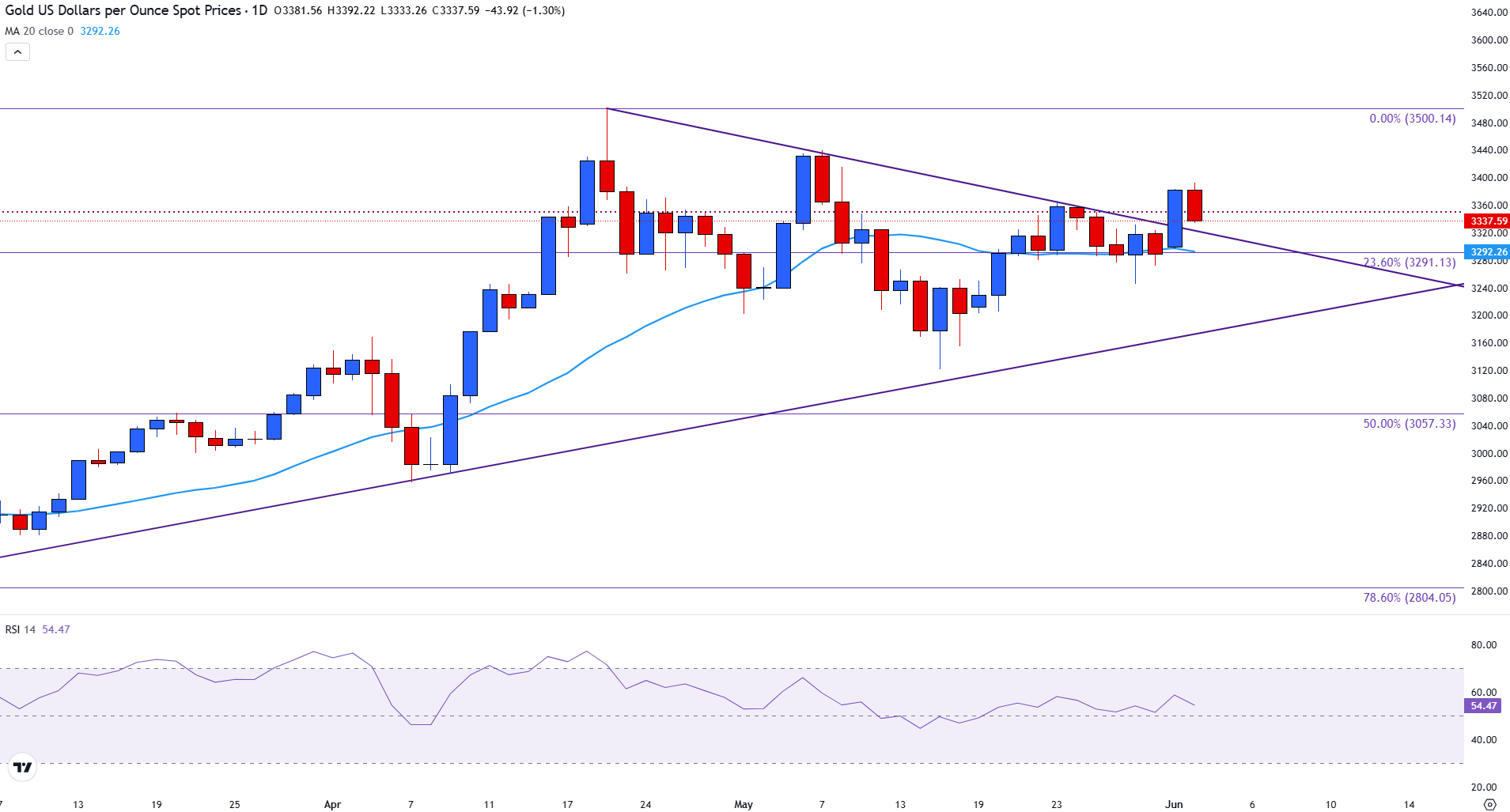
With the Relative Strength Index (RSI) at 56, the momentum of the trend remains above the 50 neutral level, but is far from technically overbought.
With prices still exhibiting signs of strength, the near-term trajectory may be further influenced by technical levels.
For the upside potential, a break of $3,400 is crucial to reignite the momentum of the uptrend.
On the downside, the upper bound of the triangle aligns with the 10-day Simple Moving Average (SMA) at $3,324, with the $3,300 psychological level just below. At $3,293, the 20-day Simple Moving Average (SMA) is providing an additional layer of support, a break of which could bring the 23.6% Fibonacci retracement level of the January-April move near $3,291.
Interest rates FAQs
Interest rates are charged by financial institutions on loans to borrowers and are paid as interest to savers and depositors. They are influenced by base lending rates, which are set by central banks in response to changes in the economy. Central banks normally have a mandate to ensure price stability, which in most cases means targeting a core inflation rate of around 2%. If inflation falls below target the central bank may cut base lending rates, with a view to stimulating lending and boosting the economy. If inflation rises substantially above 2% it normally results in the central bank raising base lending rates in an attempt to lower inflation.
Higher interest rates generally help strengthen a country’s currency as they make it a more attractive place for global investors to park their money.
Higher interest rates overall weigh on the price of Gold because they increase the opportunity cost of holding Gold instead of investing in an interest-bearing asset or placing cash in the bank. If interest rates are high that usually pushes up the price of the US Dollar (USD), and since Gold is priced in Dollars, this has the effect of lowering the price of Gold.
The Fed funds rate is the overnight rate at which US banks lend to each other. It is the oft-quoted headline rate set by the Federal Reserve at its FOMC meetings. It is set as a range, for example 4.75%-5.00%, though the upper limit (in that case 5.00%) is the quoted figure. Market expectations for future Fed funds rate are tracked by the CME FedWatch tool, which shapes how many financial markets behave in anticipation of future Federal Reserve monetary policy decisions.
Author

Tammy Da Costa, CFTe®
FXStreet
Tammy is an economist and market analyst with a deep passion for financial markets, particularly commodities and geopolitics.