Gold still flirts with a minor loss after bigger drop on Monday
- Gold was able to recover initial losses from an eventful weekend on tariffs and deportations.
- US tech stocks dive on Monday with the Nasdaq down over 3%.
- Gold fades just ahead of a fresh new all-time high.

Gold’s price (XAU/USD) slips below $2,770 at the time of writing on Monday after a very nervous headline-filled weekend. Meanwhile the week ahead is filled with quite a few central bank's rate decision . Over the weekend, markets understood why United States (US) President Donald Trump has eased on using tariffs as a tool.
It appears that tariffs will be used as leverage, for example, for countries that refuse to accept deported US immigrants who are being brought back to their country of origin. Colombia got a taste of the playbook on Sunday when President Trump ordered 25% emergency tariffs, and an increase to 50% in a week, as the country did not comply with President Trump’s deportation demands. However, the White House later confirmed that “Colombia has agreed to all of President Donald Trump’s terms, including unrestricted acceptance of all illegal aliens from Colombia returned from the US,” and Trump’s proposed tariffs were “now on hold.”
Later this week, the Federal Reserve (Fed) and the European Central Bank (ECB) will decide on policy rates on Wednesday and Thursday, respectively. Meanwhile a Chinese open source AI start up spooks markets and puts questions on the elevated valuations for tech stocks like Nvidia, dragging the Nasdaq lower.
Daily digest market movers: Rates issues ahead
- Gold’s outlook remains positive on strong demand from central banks, with the precious metal’s reputation as an alternative reserve asset continuing to attract investors, according to Kotak Securities Ltd, Bloomberg reports.
- Gold dipped, as the US Dollar (USD) rose after President Donald Trump held off from imposing threatened tariffs on Colombia as the two countries reached a deal on the return of deported migrants, Reuters reports.
- The CME FedWatch tool projects no change in the policy rate for the upcoming Federal Reserve rate decision. Going forward, the May rate decision has a 43.8% probability of a 25 basis point rate cut compared to 45.4% for no change.
Technical Analysis: Difficult reading
Gold’s price rally stalls and looks to be hitting a curb this Monday after President Donald Trump demonstrated during the weekend how and when tariffs will be used. This was enough to trigger some panic in markets, as it became clear that President Trump is not easing at all on tariffs. Meanwhile, Gold had hit overbought levels in the Relative Strength Index (RSI) indicator in the daily chart, and could see some more selling pressure as of now.
The first line of support remains at $2,721, a sort of double top in November and December broken on January 21. Just below that, $2,709 (October 23, 2024, low) is in focus as a second nearby support. In case both abovementioned levels snap, look for a dive back to $2,680 with a full-swing sell-off.
Conversely, Gold could still hit the all-time high of $2,790, which is around 1% away from current levels. Once above that, a fresh all-time high will present itself. Meanwhile, some analysts and strategists have penciled in calls for $3,000, but $2,800 looks to be a good starting point as the next resistance on the upside.
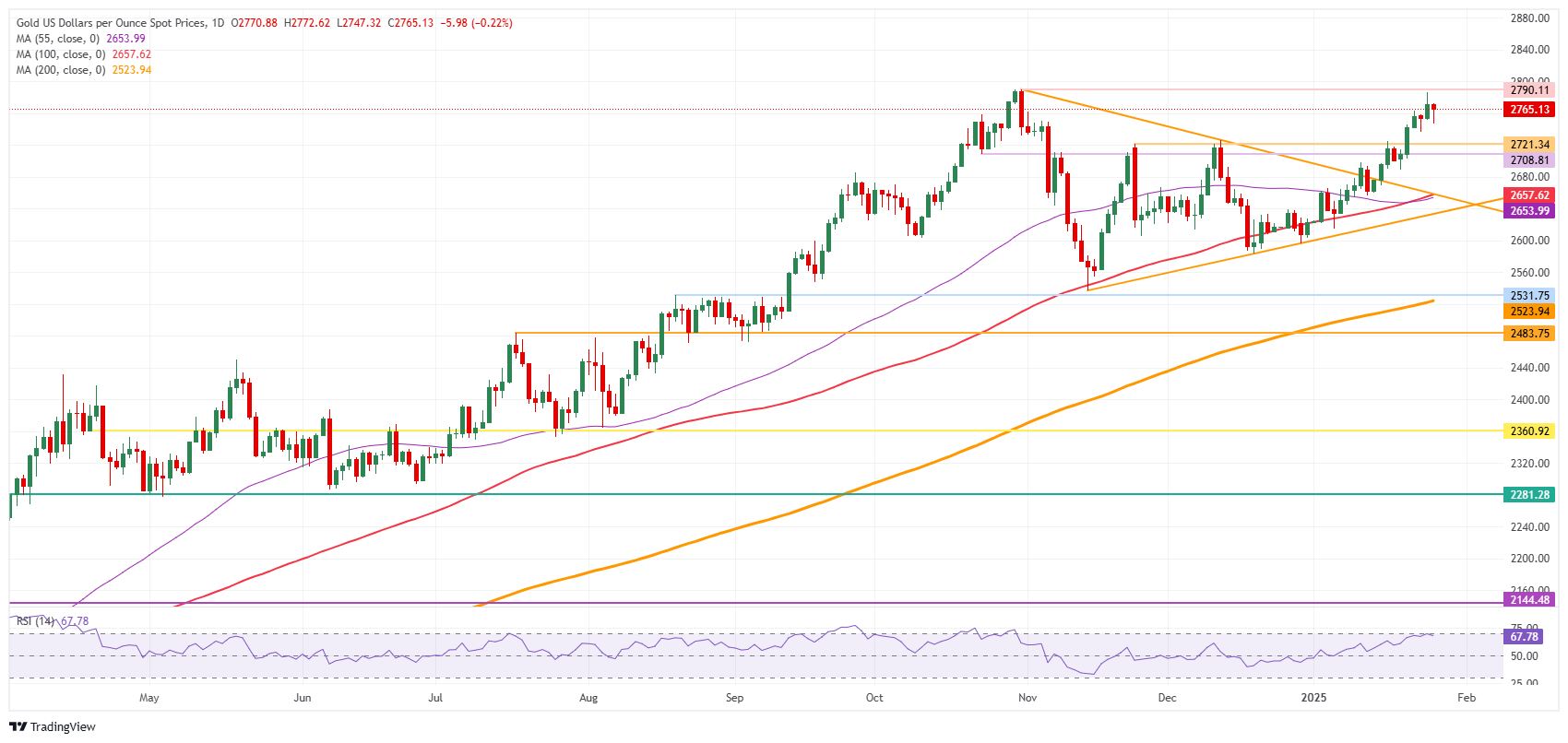
XAU/USD: Daily Chart
(This story was corrected on January 27 at 15:40 GMT to say Colombia, not Columbia.)
Gold FAQs
Gold has played a key role in human’s history as it has been widely used as a store of value and medium of exchange. Currently, apart from its shine and usage for jewelry, the precious metal is widely seen as a safe-haven asset, meaning that it is considered a good investment during turbulent times. Gold is also widely seen as a hedge against inflation and against depreciating currencies as it doesn’t rely on any specific issuer or government.
Central banks are the biggest Gold holders. In their aim to support their currencies in turbulent times, central banks tend to diversify their reserves and buy Gold to improve the perceived strength of the economy and the currency. High Gold reserves can be a source of trust for a country’s solvency. Central banks added 1,136 tonnes of Gold worth around $70 billion to their reserves in 2022, according to data from the World Gold Council. This is the highest yearly purchase since records began. Central banks from emerging economies such as China, India and Turkey are quickly increasing their Gold reserves.
Gold has an inverse correlation with the US Dollar and US Treasuries, which are both major reserve and safe-haven assets. When the Dollar depreciates, Gold tends to rise, enabling investors and central banks to diversify their assets in turbulent times. Gold is also inversely correlated with risk assets. A rally in the stock market tends to weaken Gold price, while sell-offs in riskier markets tend to favor the precious metal.
The price can move due to a wide range of factors. Geopolitical instability or fears of a deep recession can quickly make Gold price escalate due to its safe-haven status. As a yield-less asset, Gold tends to rise with lower interest rates, while higher cost of money usually weighs down on the yellow metal. Still, most moves depend on how the US Dollar (USD) behaves as the asset is priced in dollars (XAU/USD). A strong Dollar tends to keep the price of Gold controlled, whereas a weaker Dollar is likely to push Gold prices up.
Author

Filip Lagaart
FXStreet
Filip Lagaart is a former sales/trader with over 15 years of financial markets expertise under its belt.