Gold declines as US-China trade optimism offsets Fed rate cut bets
- Gold remains depressed as signs of easing US-China trade tensions dent safe-haven demand.
- Bets for more Fed rate cuts undermine the USD and offer some support to the precious metal.
- Traders also seem reluctant and opt to wait for the crucial two-day FOMC meeting this week.
Gold (XAU/USD) attracts fresh sellers following an intraday uptick to levels above the $4,100 round figure and turns lower for the second straight day on Monday. The commodity sticks to the negative bias through the first half of the European session, though it lacks bearish conviction amid a mixed fundamental backdrop. Signs of easing trade tensions between the US and China boosted investors' appetite for riskier assets, which, in turn, undermines demand for the safe-haven precious metal. However, dovish Federal Reserve (Fed) expectations act as a tailwind for the non-yielding yellow metal.
Traders now seem convinced that the US central bank will lower borrowing costs two more times by the year-end, and the bets were reaffirmed by softer US consumer inflation figures released on Friday. This, in turn, keeps the US Dollar (USD) bulls on the defensive, which, along with persistent geopolitical risks stemming from the protracted Russia-Ukraine war, offers some support to the Gold. This, in turn, warrants some caution for the XAU/USD bears and positioning for deeper losses as the market focus remains glued to the highly-anticipated two-day FOMC meeting starting on Tuesday.
Daily Digest Market Movers: Gold is pressured by receding safe-haven demand amid US-China trade optimism
- Top Chinese and US economic officials on Sunday agreed on the framework of a potential trade deal that will be discussed when US President Donald Trump and Chinese President Xi Jinping meet later this week. US Treasury Secretary Scott Bessent said that discussions on the sidelines of the ASEAN Summit in Kuala Lumpur had eliminated the threat of 100% tariffs on Chinese imports starting November 1.
- This helps soothe investor nerves and eases concerns about a further escalation of trade tensions between the world’s two largest economies. Moreover, the optimism sends stocks sharply higher at the start of a new week and exerts some downward pressure on the safe-haven Gold during the Asian session. However, bets for more interest rate cuts by the US Federal Reserve warrant some caution for bears.
- The US Bureau of Labor Statistics reported on Friday that the headline Consumer Price Index rose by 0.3% in September, putting the annual inflation rate at 3%. Excluding food and energy, the gauge showed a 0.2% monthly gain and an annual rate stood at 3%. The reading fell short of consensus estimates and reaffirmed market bets that the US central bank will lower borrowing costs later this week.
- Moreover, the CME Group's FedWatch Tool indicated that traders have nearly fully priced in another 25-basis-point Fed rate cut move in December. This, in turn, fails to assist the US Dollar to capitalize on Friday's goodish bounce from a one-week low. This, along with geopolitical risks stemming from the protracted Russia-Ukraine war, turns out to be a key factor acting as a tailwind for the non-yielding yellow metal.
- Russia launched a drone attack on the Ukrainian capital, Kyiv, in the early hours of Sunday. Ukraine’s Air Force said that it downed four of nine missiles and 90 of 101 drones launched in the Russian attacks across the country. Furthermore, Russian President Vladimir Putin also announced a successful final test of a new nuclear-powered cruise missile. This could support the safe-haven commodity.
- Traders might also opt to move to the sidelines ahead of this week's central bank event risks. Meanwhile, the focus will remain glued to the crucial FOMC policy decision on Wednesday, which will play a key role in influencing the near-term USD price dynamics and determining the next leg of a directional move for the XAU/USD pair.
Gold bears have the upper hand while below the 23.6% Fibo. level/$4,1000 mark
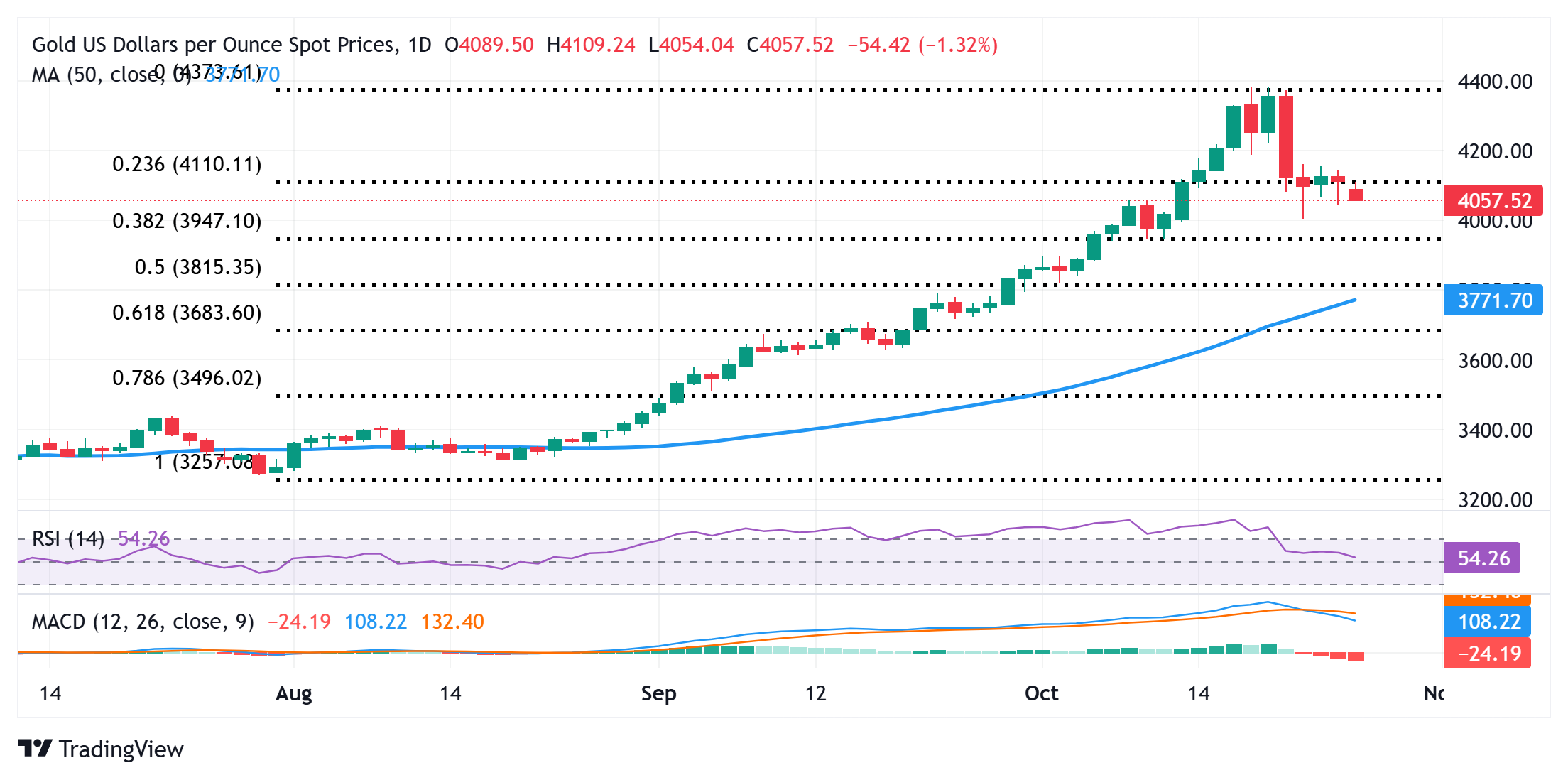
From a technical perspective, the commodity now seems to have found acceptance below the 23.6% Fibonacci retracement level of the July-October blowout rally. However, last week's bounce from the vicinity of the $4,000 psychological mark and mixed oscillators on the daily chart warrant caution for the XAU/USD bears. This, in turn, suggests that any subsequent slide below Friday's swing low, around the $4,044 area, might continue to attract some buyers near the said handle. This is followed by the 38.2% Fibo. retracement level, around the $3,948 region, which, if broken decisively, could drag the Gold price to sub-$3,900 levels. Some follow-through selling should pave the way for a fall towards the 50% retracement level, around the $3,810-$3,800 region, en route to the 50-day Simple Moving Average (SMA), currently pegged near the $3,775 area.
On the flip side, the Asian session high, around the $4,109-4,110 region, which coincides with the 23.6% Fibo. retracement level support break point might continue to act as an immediate hurdle. A sustained strength beyond could lift the Gold price to the $4,155-4,160 supply zone, which, if cleared, could trigger a short-covering rally. The XAU/USD pair might then accelerate the positive move towards reclaiming the $4,200 mark and climb further towards the next relevant hurdle near the $4,252-4,255 region.
US-China Trade War FAQs
Generally speaking, a trade war is an economic conflict between two or more countries due to extreme protectionism on one end. It implies the creation of trade barriers, such as tariffs, which result in counter-barriers, escalating import costs, and hence the cost of living.
An economic conflict between the United States (US) and China began early in 2018, when President Donald Trump set trade barriers on China, claiming unfair commercial practices and intellectual property theft from the Asian giant. China took retaliatory action, imposing tariffs on multiple US goods, such as automobiles and soybeans. Tensions escalated until the two countries signed the US-China Phase One trade deal in January 2020. The agreement required structural reforms and other changes to China’s economic and trade regime and pretended to restore stability and trust between the two nations. However, the Coronavirus pandemic took the focus out of the conflict. Yet, it is worth mentioning that President Joe Biden, who took office after Trump, kept tariffs in place and even added some additional levies.
The return of Donald Trump to the White House as the 47th US President has sparked a fresh wave of tensions between the two countries. During the 2024 election campaign, Trump pledged to impose 60% tariffs on China once he returned to office, which he did on January 20, 2025. With Trump back, the US-China trade war is meant to resume where it was left, with tit-for-tat policies affecting the global economic landscape amid disruptions in global supply chains, resulting in a reduction in spending, particularly investment, and directly feeding into the Consumer Price Index inflation.
Author

Haresh Menghani
FXStreet
Haresh Menghani is a detail-oriented professional with 10+ years of extensive experience in analysing the global financial markets.














