Gold is pressured by USD strength and risk-on mood ahead of US CPI report
- Gold drifts lower on Thursday and is pressured by a combination of negative factors.
- A positive risk tone and a modest USD uptick drive flows away from the commodity.
- Fed rate cut bets could cap the USD and support the XAU/USD ahead of the US CPI.

Gold (XAU/USD) maintains its offered tone through the first half of the European session on Thursday, though it lacks bearish conviction as traders opt to wait for the release of the US consumer inflation figures. The crucial US Consumer Price Index (CPI) will play a key role in influencing market expectations about the possibility of a jumbo rate cut next week and the number of possible rate cuts by the year-end. This, in turn, will drive the US Dollar (USD) demand and provide a fresh directional impetus to the non-yielding yellow metal.
Heading into the key data risk, some repositioning trade lifts the USD Index (DXY), which tracks the Greenback against a basket of currencies, to a fresh weekly high and exerts some pressure on the Gold. Apart from this, a generally positive risk tone is seen as another factor undermining the safe-haven precious metal. That said, rising bets for a more aggressive policy easing by the Fed might cap the USD. Moreover, trade-related uncertainties, rising geopolitical tensions, and political uncertainty in France and Japan should support the XAU/USD pair.
Daily Digest Market Movers: Gold bulls remain on the sidelines amid a firmer USD, receding safe-haven demand
- The S&P 500 and Nasdaq posted record highs closely on Wednesday, while Japan’s Nikkei 225 index jumped over 1% to hit a fresh record high on Thursday. This, in turn, dents demand for traditional safe-haven assets and fails to assist the Gold to build on the previous day's positive move.
- The US Bureau of Labor Statistics (BLS) reported on Wednesday that the US Producer Price Index declined to 2.6% on a yearly basis in August from 3.3% in the previous month. Other details showed that the core PPI, which excludes food and energy prices, rose 2.8% YoY compared to 3.7% in July.
- The lack of producer price pressures, despite import tariffs, could be seen as sign of softening domestic demand against the backdrop of a struggling labor market. This, in turn, reaffirms market expectations that the US Federal Reserve will cut interest rates at its policy meeting next week.
- Furthermore, traders are pricing in a small possibility of a jumbo rate cut on September 17 and expect the Fed to deliver three 25-basis-point rate cuts by the end of this year. This should cap the US Dollar recovery from its lowest level since July 28 and support the non-yielding yellow metal.
- On the trade-related front, US President Donald Trump has urged the European Union to slap 100% tariffs on China and India as part of his efforts to pressure Russia to end its war in Ukraine. Trump last month raised tariffs on Indian imports to 50%, citing continuing purchases of Russian oil.
- Meanwhile, Poland shot down Russian drones on Wednesday that were flying over its airspace after completing a mission in western Ukraine. This is the first time a NATO member nation has fired shots in Russia’s war on Ukraine, raising the risk of a further escalation of geopolitical tensions.
- Furthermore, Trump has threatened tougher sanctions against Russia after its heaviest aerial bombardment on Ukraine, which involved at least 810 drones and 13 missiles. This could further benefit the precious metal's safe-haven status and contribute to limiting any meaningful corrective slide.
Gold needs to find acceptance below $3,600 pivotal support to back the case for deeper losses
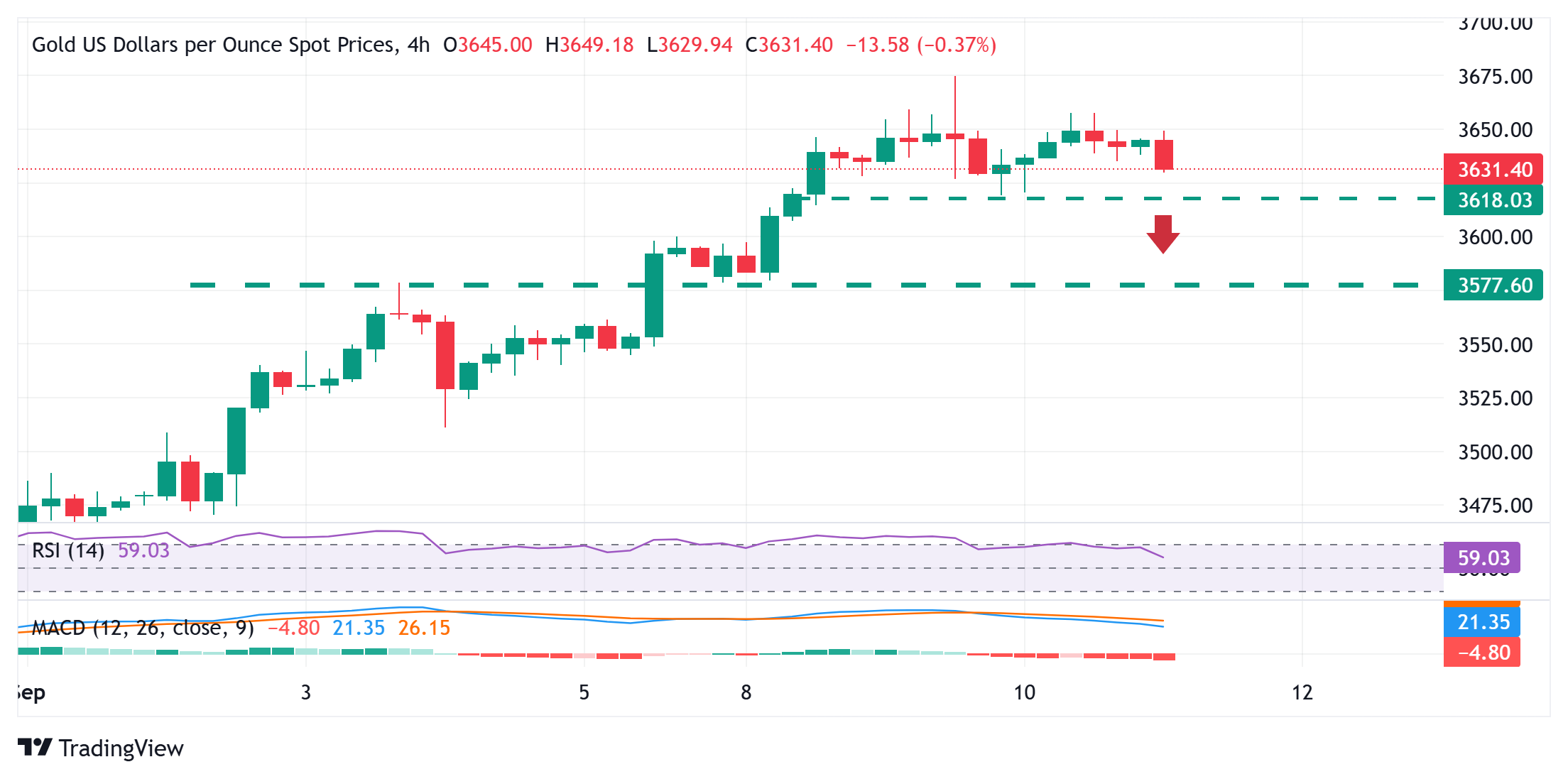
The daily Relative Strength Index (RSI) remains in overbought territory and backs the case for some near-term consolidation or a further pullback. However, any further slide below the overnight swing low, around the $3,620 area, could find some support near the $3,600 round-figure mark ahead of the weekly trough , around the $3,580 region. A convincing break below the latter could pave the way for deeper losses and drag the Gold towards the $3,565-3,560 intermediate support en route to last Thursday's swing low, around the $3,510 region.
On the flip side, the Asian session top, around the $3,649 area, followed by the overnight swing high, around the $3,657-3,658 region, might now act as immediate hurdles, above which the Gold could retest the all-time peak, around the $3,675 zone. Some follow-through buying could allow the XAU/USD pair to build on the recent breakout momentum and aim towards conquering the $3,700 mark. Bulls, however, might refrain from placing aggressive bets and pause near the said handle, which could act as a strong near-term barrier for the commodity.
Economic Indicator
Consumer Price Index ex Food & Energy (YoY)
Inflationary or deflationary tendencies are measured by periodically summing the prices of a basket of representative goods and services and presenting the data as the Consumer Price Index (CPI). CPI data is compiled on a monthly basis and released by the US Department of Labor Statistics. The YoY reading compares the prices of goods in the reference month to the same month a year earlier. The CPI Ex Food & Energy excludes the so-called more volatile food and energy components to give a more accurate measurement of price pressures. Generally speaking, a high reading is bullish for the US Dollar (USD), while a low reading is seen as bearish.
Read more.Next release: Thu Sep 11, 2025 12:30
Frequency: Monthly
Consensus: 3.1%
Previous: 3.1%
Source: US Bureau of Labor Statistics
The US Federal Reserve has a dual mandate of maintaining price stability and maximum employment. According to such mandate, inflation should be at around 2% YoY and has become the weakest pillar of the central bank’s directive ever since the world suffered a pandemic, which extends to these days. Price pressures keep rising amid supply-chain issues and bottlenecks, with the Consumer Price Index (CPI) hanging at multi-decade highs. The Fed has already taken measures to tame inflation and is expected to maintain an aggressive stance in the foreseeable future.
Author

Haresh Menghani
FXStreet
Haresh Menghani is a detail-oriented professional with 10+ years of extensive experience in analysing the global financial markets.