Gold back above $2,820 while China lashes back at US
- Gold sets forth its string a fresh record highs with a new one at $2,830.70 on Monday.
- The US is being slapped with counter-tariffs on US imports on Tuesday from China.
- Gold is flat while markets are mixed with waves of headlines around tariffs being published.

Gold’s price (XAU/USD) is looking for direction after having printed another new all-time on Monday and after China retaliated on Tuesday morning against US tariffs issued over the weekend. Beijing imposed a 15% tariff on less than $5 billion of US energy imports, such as Coal and Liquified Natural Gas (LNG), and a 10% fee on American Oil and agricultural equipment. It will also investigate Google for alleged antitrust violations. Markets are unclear on what to do with these retaliatory tariffs and are showing whipsaw patterns on Tuesday’s price action.
On the economic data front, the calendar is light ahead of the runup to the Nonfarm Payrolls report, scheduled on Friday. On Tuesday, the JOLTS Job Openings for December could be of interest later in the day, followed by two Federal Reserve (Fed) speakers, Atlanta Fed Raphael Bostic and San Francisco Fed Mary Daly.
Daily digest market movers: Offsetting each other
- China retaliated to US President Donald Trump’s opening trade war tariffs by targeting a handful of American companies and slapping levies on some US goods, in a move seemingly designed to avoid escalating tensions between the world’s two biggest economies, Bloomberg reports. China's response was seen as "measured and appropriate" and "targeted to send Trump a warning without hurting its own access to important commodities."The tariffs are set to kick in on February 10, potentially leaving room for negotiation.
- European Central Bank (ECB) member Olli Rhen said that EU should retaliate if President Trump imposes tariffs, the Financial Times reports.
- At 15:00 GMT, the December JOLTS Job Openings report is due. Expectations are that there will be a decrease to 8 million job openings, down from 8.098 million in November.
- At 16:00 GMT, Atlanta Fed President Raphael W. Bostic moderates a conversation with Atlanta Mayor Andre Dickens at a National Housing Crisis Task Force meeting in Atlanta.
- At 19:00 GMT, Federal Reserve Bank of San Francisco President Mary Daly will participate in the Walter E. Hoadley Annual Economic Forecast panel, hosted by the Commonwealth Club World Affairs of California.
- The CME FedWatch tool shows an 86.5% chance of keeping interest rate unchanged in the March 19 meeting, compared to 13.5% for a 25 basis points rate cut.
Technical Analysis: Headline risks taking over
This is where the boys will be separated from the men in trading after China counteracted on Tuesday President Trump’s tariffs slapped over the weekend. Whipsaw moves and headline-driven volatility will take over the logic price action from here on out. Stay loyal to the bigger levels, which will act as support or resistance intraday and in the longer term.
The first support comes in at the $2,800 round level, followed by $2,790, which was November’s high. The low of Monday in the chaotic opening of this week at $2,772 should act as the next support. Once that level should snap, a quick sprint to $2,721 could be underway.
Analysts and strategists have called for $3,000, but the region around $2,800 looks like a good starting point for profit-taking. Based on Monday’s price action, technical analysis (pivot points) shows $2,839 and $2,864 as the next daily resistance levels. These will become important, along with the logic big figures such as $2,850 and $2,880.
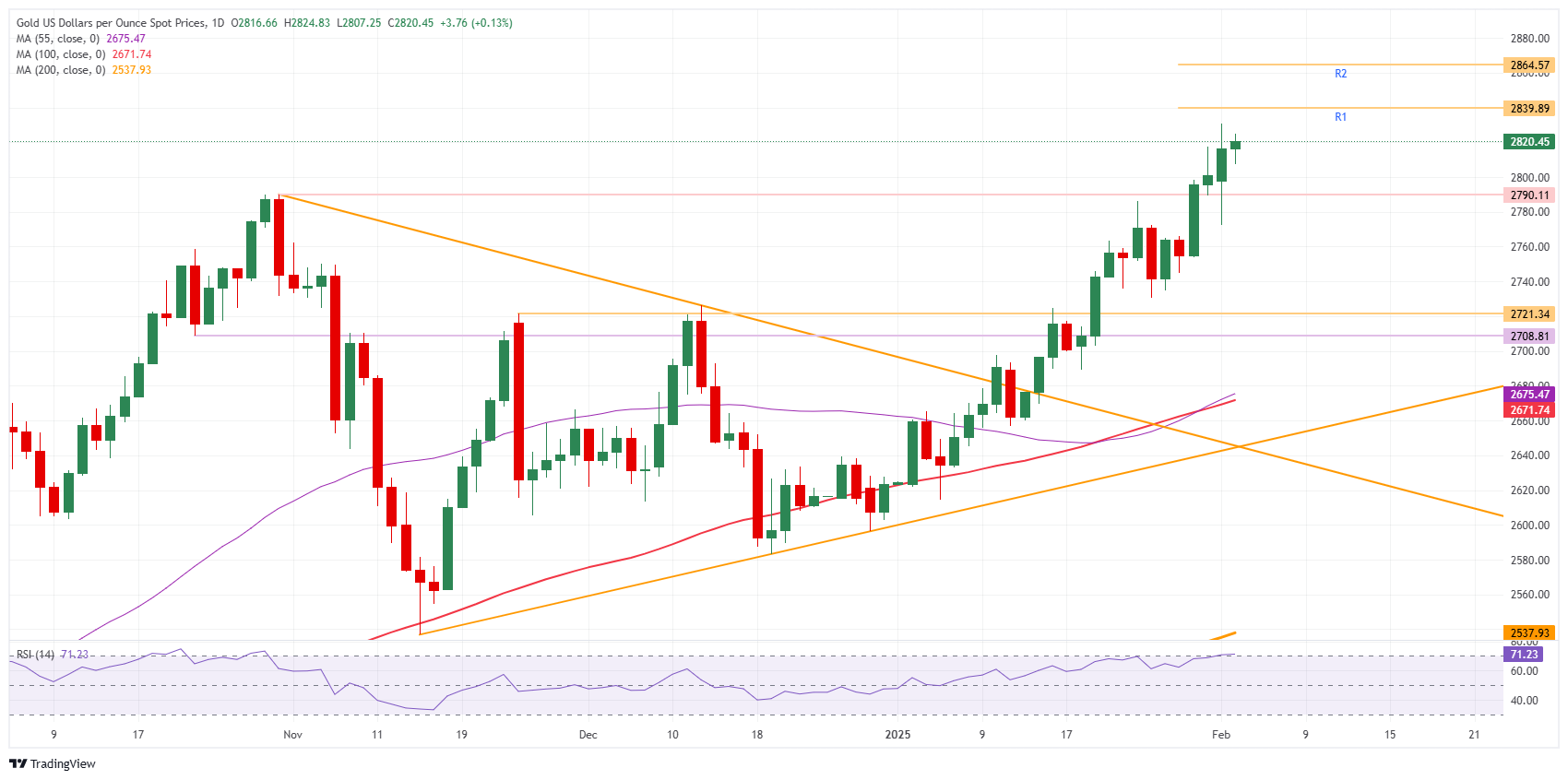
XAU/USD: Daily Chart
US-China Trade War FAQs
Generally speaking, a trade war is an economic conflict between two or more countries due to extreme protectionism on one end. It implies the creation of trade barriers, such as tariffs, which result in counter-barriers, escalating import costs, and hence the cost of living.
An economic conflict between the United States (US) and China began early in 2018, when President Donald Trump set trade barriers on China, claiming unfair commercial practices and intellectual property theft from the Asian giant. China took retaliatory action, imposing tariffs on multiple US goods, such as automobiles and soybeans. Tensions escalated until the two countries signed the US-China Phase One trade deal in January 2020. The agreement required structural reforms and other changes to China’s economic and trade regime and pretended to restore stability and trust between the two nations. However, the Coronavirus pandemic took the focus out of the conflict. Yet, it is worth mentioning that President Joe Biden, who took office after Trump, kept tariffs in place and even added some additional levies.
The return of Donald Trump to the White House as the 47th US President has sparked a fresh wave of tensions between the two countries. During the 2024 election campaign, Trump pledged to impose 60% tariffs on China once he returned to office, which he did on January 20, 2025. With Trump back, the US-China trade war is meant to resume where it was left, with tit-for-tat policies affecting the global economic landscape amid disruptions in global supply chains, resulting in a reduction in spending, particularly investment, and directly feeding into the Consumer Price Index inflation.
Author

Filip Lagaart
FXStreet
Filip Lagaart is a former sales/trader with over 15 years of financial markets expertise under its belt.