Gold consolidates as investors weigh US tariffs, Iran talks and Fed outlook
- Gold consolidates on Wednesday after briefly reclaiming the $5,200 level.
- Investors are cautious ahead of US-Iran nuclear talks on Thursday.
- Technically, XAU/USD trades within a rising wedge on the 4-hour chart, with $5,250 acting as key resistance.

Gold (XAU/USD) stages a modest rebound on Wednesday, trimming part of the previous day’s losses as fresh uncertainty over US trade policy and lingering geopolitical tensions in the Middle East continue to underpin safe-haven demand.
At the time of writing, XAU/USD trades near $5,192, holding firm after dipping to a daily low of $5,121. A broadly steady US Dollar (USD), alongwith a modest recovery in global equity markets, is limiting follow-through buying in Bullion.
Global trade jitters and US-Iran talks keep markets on edge
Global trade tensions resurfaced after US President Donald Trump announced a 10% tariff on imports from all countries, seeking to preserve tariff measures following the US Supreme Court’s ruling against the use of the International Emergency Economic Powers Act (IEEPA).
Market sentiment also remains cautious ahead of high-level US-Iran nuclear talks scheduled in Geneva on Thursday. Investors remain wary of a potential military escalation, given the significant presence of US armed forces in the region, if the talks fail to deliver a meaningful breakthrough.
On Tuesday night, US President Trump said during his State of the Union address that his preference is to resolve the Iran nuclear issue through diplomacy. Meanwhile, Iran’s Foreign Minister Abbas Araghchi said that Tehran is ready to take the necessary steps to reach an agreement with the US.
Traders reassess Fed easing path
Investors have scaled back expectations for near-term Federal Reserve (Fed) interest rate cuts as policymakers continue to flag concerns over persistent inflation pressure. Chicago Fed President Austan Goolsbee said on Tuesday that he is cautious about front-loading rate cuts without clear evidence that inflation is moving sustainably back toward the 2% target.
Boston Fed President Susan Collins said that interest rates were likely to stay unchanged “for some time” and that she was looking for more confidence that disinflation resumes.
This shift is likely supporting the US Dollar’s resilience, which in turn is acting as a headwind for the non-yielding metal, as Gold typically performs better in a lower interest rate environment.
Looking ahead, in the absence of major US data releases, traders will focus on Fed signals and geopolitical news for short-term direction in Gold.
Technical analysis: XAU/USD stalls below $5,250
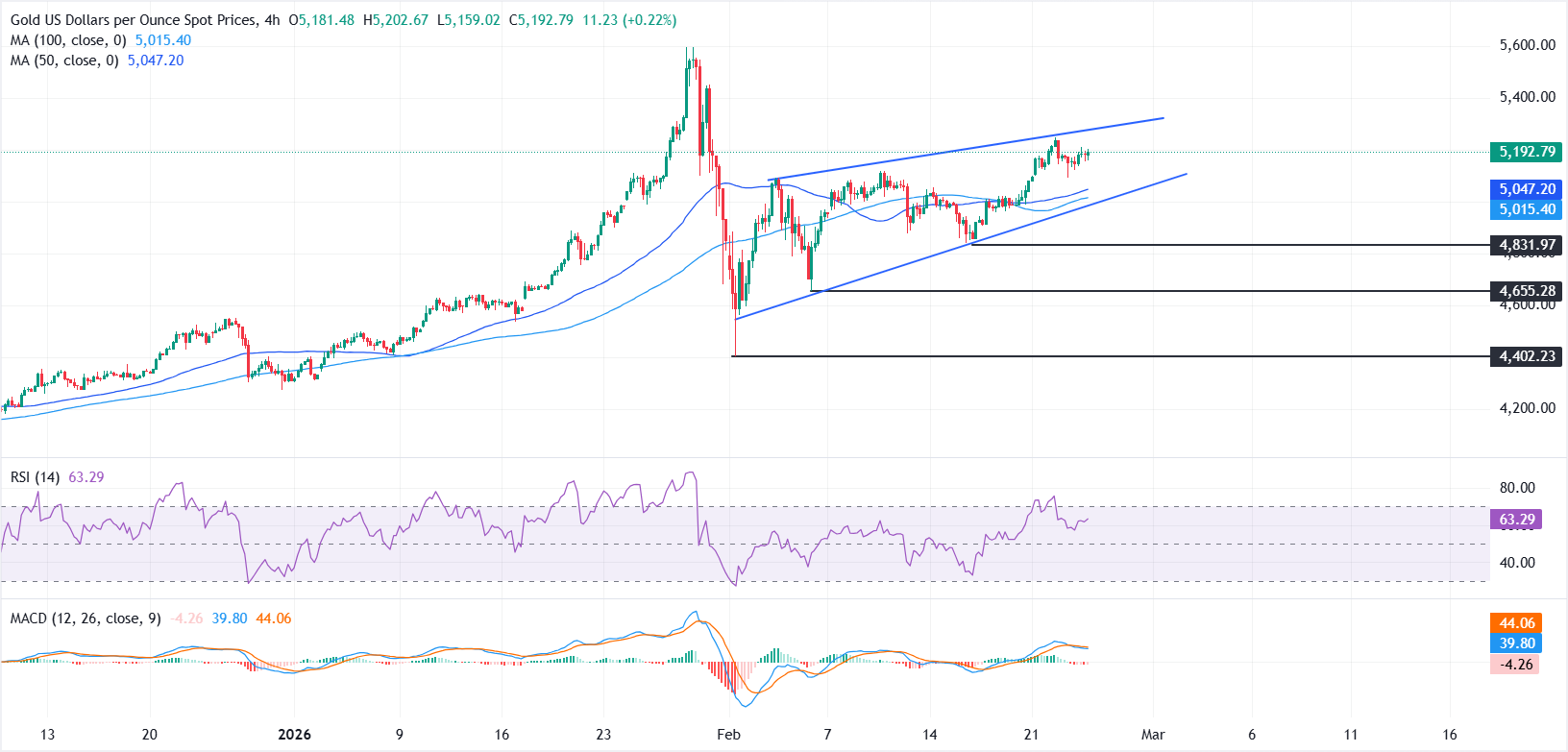
The 4-hour chart shows XAU/USD forming a rising wedge pattern, typically seen as a bearish reversal structure. The near-term bias has turned mildly negative after sellers stepped in around the $5,250 area.
Momentum indicators suggest upside pressure is fading. The Relative Strength Index (14) has retreated from overbought readings above 70 toward the high-50s, signaling cooling upside pressure, while the Moving Average Convergence Divergence (MACD) (12, 26, 9) shows the line slipping below its signal with the histogram in negative territory, hinting at fading bullish momentum.
On the upside, a sustained break above the $5,250 level — the upper boundary of the wedge — would be needed to resume the broader uptrend, potentially opening the door toward the $5,500 region.
On the downside, a break below $5,100 would expose the 100-period SMA near $5,012, which aligns closely with the lower boundary of the wedge. A decisive move below this zone could trigger a deeper correction toward $4,850, with scope to extend toward $4,650 if selling pressure accelerates.
Author

Vishal Chaturvedi
FXStreet
I am a macro-focused research analyst with over four years of experience covering forex and commodities market. I enjoy breaking down complex economic trends and turning them into clear, actionable insights that help traders stay ahead of the curve.