Gold consolidates as Fed Minutes and ceasefire speculation cap gains
- Gold consolidates in $3,320–$3,360 range as markets await Fed Minutes and Powell’s Jackson Hole speech.
- September Fed cut expected, but 50-bps odds fade after CPI–PPI divergence; some bet on no change.
- Ceasefire speculation after Trump–Putin and Trump–Zelenskiy meetings tempers safe-haven demand.

Gold price traded sideways on Monday as traders await the meeting between Trump, Zelenskiy, and European leaders in Washington following last week's summit between US President Donald Trump and Russian President Vladimir Putin. Growing speculation of a ceasefire on a peace deal caps Bullion prices, which trade near $3,330, virtually unchanged.
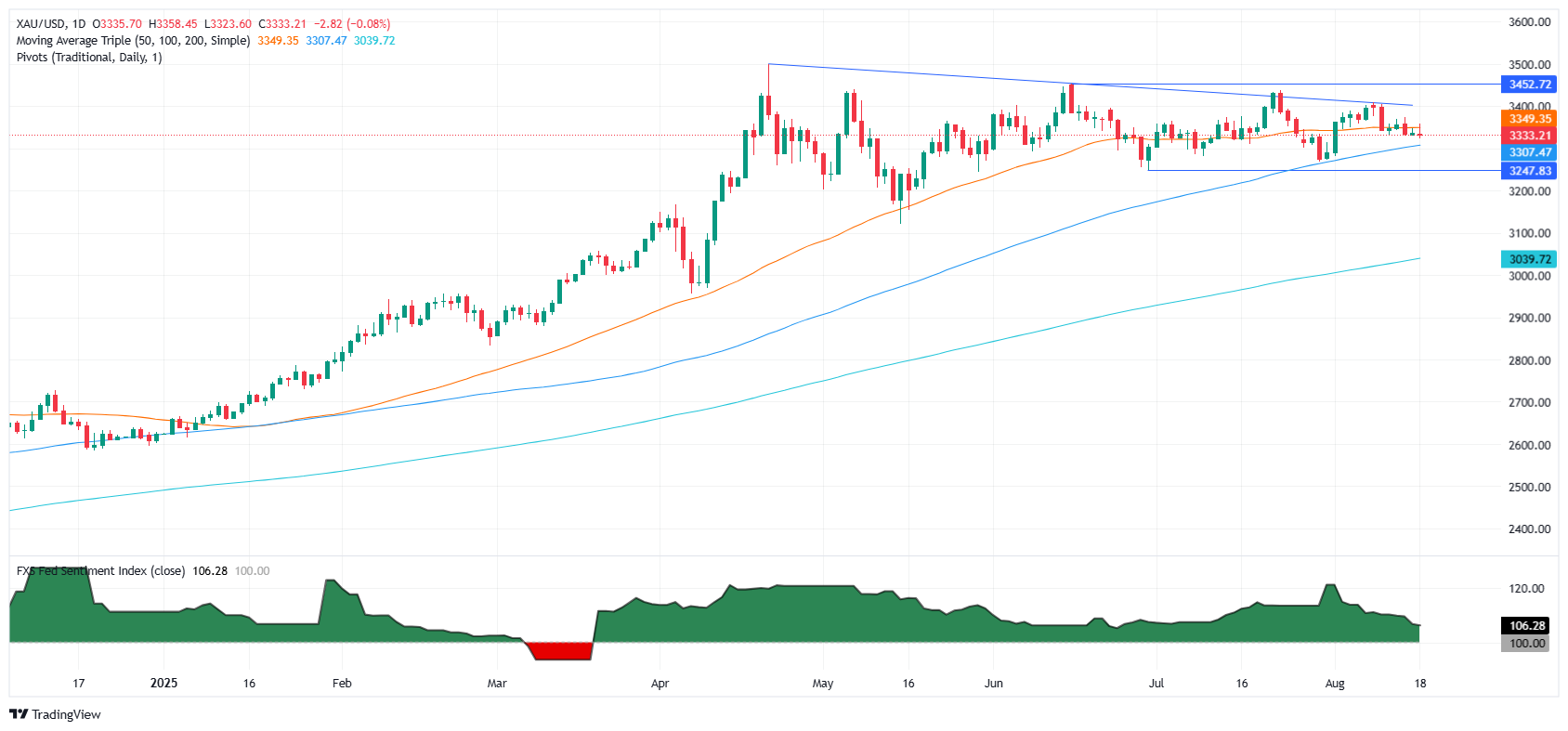
XAU/USD trades within the $3,320-$3,360 range during the day as market participants brace for the release of the Minutes from the last meeting of the Federal Reserve (Fed) and Fed Chair Jerome Powell's speech at the Jackson Hole Symposium on Friday.
Expectations that the Fed will reduce rates in September remain high, though traders priced out a 50 bps chance that emerged following the US Consumer Price Index (CPI) report. However, July’s Producer Price Index (PPI) spooked investors, who had also bet that the central bank might reduce rates at the September meeting.
Besides this, geopolitics would play its part as market participants grow optimistic for a possible ceasefire between Ukraine and Russia, following Trump’s meeting with Putin in Alaska on Friday.
As of writing, US President Donald Trump and Ukraine’s President Volodymyr Zelenskiy are meeting at the White House. So far, Trump welcomed Zelenskiy, saying that it’s an honor to have him there, while Zelenskiy thanked Trump’s efforts to reach a deal that would end the war in Ukraine. Trump said recently, however, that he does not think there will be a ceasefire.
Daily digest market movers: Gold capped by elevated US yields
- US Treasury yields rebounded across the curve on Thursday, with the benchmark 10-year rising one basis point (bps) to 4.335%. US real yields, which inversely correlate with Gold prices, are also up more than 1.5 bps, climbing to 1.955%.
- The US Dollar Index (DXY), which tracks the performance of the buck’s value against a basket of six currencies, edges up 0.31% at 98.14.
- Last week’s US Retail Sales suggest the economy remains solid. However, pessimism among US consumers, as revealed by the University of Michigan (UoM) Consumer Sentiment Index poll, and rising inflation expectations could prevent the Fed from easing policy as demanded by the White House, with Trump and Bessent being vocal and demanding lower interest rates.
- In the US, traders are awaiting the release of the Federal Open Market Committee (FOMC) Meeting Minutes, Initial Jobless Claims, second-tier housing data ─ Building Permits, Housing Starts, and Existing Home Sales ─ and S&P Global Flash PMIs.
- Fed Interest Rate Probabilities show that traders have priced in an 82% chance of a 25 bps rate cut at the September meeting, according to Prime Market Terminal data.
Technical outlook: Gold price dips but remains bullish above $3,300
Gold’s uptrend stalled on Monday, with the yellow metal hovering near $3,330 with key resistance lying overhead close to $3,360. The Relative Strength Index (RSI) is bearish, though it turned flat, an indication that buyers are stepping in at the $3,320 area.
For a bullish continuation, buyers need to clear the confluence of the 20-day and 50-day Simple Moving Averages (SMAs) between $3,347 and $3,353. A breach of $3,353 would expose the following resistance levels at $3,380 and $3,400, before targeting the June 16 high at $3,452 and ultimately the all-time peak of $3,500. On the downside, a close below $3,330 could trigger a slide toward $3,300, with further support at the 100-day SMA near $3,298.
Gold FAQs
Gold has played a key role in human’s history as it has been widely used as a store of value and medium of exchange. Currently, apart from its shine and usage for jewelry, the precious metal is widely seen as a safe-haven asset, meaning that it is considered a good investment during turbulent times. Gold is also widely seen as a hedge against inflation and against depreciating currencies as it doesn’t rely on any specific issuer or government.
Central banks are the biggest Gold holders. In their aim to support their currencies in turbulent times, central banks tend to diversify their reserves and buy Gold to improve the perceived strength of the economy and the currency. High Gold reserves can be a source of trust for a country’s solvency. Central banks added 1,136 tonnes of Gold worth around $70 billion to their reserves in 2022, according to data from the World Gold Council. This is the highest yearly purchase since records began. Central banks from emerging economies such as China, India and Turkey are quickly increasing their Gold reserves.
Gold has an inverse correlation with the US Dollar and US Treasuries, which are both major reserve and safe-haven assets. When the Dollar depreciates, Gold tends to rise, enabling investors and central banks to diversify their assets in turbulent times. Gold is also inversely correlated with risk assets. A rally in the stock market tends to weaken Gold price, while sell-offs in riskier markets tend to favor the precious metal.
The price can move due to a wide range of factors. Geopolitical instability or fears of a deep recession can quickly make Gold price escalate due to its safe-haven status. As a yield-less asset, Gold tends to rise with lower interest rates, while higher cost of money usually weighs down on the yellow metal. Still, most moves depend on how the US Dollar (USD) behaves as the asset is priced in dollars (XAU/USD). A strong Dollar tends to keep the price of Gold controlled, whereas a weaker Dollar is likely to push Gold prices up.
Author

Christian Borjon Valencia
FXStreet
Markets analyst, news editor, and trading instructor with over 14 years of experience across FX, commodities, US equity indices, and global macro markets.

















