Gold surges above $2,500 ahead of US CPI as Fed rate cut looms
- Gold gains ground despite broad US Dollar strength, traders focus on the upcoming US Consumer Price Index (CPI) release.
- CME FedWatch Tool shows 73% odds of a 25 bps Fed rate cut, shifting from previous speculation of a 50 bps move.
- US Treasury yields remain stable, while traders await further clues on inflation trends and the Fed’s rate path.

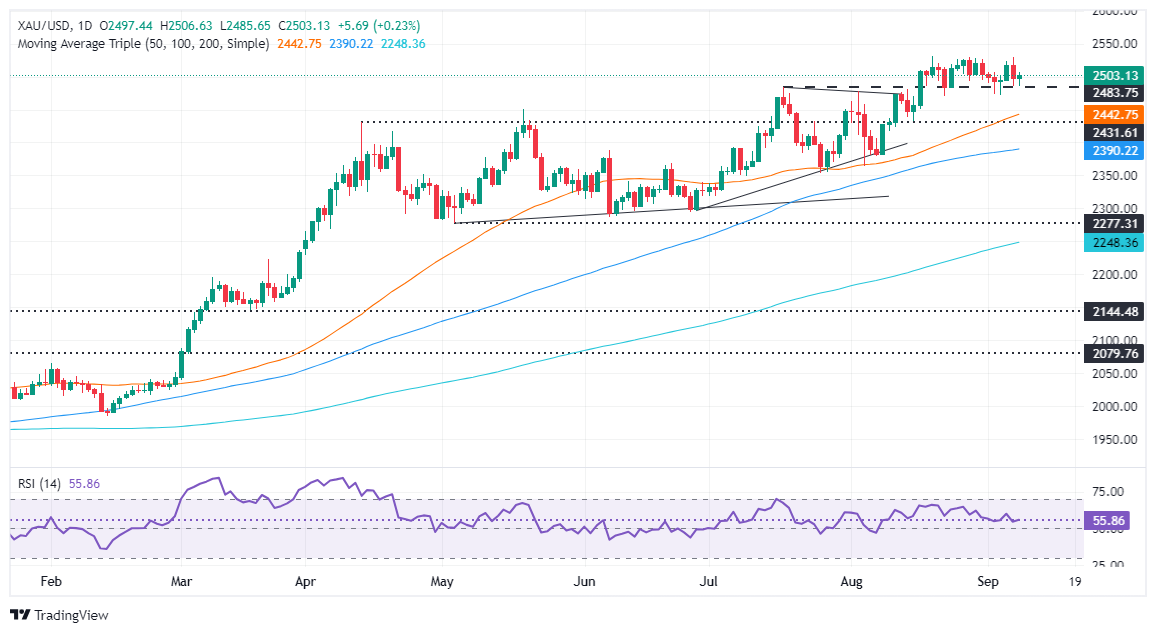
Gold gained ground on Monday as traders braced for the release of August’s inflation report in the United States (US) and looked for hints that the Federal Reserve (Fed) would cut rates by 50 or 25 basis points. At the time of writing, XAU/USD trades at $2,502, up by 0.23%.
Market mood improved during the overnight session for North American traders, as evidenced by solid gains in US equities. US Treasury bond yields retreated somewhat along the short and long end of the curve with the 10-year T-note yielding 3.706% unchanged compared to last Friday’s close.
Bullion traders ignored broad US Dollar strength as the Greenback posted gains of over 0.30%, according to the US Dollar Index (DXY), which measures the buck’s performance against six currencies.
Meanwhile, traders pared odds for a 50 bps rate cut following last Friday’s Nonfarm Payrolls (NFP) figures, which despite missing the mark showed the Unemployment Rate ticking lower from 4.3% to 4.2%. Now, eyes are on the release of the Consumer Price Index (CPI), which is expected to dip further toward the Fed’s 2% goal.
The CME FedWatch Tool shows that the odds for a 25 bps Fed rate cut increased to 73%, while the odds for 50 bps lie at 27%.
Sources quoted by Reuters noted, “The market seems to be reconciling that the Fed is probably more likely to do the smaller 25-basis-point cut, and that's been my position all along.”
Earlier, the US economic docket featured the New York Fed inflation expectations report, which showed that prices remain anchored to the 3% threshold, unchanged from the previous survey though slightly above the Fed’s target.
Daily digest market moves: Gold price climbs as traders eye US CPI
- US CPI is expected to decline from 2.9% to 2.6% YoY in August, while core CPI is projected to remain at 3.2%.
- Last week’s NFP report revealed the economy added over 142K employees to the workforce but missed consensus of 160K. However the dip in the Unemployment Rate lent a lifeline to the Greenback.
- Last Friday, Fed officials were dovish. New York Fed President John Williams said that cutting rates will help keep the labor market balanced, while Governor Christopher Waller said that “the time has come” to ease policy.
- Chicago Fed President Austan Goolsbee was dovish, saying policymakers have an “overwhelming” consensus to reduce borrowing costs.
- It is worth noting that Fed officials entered their blackout period ahead of the Federal Open Market Committee (FOMC) monetary policy meeting.
- Data from the Chicago Board of Trade (CBOT) indicates that the Fed is anticipated to cut at least 104.5 basis points (bps) this year, based on the fed funds rate futures contract for December 2024.
- China's central bank pauses Gold purchases for a fourth month in August.
Technical outlook: Gold price buyers reclaim $2,500
Gold prices resumed their uptrend above $2,500, though buyers seem to be failing to gather steam with prices below $2,510.
Momentum remains bullish, but the yellow metal could consolidate in the short term before resuming its uptrend or turning lower. The Relative Strength Index (RSI) is almost flat, suggesting that neither buyers nor sellers are in charge.
If XAU/USD climbs above the year-to-date high at $2,531, that could sponsor a leg-up to challenge $2,550. If surpassed, the next stop would be the psychological $2,600 mark.
On the other hand, if Gold prices drop below $2,500, the next support would be the August 22 low at $2,470. If broken, the next demand zone would be the confluence of the May 20 high, which turned into support, and the 50-day Simple Moving Average (SMA) between $2,450 and $2,440.
Gold FAQs
Gold has played a key role in human’s history as it has been widely used as a store of value and medium of exchange. Currently, apart from its shine and usage for jewelry, the precious metal is widely seen as a safe-haven asset, meaning that it is considered a good investment during turbulent times. Gold is also widely seen as a hedge against inflation and against depreciating currencies as it doesn’t rely on any specific issuer or government.
Central banks are the biggest Gold holders. In their aim to support their currencies in turbulent times, central banks tend to diversify their reserves and buy Gold to improve the perceived strength of the economy and the currency. High Gold reserves can be a source of trust for a country’s solvency. Central banks added 1,136 tonnes of Gold worth around $70 billion to their reserves in 2022, according to data from the World Gold Council. This is the highest yearly purchase since records began. Central banks from emerging economies such as China, India and Turkey are quickly increasing their Gold reserves.
Gold has an inverse correlation with the US Dollar and US Treasuries, which are both major reserve and safe-haven assets. When the Dollar depreciates, Gold tends to rise, enabling investors and central banks to diversify their assets in turbulent times. Gold is also inversely correlated with risk assets. A rally in the stock market tends to weaken Gold price, while sell-offs in riskier markets tend to favor the precious metal.
The price can move due to a wide range of factors. Geopolitical instability or fears of a deep recession can quickly make Gold price escalate due to its safe-haven status. As a yield-less asset, Gold tends to rise with lower interest rates, while higher cost of money usually weighs down on the yellow metal. Still, most moves depend on how the US Dollar (USD) behaves as the asset is priced in dollars (XAU/USD). A strong Dollar tends to keep the price of Gold controlled, whereas a weaker Dollar is likely to push Gold prices up.
Author

Christian Borjon Valencia
FXStreet
Markets analyst, news editor, and trading instructor with over 14 years of experience across FX, commodities, US equity indices, and global macro markets.