Gold price edges up over 1% on Trump not liking a 90-day pause on tariffs
- Gold price bounces off vital support at $2,955 and snaps losing streak.
- Markets still favor Gold as the safe bet for any stagflation or recession scenario besides tariffs.
- Gold bounces off from $2,955 and pops back above $3,010, gaining nearly 1% intraday.

Gold price (XAU/USD) pops while Equities run higher after their nosedive move on Monday and past Friday. The precious metal trades just above the $3,000 mark at the time of writing on Tuesday. The bounce is supported by a technical element on the one hand and a geopolitical driver on the other. That last one is the tit-for-tat war between China and the United States (US) spiraling out of control. US President Donald Trump threatened to impose an additional 50% tariff on Chinese imports.
Meanwhile, traders are sending the US yield curve all over the place. At a given point on Monday, investors were betting on five interest rate cuts from the Federal Reserve in 2025, quite a change compared to the one-or-none stance from just a week ago.
Treasury Secretary Scott Bessent meanwhile said that already 70 countries have asked to enter in negotiation talks with the US. President Trump will personally be involved in the trade talks. Meanwhile tariffs will not be paused and will remain in effect as talks will be underway.
Daily digest market movers: Easing rate cut bets
- West Australia’s Gold Road Resources says a scoping study on its flagship asset suggests there is more Gold than first thought, a clear indication that a $3.3 billion takeover bid from its joint venture partner undervalues the company, Financial Review reports. On Tuesday, Gold Road Resources released new data that showed the open-pit mine could hold more ounces underground that can be tapped profitably.
- The CME FedWatch tool shows chances for an interest rate cut by the Fed in May’s meeting standing at 31.7%, falling back from nearly 50% on Monday. For June, the chances of a rate cut are 96.9%, with a slim 3.1% chance for no rate cut at all.
- In his latest move, Trump threatened to slap an additional 50% levy on Chinese imports, while Beijing responded by saying it’s prepared to “fight to the end.” Shares in Europe rebounded from the worst three-day loss in five years, while US equity-index futures pointed to gains on Wall Street after Monday’s dizzying swings. Treasuries advanced after Monday’s sharp selloff. Oil gained while Gold climbed for the first time in four days. The US Dollar slipped against major peers, Bloomberg reports.
Gold Price Technical Analysis: $3,000 should be able to hold
Gold, known as a safe haven asset, is unable to withstand selling pressure when market turmoil spreads to all asset classes, as seen in the past few days. That is something to keep in mind, meaning that the precious metal will not recover back to the all-time high at $3,167 in a straight line, as trade war tensions are set to take place from here on out.
Looking up, resistances are a bit spread out, with the first cap at $3,040 as the R1 resistance, followed by $3,057, a pivotal level since March 20. Further up, the R2 resistance at $3,097 precedes the current all-time high at $3,167.
On the downside, the pivotal level of the March 14 high at $3,004 roughly coincides with the $3,000 round number and is trying to provide support as writing. If this area does not hold as support, bears can target $2,955, where clearly many buyers were interested in scooping up Gold on Monday. Further down, the S2 support at $2,899 is the last line of defence, with the 55-day Simple Moving Average (SMA) coming in already in advance at $2,930.
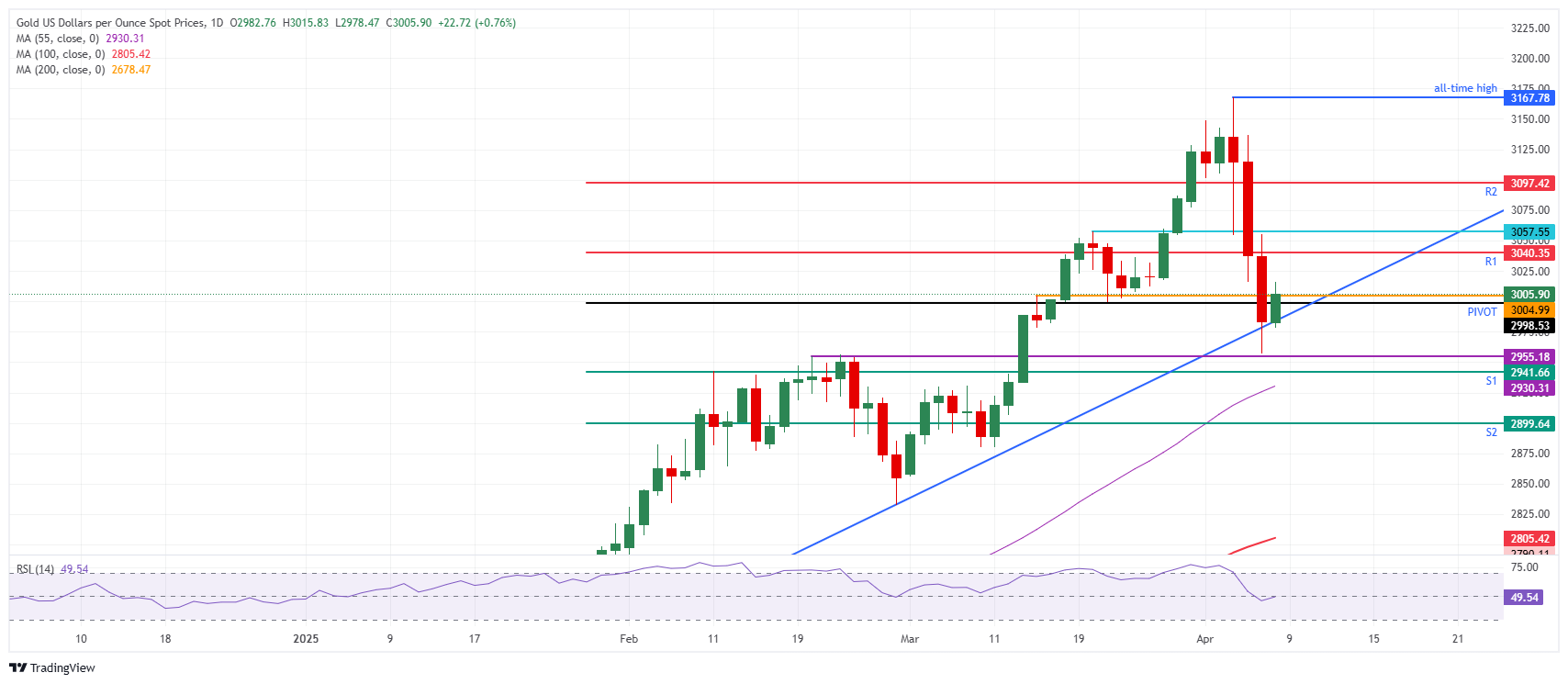
XAU/USD: Daily Chart
Interest rates FAQs
Interest rates are charged by financial institutions on loans to borrowers and are paid as interest to savers and depositors. They are influenced by base lending rates, which are set by central banks in response to changes in the economy. Central banks normally have a mandate to ensure price stability, which in most cases means targeting a core inflation rate of around 2%. If inflation falls below target the central bank may cut base lending rates, with a view to stimulating lending and boosting the economy. If inflation rises substantially above 2% it normally results in the central bank raising base lending rates in an attempt to lower inflation.
Higher interest rates generally help strengthen a country’s currency as they make it a more attractive place for global investors to park their money.
Higher interest rates overall weigh on the price of Gold because they increase the opportunity cost of holding Gold instead of investing in an interest-bearing asset or placing cash in the bank. If interest rates are high that usually pushes up the price of the US Dollar (USD), and since Gold is priced in Dollars, this has the effect of lowering the price of Gold.
The Fed funds rate is the overnight rate at which US banks lend to each other. It is the oft-quoted headline rate set by the Federal Reserve at its FOMC meetings. It is set as a range, for example 4.75%-5.00%, though the upper limit (in that case 5.00%) is the quoted figure. Market expectations for future Fed funds rate are tracked by the CME FedWatch tool, which shapes how many financial markets behave in anticipation of future Federal Reserve monetary policy decisions.
BRANDED CONTENT
Finding the right broker for trading Gold is crucial, as not all brokers offer the same advantages. Explore our list of top-performing brokers to discover the best options for seamless and cost-effective Gold trading.
Author

Filip Lagaart
FXStreet
Filip Lagaart is a former sales/trader with over 15 years of financial markets expertise under its belt.