|

GME Stock News: GameStop Corp soars once again as short sellers feel the heat

  • NYSE:GME surges by 15.82% as the latest meme stock gamma squeeze continues.
  • More details emerge about the new GameStop NFT site that surfaced on Tuesday.
  • Fellow meme stocks rally alongside GameStop as short seller losses continue to pile up.

NYSE:GME has officially gone bananas, literally, as the Reddit Apes continue to pile into the stock in the latest coordinated short squeeze of hedge fund managers. On Wednesday, shares of GameStop skyrocketed gaining 15.82% to close the trading session at a staggering $242.56. Any sort of fundamental analysis has been thrown out the window with GameStop, and it is surprising that institutional investors continued to openly short the stock despite the ongoing attention it has received. The stock has gained an incredible 45% over the past five trading days.


Stay up to speed with hot stocks' news!


In an announcement that flew somewhat under the radar, GameStop announced that it was hiring for its new NFT or Non Fungible Token site. Not much is known about the site yet, except that it will operate on the Ethereum blockchain, and that GameStop is finally making its long awaited entry into the cryptocurrency sector. NFTs have been an incredibly popular way to digitally certify things like artwork, and so this could be an interesting revenue stream for GameStop as Ryan Cohen attempts to rebuild the franchise from the ground up. 

GME stock forecast
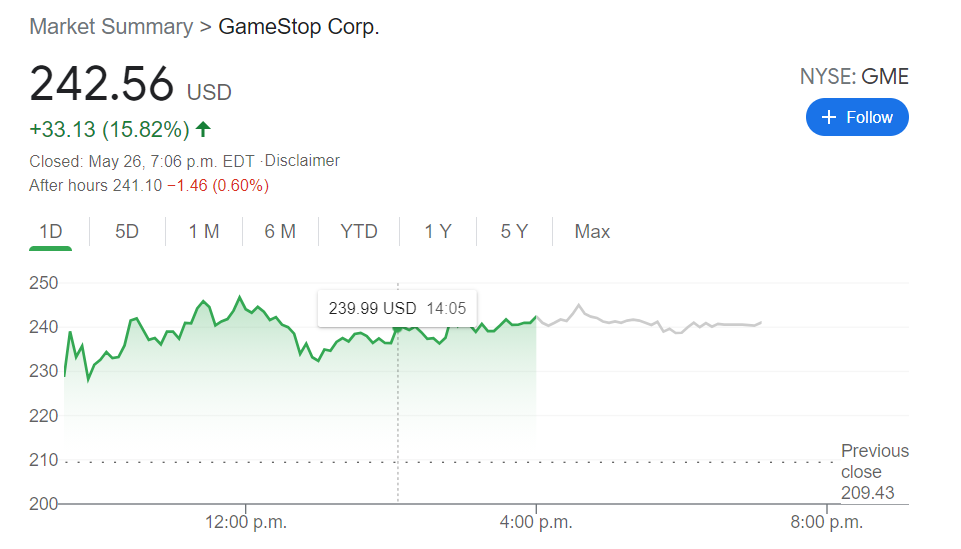
Wednesday also saw other stocks like AMC (NYSE:AMC) and BlackBerry (NYSE:BB) surge as sympathy plays to GameStop. The rally also came alongside a rebound in the cryptocurrency markets, as Reddit investors continue to move back and forth between cryptos and meme stocks. It is estimated that the latest short squeeze cost hedge funds over $754 million on Tuesday alone, and there could be a lot more pain incoming as Redditors are refusing to let off the gas. 

Author

More from Stocks Reporter
Share:

Editor's Picks

AUD/USD bulls regain control above 0.6950 amid USD retreat

AUD/USD regains traction and extends the previous day's bounce from the weekly low, aiming for 0.7000 in Asia on Friday. The overnight pullback in US bond yields keeps the US Dollar below an 18-month high, which in turn offers some support to the pair. Meanwhile, hawkish RBA expectations also keep the major underpinned.

USD/JPY holds gains near 158.00 after Japan's weak Household Spending data

USD/JPY clings to gains around 158.00 after data showed on Friday that Japan's Household Spending fell for the ninth straight month, undermining the Japanese Yen. Meanwhile, the US Dollar remains depressed as the overnight fall in US bond yields counters a hawkish Fed and geopolitical uncertainties, could cap any downside in the pair.

Gold remains range-bound below $4,200

Gold has given up some ground after an initial bullish attempt to reach weekly highs, returning to below the $4,200 mark per troy ounce on Friday. The US Dollar’s strong upside momentum, combined with rising US Treasury yields across the curve, seems to keep further gains in the yellow metal under scrutiny.

Has Bitcoin really escaped the macro forces it was built to fight?
Over 17 years ago, Satoshi Nakamoto designed Bitcoin (BTC) on the back of a global financial crisis as an alternative to the global monetary system outside the control of central banks, governments and traditional intermediaries. This raises a key question: has Bitcoin really become independent of the macroeconomic forces it was built to challenge?
The Euro is not the sick man of Europe. France's bond market is
EUR/USD remains under pressure, near the 17-month low of 1.1161 reached on Monday. The pair has lost more than 7% since its yearly peak, as concerns over France's public finances increasingly weigh on the single currency. But behind the weakness of the Euro (EUR), the problem does not necessarily lie with the European economy as a whole.
Has Bitcoin really escaped the macro forces it was built to fight?
Over 17 years ago, Satoshi Nakamoto designed Bitcoin (BTC) on the back of a global financial crisis as an alternative to the global monetary system outside the control of central banks, governments and traditional intermediaries. This raises a key question: has Bitcoin really become independent of the macroeconomic forces it was built to challenge?
















