Germany FX Today: Euro shines before German Industrial Production

The Euro (EUR) strengthens on Friday against the US Dollar (USD), trading at around 1.1750 (+0.85%), as investors sell off the Greenback en masse following the publication of US employment figures.
Looking at other currency pairs, the Euro is more stable against the Japanese Yen (JPY) (-0.1%) and Pound Sterling (GBP) (+0.1%), as traders look ahead to the German Industrial Production figures for July, to be published on Monday.
The consensus is for a rebound of +1.3% month-on-month, following the sharp contraction of -1.9% in June, according to FXStreet’s Economic Calendar.
For the Euro on the Forex market, the statistic represents an important test, as the Eurozone's leading economy has shown signs of fragility in recent months, and any deviation from expectations could rekindle volatility.
EUR/USD technical analysis: The Euro benefits from the US Dollar's plunge
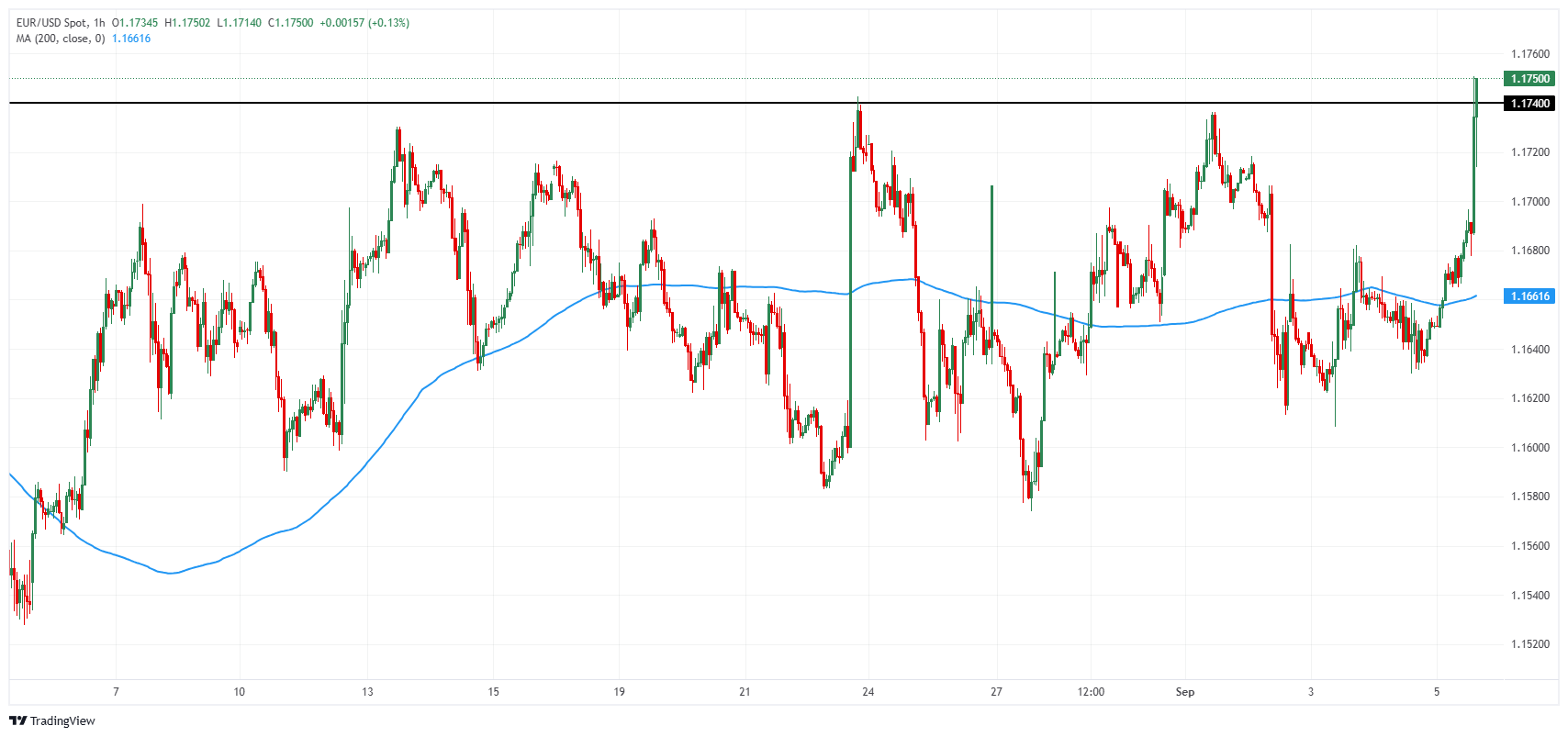
EUR/USD 1-hour chart. Source: FXStreet
The EUR/USD pair rises sharply during the American session on Friday, boosted by poor US employment figures.
The Euro is now testing a key resistance level at 1.1740/1.1750, a zone not seen since July 28.
A clear bullish break could then pave the way for a test of the July 24 high near 1.1790, before the 1.1800 level.
Conversely, should the bullish break attempt fail, EUR/USD could fall back towards 1.1700.
Euro Price Today
The table below shows the percentage change of Euro (EUR) against listed major currencies today. Euro was the strongest against the Canadian Dollar.
| USD | EUR | GBP | JPY | CAD | AUD | NZD | CHF | |
|---|---|---|---|---|---|---|---|---|
| USD | -0.71% | -0.61% | -0.90% | 0.07% | -0.68% | -0.88% | -0.98% | |
| EUR | 0.71% | 0.11% | -0.28% | 0.79% | 0.12% | -0.15% | -0.28% | |
| GBP | 0.61% | -0.11% | -0.34% | 0.67% | 0.02% | -0.27% | -0.35% | |
| JPY | 0.90% | 0.28% | 0.34% | 1.04% | 0.29% | 0.05% | 0.08% | |
| CAD | -0.07% | -0.79% | -0.67% | -1.04% | -0.70% | -0.95% | -1.03% | |
| AUD | 0.68% | -0.12% | -0.02% | -0.29% | 0.70% | -0.29% | -0.36% | |
| NZD | 0.88% | 0.15% | 0.27% | -0.05% | 0.95% | 0.29% | -0.08% | |
| CHF | 0.98% | 0.28% | 0.35% | -0.08% | 1.03% | 0.36% | 0.08% |
The heat map shows percentage changes of major currencies against each other. The base currency is picked from the left column, while the quote currency is picked from the top row. For example, if you pick the Euro from the left column and move along the horizontal line to the US Dollar, the percentage change displayed in the box will represent EUR (base)/USD (quote).
German industry in the spotlight
Industrial production remains a mainstay of the German economy, which is largely export-oriented. The latest data from Statistisches Bundesamt Deutschland showed a marked decline in June, reflecting the manufacturing sector's difficulties in the face of trade uncertainties and the US slowdown.
According to KPMG’s Economic Key Facts Germany report, Germany remains a considerable industrial power, with a Gross Domestic Product (GDP) of 4,305 billion Euros in 2024, making it the third largest economy in the world and the largest in Europe.
But tensions linked to US tariffs, raised from 10% to 15% on European exports since August, are weighing on the prospects of the export sector, particularly the automotive and chemicals industries.
Contrasting economic conditions: Weakness but signs of resilience
German GDP contracted by -0.1% in the second quarter, following growth of +0.4% in the first. This volatility is explained by experts as being due to jolts linked to US tariff policy and to companies' wait-and-see attitude regarding their order books.
Nevertheless, certain signals remain positive: exports rose by +0.8% in June, buoyed by European and Chinese demand, while the ifo Business Climate Index reached 88.6 points in July, its highest level for over a year.
"The German economy is slowing down, but it's not at a standstill. The outlook for 2026 is already more favorable, thanks to fiscal stimulus and private investment", emphasized Joachim Nagel, President of the Bundesbank, when presenting his forecasts.
These forecasts predict almost zero growth in 2025, but a gradual recovery from next year (+0.7% expected in 2026).
Author

Ghiles Guezout
FXStreet
Ghiles Guezout is a Market Analyst with a strong background in stock market investments, trading, and cryptocurrencies. He combines fundamental and technical analysis skills to identify market opportunities.