|

German DAX leads the pack as European stocks close higher on Monday

  • European equities saw gains to kick off the new trading week.
  • Risk appetite recovering on the new week despite macro headwinds.
  • German economy continues to lag in step with broader Eurozone economic conditions.

The German DAX led the charge in European equities on Monday, as investors bid up stocks and saw a healthy rebound in risk appetite after 2024 kicked things off with a retreat in market sentiment.

European economic figures on Monday were broadly better than expected as investor optimism carefully threads the needle on a positive outlook on data. Eurozone Retail Sales for the year through November declined less than expected, falling 1.1% versus the forecast 1.5% decline, compared to October’s YoY figure of -0.8% (revised upwards from -1.2%).

The Eurozone Sentix Investor Confidence index for January rebounded from -16.8 to -15.8, while the Eurozone Consumer Confidence survey index unexpectedly rose from -15.1 to -15.0, versus the market forecast for a steady hold at -15.1.

Eurozone Retail Sales for November also slid exactly as much as investors were expecting, printing at -0.3% compared to October’s print of 0.4% (revised upwards from 0.1%).

Structural economic issues continue to loom over the domestic German economy, with an aging population set to worsen an already-steep labor shortage, and the International Monetary Fund is projecting that Germany will be the only G7 country to see real economic decline in 2023.

Germany’s government budget for 2024 was rejected by Germany’s own top court last November, and Germany is scrambling to find a stopgap for a projected 17 billion Euro funding deficit for 2024.

Despite economic concerns swirling around the Eurozone’s single largest economy, European investors found reasons to buy on Monday, sending the German DAX higher by 122 points to close at €16,716.47, gaining nearly three-quarters of a percent. France’s CAC 40 index also closed up at €7,450, climbing 0.4% and gaining almost 30 points.

The Eurostoxx 600 major index also climbed around 0.4% to close up 1.8 points at €478.18. The London FTSE equity index climbed a little under five points to close at £7,694.20, a scant 0.06% higher.

DAX Technical Outlook

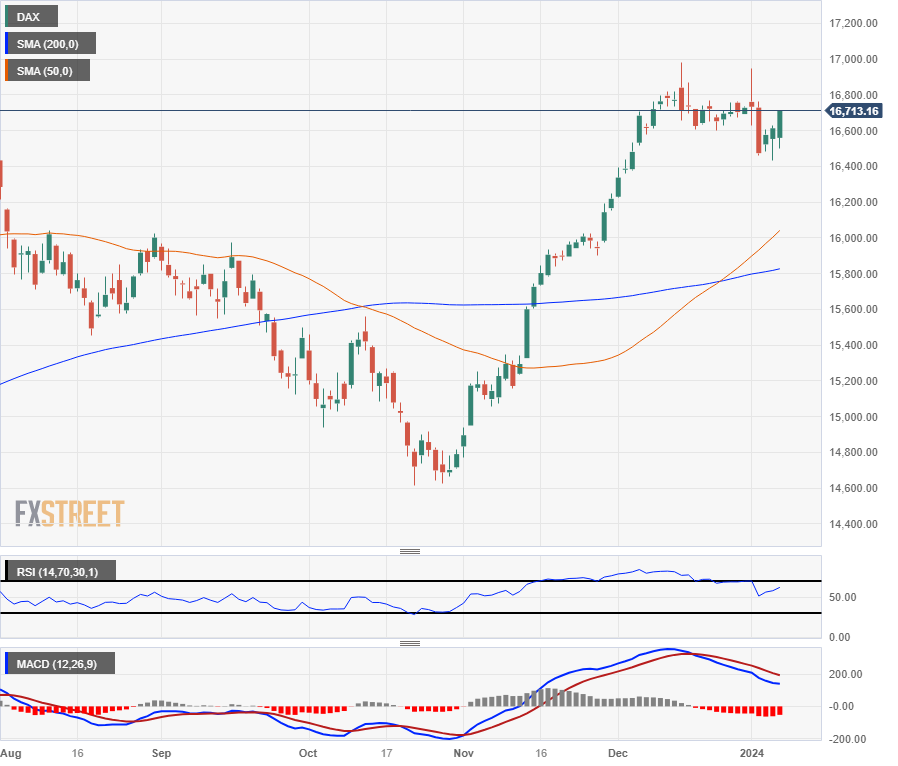
The German DAX etched in a third straight gain on Monday, keeping the equity index on the high end after hitting an all-time high of €16,984.44 in December.

The DAX’s current bull run kicked off from a six-month low of €14,618.09, climbing over 16% bottom-to-top.

The DAX is trading into lofty chart territory well above the 200-day Simple Moving Average (SMA) near €15,800, and a bullish crossover by the 50-day SMA is accelerating technical support at the €16,000 major handle.

DAX Daily Chart
DAX Technical Outlook

DAX

Overview
Today last price16709.16
Today Daily Change95.59
Today Daily Change %0.58
Today daily open16613.57
 
Trends
Daily SMA2016687.52
Daily SMA5016041.61
Daily SMA10015750.96
Daily SMA20015830.07
 
Levels
Previous Daily High16629.59
Previous Daily Low16434.4
Previous Weekly High16945.4
Previous Weekly Low16434.4
Previous Monthly High16984.44
Previous Monthly Low16229.16
Daily Fibonacci 38.2%16555.03
Daily Fibonacci 61.8%16508.96
Daily Pivot Point S116488.78
Daily Pivot Point S216364
Daily Pivot Point S316293.59
Daily Pivot Point R116683.97
Daily Pivot Point R216754.38
Daily Pivot Point R316879.16

Author

Joshua Gibson

Joshua joins the FXStreet team as an Economics and Finance double major from Vancouver Island University with twelve years' experience as an independent trader focusing on technical analysis.


More from Joshua Gibson
Share:

Editor's Picks

AUD/USD consolidates above 0.7000; remains close to monthly top

AUD/USD holds steady above 0.7000 during the Asian session on Friday, trading just below the previous day's monthly low amid diverging forces. A hawkish RBA continues to support the Aussie, while the recent decline in US bond yields keeps the US Dollar depressed near a three-week low. However, oil-driven inflation fears reinforce Fed hike bets, which, along with geopolitical risks, could benefit the safe-haven buck and cap the currency pair.

USD/JPY bounces off one-month low; climbs to 157.00 amid reviving USD demand

USD/JPY rebounds from the 156.00 neighborhood, or a one-month low touched during Friday’s Asian session, with bulls looking to extend momentum beyond 157.00 amid the emergence of some US Dollar buying. Meanwhile, Japan's National CPI rose to a nine-month peak and reaffirmed BoJ rate-hike bets, which could support the Japanese Yen and cap gains for the currency pair.

Gold treads water around $4,000

Gold prices maintain its offered stance in place at the end of the week, hovering around the key $4,000 threshold per troy ounce. The persistent selling bias in the precious metal comes amid decent gains in the US Dollar and an acceptable rebound in US Treasury yields across the curve, all alongside further upside traction in crude oil prices.

Crypto Today: Bitcoin holds the 50-day EMA as Ethereum and XRP face structural resistance

Bitcoin gradually ticks up on Friday, trading above $81,000. The Crypto King has recently defended structural support near $80,000, reinforcing the prevailing bullish outlook. Ethereum similarly edges higher above $2,400, while Ripple trades above $1.32 after testing support around $1.30.

The French bond panic is overdone. Here's what the market is misreading 

France's 10-year government bond yield has climbed above 5%, reigniting fears of a sovereign debt crisis in the Eurozone. With public debt exceeding €3.5 trillion, persistent budget deficits and a fragmented political landscape, investors are increasingly questioning the French government's ability to stabilize its finances.

What November 3 means for the Fed's rate path and the US Dollar

The USD faces a decisive period ahead of the November 3 midterm elections. While markets anticipate another interest rate increase from the Fed in December, the battle for control of Congress could reshape fiscal policy expectations and, indirectly, the path of US monetary policy in 2027.















