|

Geopolitical breakout: Why Russia sanctions pushed PBF Energy to a critical technical test

PBF Energy Inc. (PBF), a major U.S. petroleum refiner, experienced an explosive day on Thursday, surging 15.67% to close at $34.10. This aggressive move was fueled not only by recent analyst upgrades but, more significantly, by the increase in global oil costs due to new U.S. sanctions on Russia. By limiting or halting Russian oil sales, particularly to large markets like India, the resulting reduction in global supply has sharply increased demand—and market pricing power—for domestic refiners like PBF.

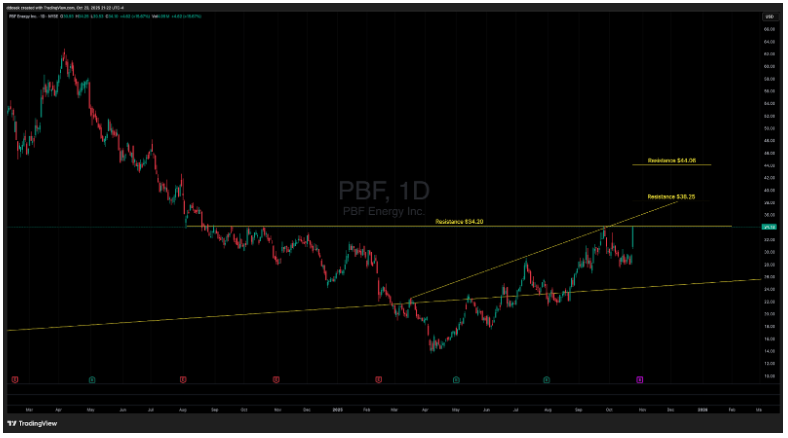
Technical analysis shows that this fundamental catalyst has propelled PBF directly to a critical technical pivot.

Price closed just fractionally beneath a significant, long-term horizontal trendline at $34.20, a barrier that has successfully contained the stock since August 2024. With the geopolitical momentum now firmly behind the stock, PBF is highly likely to pierce and establish price above this $34.20 ceiling.

Once price records multiple closing days above $34.20, pullbacks should be treated as potential buying opportunities.

The next major resistance level is found at $38.25. This level could serve as the first speed bump for the ultimate technical near-term target at $44.06. The current inclining trendline is likely to continue to define the trajectory to this final target.
Author

Drew Dosek

Drew Dosek

Verified Investing

Passionate technical and cycle analyst committed to empowering traders through data-driven insights.


More from Drew Dosek
Share:

Editor's Picks

AUD/USD cracks 0.7000 as Bullock dulls RBA hike, CPI looms

The Aussie Dollar tumbled over 0.40% against the US Dollar on Tuesday, even though the Reserve Bank of Australia raised rates to 4.60%, but a mild-dovish tilt by RBA Governor Bullock cleared the path to push the pair below the 0.7000 threshold.

USD/JPY consolidates near 157.50 as a bullish USD counters intervention risks

USD/JPY struggles to capitalize on the overnight bounce from a one-week low, consolidating around 157.50 in the Asian session on Tuesday. Trump's concerns about the Japanese Yen's weakness fueled speculation about another US-Japan joint intervention. This, along with the hawkish BoJ, underpins the JPY and caps the currency pair. Meanwhile, rising Fed rate-hike bets and oil-driven inflation fears continue to push US bond yields to multi-year highs, keeping the US Dollar pinned near a two-month high and supporting the pair.

Gold trims gains; back toward $4,150

Gold now surrenders some of its initial advance and retests the $4,150 zone per troy ounce on Tuesday. Meanwhile, the move higher in the yellow metal comes despite the firmer US Dollar and rising US Treasury yields across the board, while escalating geopolitical tensions appear to limit the downside potential.

Ethereum sees profit-taking near $2,700 ahead of key US economic data
Ethereum (ETH) has shown signs of profit-taking near $2,700 over the past few days, with rising exchange deposits and a slowdown in exchange-traded fund (ETF) inflows ahead of US inflation and labor market data releases. The top altcoin's Exchange Reserves, which track the total amount of a crypto asset held across exchange wallets, have increased by roughly 125K ETH since Friday.
Silver is more volatile than Gold ahead of PCE and NFP. This chart shows the positioning gap
The market’s attention is focused on American data this week, but there’s something only those with a trained eye may be looking at: Gold and Silver positioning gap. Financial markets are moving on fears, mostly related to persistently high energy prices driven by the Middle East war. Sure, the US Dollar (USD) is strong, but at what cost?
Silver is more volatile than Gold ahead of PCE and NFP. This chart shows the positioning gap
The market’s attention is focused on American data this week, but there’s something only those with a trained eye may be looking at: Gold and Silver positioning gap. Financial markets are moving on fears, mostly related to persistently high energy prices driven by the Middle East war. Sure, the US Dollar (USD) is strong, but at what cost?