GBP/USD three-day downtrend stalls, as bulls eye 1.2600 amid speculations of Fed easing policy
- GBP/USD rebounds from weekly lows, buoyed by positive sentiment diminishing the Greenback's safe-haven appeal.
- US labor market easing supports Fed rate cut speculations, shifting market narrative.
- ECB, Fed, and BoE rate cut expectations in swaps markets: ECB at 140 bps, Fed at 120 bps, BoE at 75 bps; UK economic data mixed.

The GBP/USD capped its three-day decline, rose from weekly lows reached at around 1.2544, and exchanges hands near the 1.2600 figure, posting modest gains of 0.23% late in the North American session.
Upbeat market sentiment and Fed rate cut speculations, a tailwind for the GBP/USD
Sentiment is one of the main drivers of the session, which remains positive to the detriment of the safe-haven status of the Greenback (USD). The GBP/USD remains underpinned by the drop of the buck, which, according to the US Dollar Index (DXY), drops 0.67% and trades at 103.48.
Meanwhile, the labor market continues to ease pressure off the US Federal Reserve. Data during the current week, witnessed the rise in unemployment claims of 220K, exceeding the previous reading of 218K, despite missing estimates for a higher print. The US Challenge Job Cuts, smashed October’s figure by 24% and rose to 45,510 vs. 38,836 reported in the last month.
Given the Fed's fundamental backdrop and forward guidance, the financial markets narrative shifted from high inflation to rate cuts, which would be the first central bank to ease policy. Speculations suggest that the European Central Bank (ECB) could be the first to pull the trigger by March, followed by the Federal Reserve in May, and the Bank of England (BoE) in July.
Rate cut estimates for each central bank according to swaps markets, for the ECB at 140 bps, the Fed at 120 bps, and the BoE at 75 bps.
Aside from this, the UK’s economic data in the week showed that business activity in the services sector improved. However, the S&P Global/CIPS Construction PMI dropped sharply, compared to October’s 45.6, at 45.5. this contrasts with the Composite PMI, which suggests the economy is expanding slower.
Meanwhile, GBP/USD traders are eyeing the US Nonfarm Payrolls report on Friday for a green light to continue to extend its gains if data supports the thesis of the US economy slowing down. If it’s not the case, further downside is expected, as markets had early anticipated the beginning of the Fed’s easing cycle.
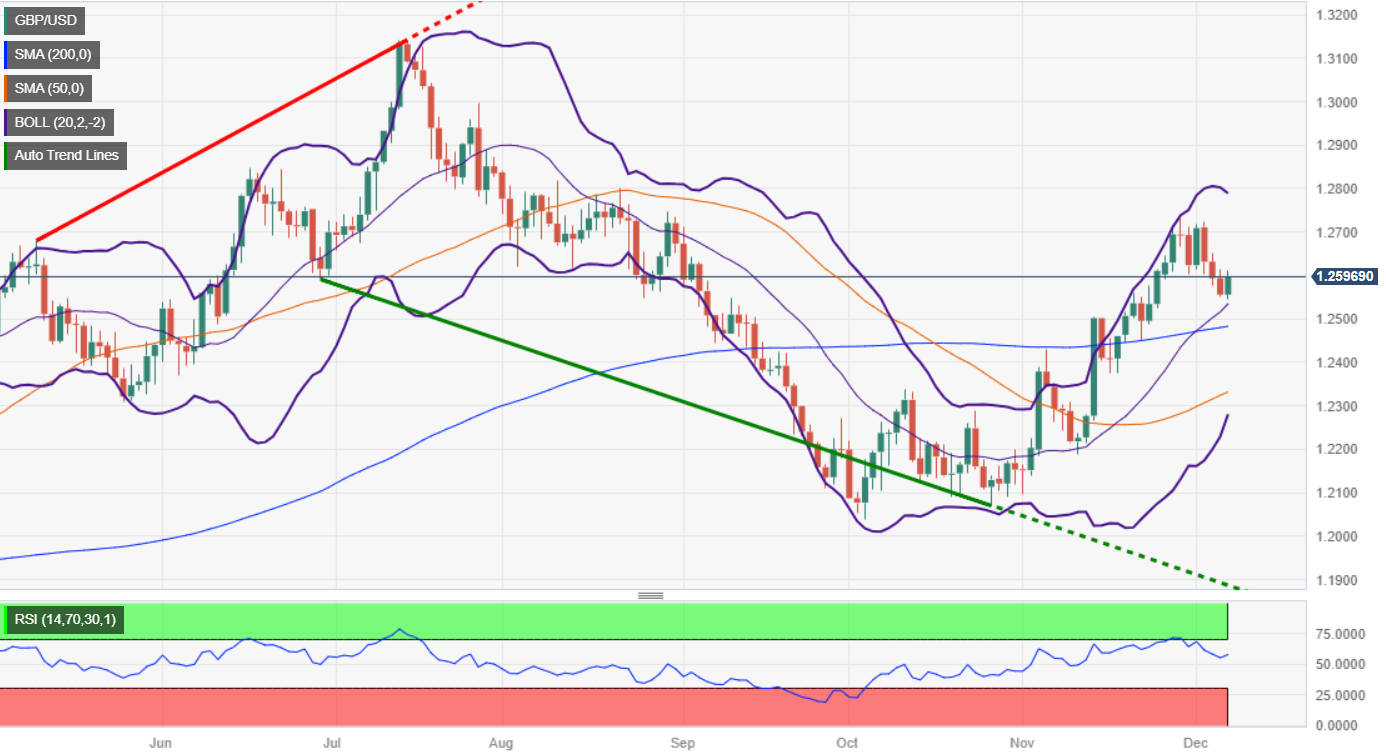
GBP/USD Price Analysis: Technical outlook
The major remains upward biased unless it breaches the latest support level at 1.2506, the November 14 swing high. Despite trading in the green, the cross of the 100-day moving average (DMA) below the 200-DMA is opening the door for a bearish resumption. However, as the GBP/USD stays above the above-mentioned support area, bulls can remain hopeful of higher prices. Key resistance levels lie at 1.2600, followed by December’s 5 high at 1.2651, ahead of the psychological 1.2700. On the flip side, the first support is 1.2500, followed by the 200-DMA at 12481 and the 100-DMA at 1.2465.
Author

Christian Borjon Valencia
FXStreet
Markets analyst, news editor, and trading instructor with over 14 years of experience across FX, commodities, US equity indices, and global macro markets.