GBP/USD takes a break from sustained losses near 1.3150
- GBP/USD churned the waters on Thursday, finding a floor near 1.3150.
- Ongoing US government shutdown adds further weight to wobbly private data.
- UK data docket remains limited until the BoE’s interest rate decision this week.

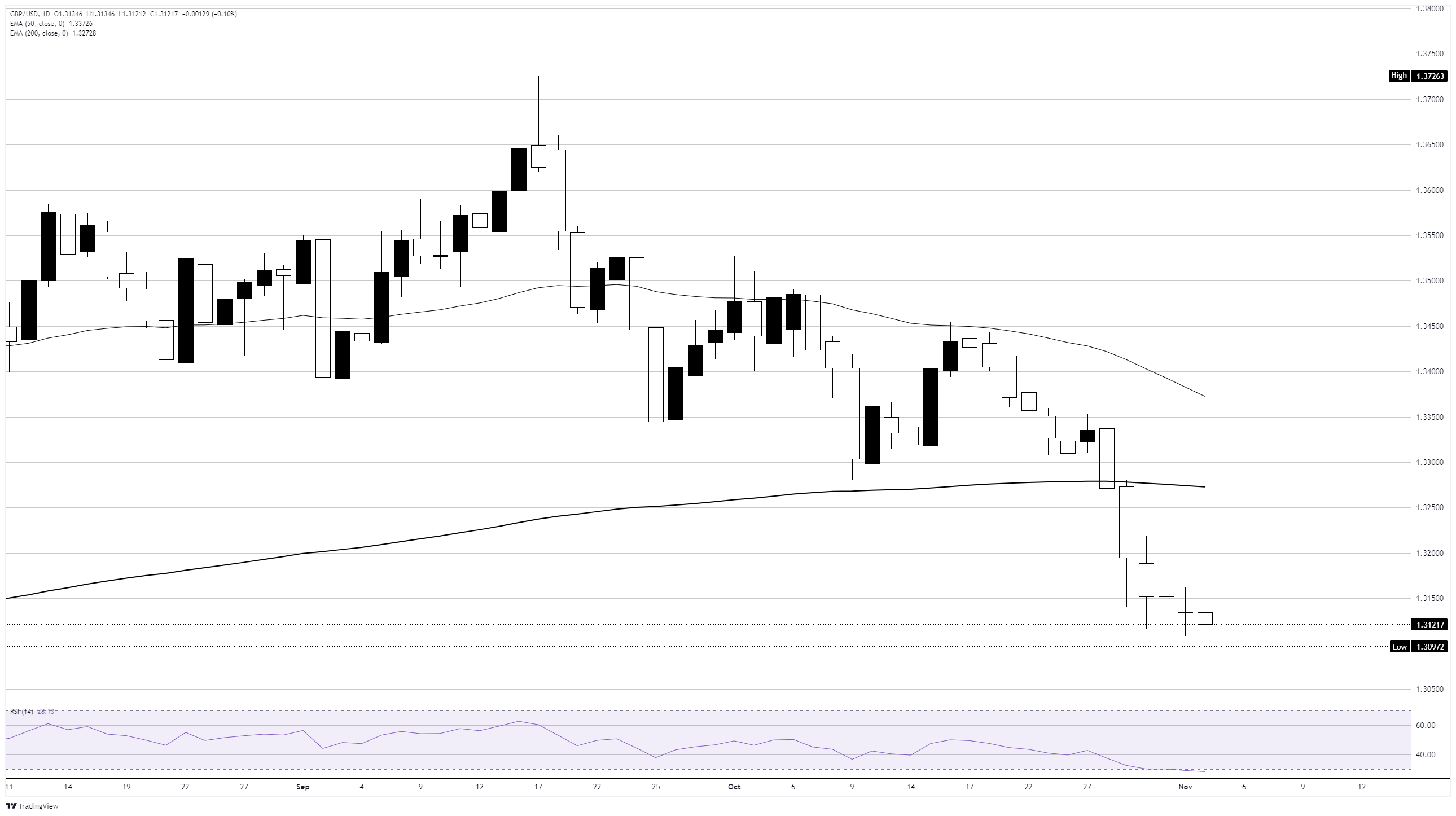
GBP/USD has managed to keep pumping the brakes at the outset of another trading week, finding enough friction to hold off on further declines as price action toys with the 1.3150 level. A technical rebound has yet to materialize, and Cable is likely to continue some rough chop in the interim as Pound Sterling (GBP) traders await the Bank of England’s (BoE) latest interest rate decision.
The latest Institute for Supply Management (ISM) Purchasing Managers Index (PMI) report dipped to 48.7 in October, missing expectations and falling back slightly from September’s 49.1. Demand indicators within the ISM report broadly improved over the month; however, all remain in contraction territory, implying that businesses are struggling to find new customers or convince current clients to expand their operations. Overall, manufacturing activity among businesses that bothered to submit responses to surveys showed a net decline in economic activity in the manufacturing sector for an eighth straight month.
Amid the ongoing US government shutdown, investors are tilting further into giving a level of consideration to private datasets that may not necessarily be due. Response rates to private surveys are notoriously low, and in a questionable economic environment where official, large-scale data isn’t available, the volatile and generally inaccurate nature of private data means investors may get caught on either side of the margin of error line thanks to faulty recency bias.
Little of note lies on the UK side of this week’s data docket until the BoE’s upcoming interest rate decision on Thursday. Even here, little change is expected. The Monetary Policy Committee (MPC) is expected to vote six-to-three to keep interest rates unchanged. The addition of another rate cut vote will be of some note for particularly attentive central bank policy wonks; however, meaningful changes in the BoE’s interest rate stance are unlikely to materialize with the UK’s headline inflation rate standing at 3.8% as of August, nearly double the BoE’s preferred 2% target band.
GBP/USD daily chart
The addition of another rate cut vote will be of some note for particularly attentive central bank policy wonks; however, meaningful changes in the BoE’s interest rate stance are unlikely to materialize with the UK’s headline inflation rate standing at 3.8% as of August, nearly double the BoE’s preferred 2% target band.
Pound Sterling FAQs
The Pound Sterling (GBP) is the oldest currency in the world (886 AD) and the official currency of the United Kingdom. It is the fourth most traded unit for foreign exchange (FX) in the world, accounting for 12% of all transactions, averaging $630 billion a day, according to 2022 data. Its key trading pairs are GBP/USD, also known as ‘Cable’, which accounts for 11% of FX, GBP/JPY, or the ‘Dragon’ as it is known by traders (3%), and EUR/GBP (2%). The Pound Sterling is issued by the Bank of England (BoE).
The single most important factor influencing the value of the Pound Sterling is monetary policy decided by the Bank of England. The BoE bases its decisions on whether it has achieved its primary goal of “price stability” – a steady inflation rate of around 2%. Its primary tool for achieving this is the adjustment of interest rates. When inflation is too high, the BoE will try to rein it in by raising interest rates, making it more expensive for people and businesses to access credit. This is generally positive for GBP, as higher interest rates make the UK a more attractive place for global investors to park their money. When inflation falls too low it is a sign economic growth is slowing. In this scenario, the BoE will consider lowering interest rates to cheapen credit so businesses will borrow more to invest in growth-generating projects.
Data releases gauge the health of the economy and can impact the value of the Pound Sterling. Indicators such as GDP, Manufacturing and Services PMIs, and employment can all influence the direction of the GBP. A strong economy is good for Sterling. Not only does it attract more foreign investment but it may encourage the BoE to put up interest rates, which will directly strengthen GBP. Otherwise, if economic data is weak, the Pound Sterling is likely to fall.
Another significant data release for the Pound Sterling is the Trade Balance. This indicator measures the difference between what a country earns from its exports and what it spends on imports over a given period. If a country produces highly sought-after exports, its currency will benefit purely from the extra demand created from foreign buyers seeking to purchase these goods. Therefore, a positive net Trade Balance strengthens a currency and vice versa for a negative balance.
Author

Joshua Gibson
FXStreet
Joshua joins the FXStreet team as an Economics and Finance double major from Vancouver Island University with twelve years' experience as an independent trader focusing on technical analysis.
















