GBP/USD surges to 15-month peak at 1.3000 amid easing US inflation

- GBP/USD pair skyrockets to a 15-month high as cooling US inflation data curtails Dollar’s strength.
- Despite a potential 25 basis points rate hike in July, Fed’s further tightening seems less probable amid diminishing inflation.
- UK’s high inflation rate and expectations of a 50 basis point rate hike by the BoE provide additional buoyancy to GBP.
GBP/USD advanced sharply and touched a new 15-month high at 1.3000 during the North American session as data released before Wall Street opened showed the Consumer Price Index (CPI) hitting its lowest level in two years, as inflation abated, following 500 basis points of tightening. Hence, the GBP/USD, exchanging hands at 1.2989, gains 0.45%, after hitting a low of 1.2902.
Pound Sterling gains ground as Fed rate hikes seem uncertain
According to the latest data from the US Bureau of Labor Statistics (BLS), inflation in the United States experienced a significant deceleration in June. The Consumer Price Index (CPI) revealed a year-on-year increase of 3.0%, falling below the estimated 3.1%. Furthermore, the Core CPI, which excludes volatile items such as food and energy, decreased by 0.5%, dropping from 5.3% in May to 4.8% last month.
The latest inflation report shows that inflation is approaching the 2% target faster than expected, according to Federal Reserve (Fed) projections delivered at June’s monetary policy meeting. That could refrain policymakers from increasing rates past the July FOMC’s decision.
According to the CME FedWatch Tool, there is a high probability of 92.4% for a 25 basis points rate increase in the upcoming July meeting. However, the likelihood of additional interest rate hikes has diminished significantly, falling below 30%.
The US Dollar Index (DXY), which measures the value of the US Dollar against a basket of other major currencies, continues to face downward pressure and is currently trading near its two-year lows. The DXY is at 100.597, reflecting a decline of 1.04%.
Federal Reserve speakers had crossed the wires earlier in the New York session, led by Richmond Fed President Thomas Barking, saying. that inflation is too high and emphasizing he is comfortable doing more to tackle inflation. Recently, the Minnesota Fed President Neil Kashkari noted that the Fed’s fight against inflation must be won and that if it gets higher, hikes must be raised.
On the UK front, the latest employment report increased the odds for further tightening by the Bank of England (BoE), with the inflation level still at an 8.6% annualized rate. Expectations are for a 50 basis point rate hike, while upcoming growth data could weigh on the BoE’s decision, which walks a fine line between raising rates to tackle inflation without slowing the economy to the point of triggering a recession.
GBP/USD Price Analysis: Technical outlook
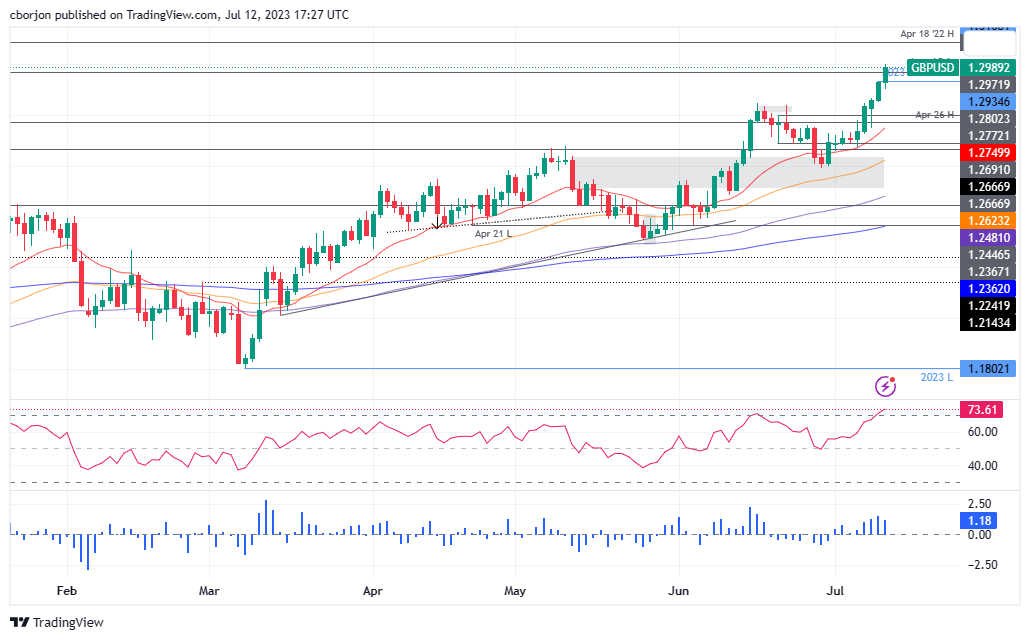
From a technical perspective, the GBP/USD daily chart shows the pair is in a strong uptrend, with buyers eyeing an April 22, 2022, daily high of 1.3035, below the 2021 yearly low of 1.3160. It should be said the Relative Strength Index (RSI) entered overbought conditions, but in a strong uptrend, the indicator could reach its extreme readings at around or past the 80.00 mark. That said, the GBP/USD could threaten 1.3000 and extend its gains to 1.3100. Conversely, if GBP/USD slumps below the July 11 low of 1.2853, that could exacerbate a test of the 1.2800 figure, followed by the 20-day Exponential Moving Average (EMA) at 1.2750.
Author

Christian Borjon Valencia
FXStreet
Markets analyst, news editor, and trading instructor with over 14 years of experience across FX, commodities, US equity indices, and global macro markets.

















