GBP/USD spins in a giant circle on Monday
- Tariff headlines grip global markets as US President Trump lashes out at global trade stability.
- A wide cut of US tariffs has sewered global market sentiment.
- A last-minute aversion of Mexico tariffs has bolstered investor hopes that a global trade war might not happen.

GBP/USD roiled on Monday, tumbling 1.5% during the overnight session before recovering back to flat for the day at the 1.2400 handle. Import tariffs from the US brewing into a large-scale global trade war hobbled market sentiment over the weekend.
The US was geared up to impose sweeping import tariffs of 25% on Canada and Mexico, as well as an additional 10% on China, with US President Donald Trump promising to add an additional 10% levy on goods imported from the EU. However, Mexico was able to obtain a one-month reprieve from the US' tariffs, leading investors to hope that the majority of global tariffs will able to be averted by countries acquiescing to whatever Trump demands in exchange for easing tariffs. Donald Trump specifically voiced a desire for "rare earth metals" agreements from Ukraine in exchange for the US' continued help with the Russian invasion, as well as re-floating taking control of the Panama Canal, which is currently owned and controlled by the country of Panama.
Trump specifically waved off the idea of tariffs on the UK, stating that it is likely that the two countries would be able to work something out, sparking a relief rally in the Pound Sterling that took Monday's bearish plunge back to flat.
The Bank of England (BoE) is expected to cut interest rates later this week. However, things could change rapidly if it appears like tariffs are going to become an ongoing, globally-inflationary issue.
GBP/USD price forecast
GBP/USD continues to grind through a middle-ground technical stance, hung up on price action near the 1.2400 handle. However, continued tests into the low end and a general uptick in volatility this week will likely keep the Pound Sterling on the defensive as Cable continues to fall away from the 50-day Exponential Moving Average (EMA) near 1.2500.
GBP/USD daily chart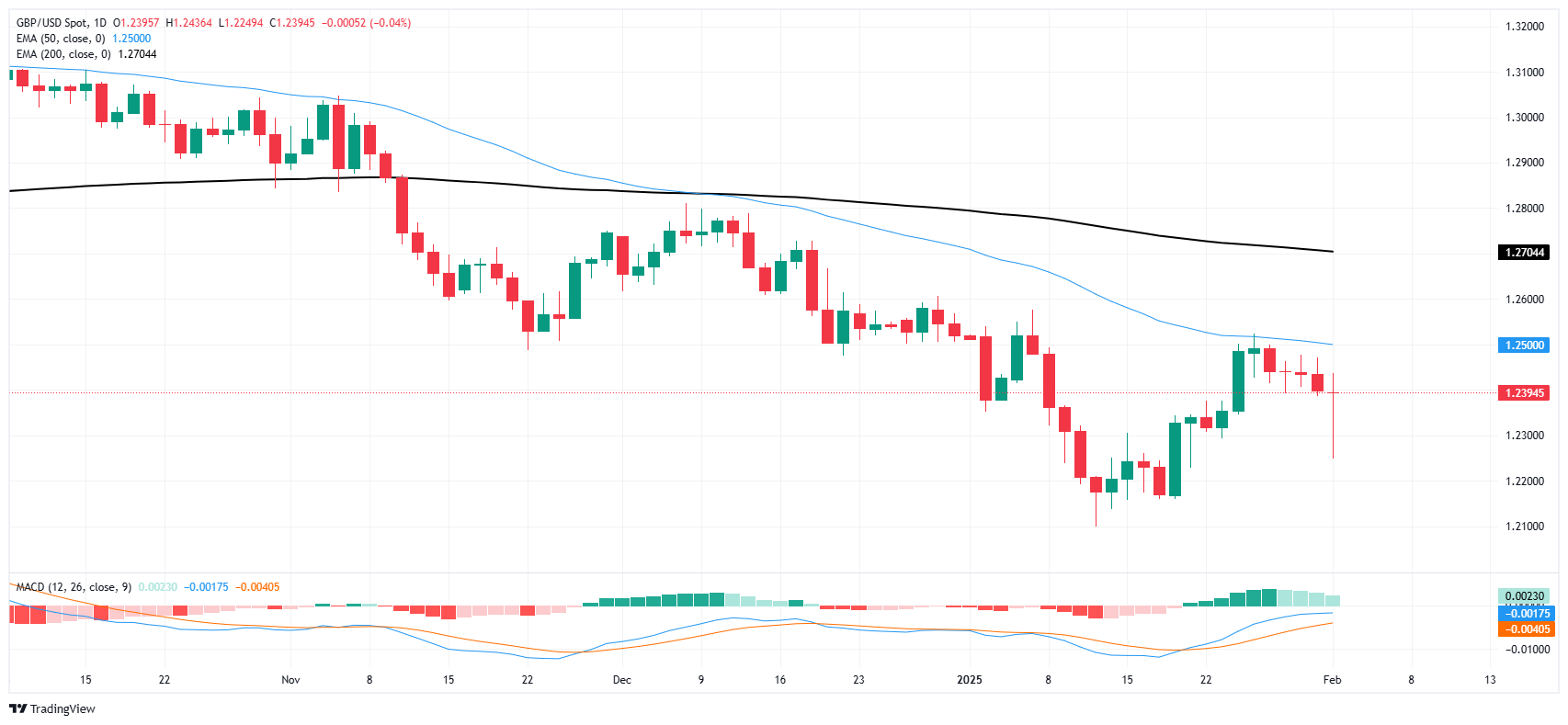
Pound Sterling FAQs
The Pound Sterling (GBP) is the oldest currency in the world (886 AD) and the official currency of the United Kingdom. It is the fourth most traded unit for foreign exchange (FX) in the world, accounting for 12% of all transactions, averaging $630 billion a day, according to 2022 data. Its key trading pairs are GBP/USD, also known as ‘Cable’, which accounts for 11% of FX, GBP/JPY, or the ‘Dragon’ as it is known by traders (3%), and EUR/GBP (2%). The Pound Sterling is issued by the Bank of England (BoE).
The single most important factor influencing the value of the Pound Sterling is monetary policy decided by the Bank of England. The BoE bases its decisions on whether it has achieved its primary goal of “price stability” – a steady inflation rate of around 2%. Its primary tool for achieving this is the adjustment of interest rates. When inflation is too high, the BoE will try to rein it in by raising interest rates, making it more expensive for people and businesses to access credit. This is generally positive for GBP, as higher interest rates make the UK a more attractive place for global investors to park their money. When inflation falls too low it is a sign economic growth is slowing. In this scenario, the BoE will consider lowering interest rates to cheapen credit so businesses will borrow more to invest in growth-generating projects.
Data releases gauge the health of the economy and can impact the value of the Pound Sterling. Indicators such as GDP, Manufacturing and Services PMIs, and employment can all influence the direction of the GBP. A strong economy is good for Sterling. Not only does it attract more foreign investment but it may encourage the BoE to put up interest rates, which will directly strengthen GBP. Otherwise, if economic data is weak, the Pound Sterling is likely to fall.
Another significant data release for the Pound Sterling is the Trade Balance. This indicator measures the difference between what a country earns from its exports and what it spends on imports over a given period. If a country produces highly sought-after exports, its currency will benefit purely from the extra demand created from foreign buyers seeking to purchase these goods. Therefore, a positive net Trade Balance strengthens a currency and vice versa for a negative balance.
Author

Joshua Gibson
FXStreet
Joshua joins the FXStreet team as an Economics and Finance double major from Vancouver Island University with twelve years' experience as an independent trader focusing on technical analysis.
















