GBP/USD slips near 1.3430 as Trump eases Greenland rhetoric
- GBP/USD turns marginally negative as Trump tones down tariff threats, lifting broader market sentiment.
- UK inflation beats forecasts, but softer jobs data keeps Bank of England easing bets intact.
- Traders await US GDP and PCE data for clarity on growth and inflation trends.

GBP/USD turns negative on Wednesday following remarks by US President Donald Trump in Davos, who said that he would not use excessive force to get Greenland. At the time of writing, the pair trades at 1.3433, down 0.03%.
Sterling edges lower as improving risk sentiment offsets hotter UK inflation and pressures the Dollar less
Market sentiment improved following Trump's comments in Davos. Despite insisting on negotiating with Denmark, he refrained from using the tariff word, which he used over the weekend when he imposed 10% duties on eight European countries, including Denmark.
Economic data has taken a back seat to geopolitical issues, which so far de-escalated following Trump’s speech. Data-wise, Pending Home Sales for December in the US plunged 9.3%, below forecasts of a 0.3% contraction and down from November 3.3% growth.
Across the pond, UK inflation increased above estimates of 3.3%, coming at 3.4% YoY in December, sparked by air fares and tobacco prices. Even though inflation became slightly hot, it remained below the Bank of England’s 3.5% projection.
Despite this, money markets continued to price in 47 basis points of BoE easing towards the end of the year, according to Prime Market Terminal data.
A day ago, the Office for National Statistics (ONS) revealed that the job market weakened in November, which could push the BoE to reduce rates to support the economy.
Ahead in the week, the UK economic docket will be absent. The US docket would feature the release of Gross Domestic Product (GDP) Q3 2025, Initial Jobless Claims and the Personal Consumption Expenditures (PCE) Price Index.
Pound Sterling Price This week
The table below shows the percentage change of British Pound (GBP) against listed major currencies this week. British Pound was the strongest against the Japanese Yen.
| USD | EUR | GBP | JPY | CAD | AUD | NZD | CHF | |
|---|---|---|---|---|---|---|---|---|
| USD | -1.01% | -0.60% | 0.27% | -0.75% | -1.39% | -1.79% | -0.87% | |
| EUR | 1.01% | 0.41% | 1.28% | 0.25% | -0.41% | -0.80% | 0.13% | |
| GBP | 0.60% | -0.41% | 0.62% | -0.16% | -0.81% | -1.20% | -0.28% | |
| JPY | -0.27% | -1.28% | -0.62% | -1.00% | -1.64% | -2.02% | -1.12% | |
| CAD | 0.75% | -0.25% | 0.16% | 1.00% | -0.62% | -1.03% | -0.12% | |
| AUD | 1.39% | 0.41% | 0.81% | 1.64% | 0.62% | -0.39% | 0.54% | |
| NZD | 1.79% | 0.80% | 1.20% | 2.02% | 1.03% | 0.39% | 0.93% | |
| CHF | 0.87% | -0.13% | 0.28% | 1.12% | 0.12% | -0.54% | -0.93% |
The heat map shows percentage changes of major currencies against each other. The base currency is picked from the left column, while the quote currency is picked from the top row. For example, if you pick the British Pound from the left column and move along the horizontal line to the US Dollar, the percentage change displayed in the box will represent GBP (base)/USD (quote).
GBP/USD Price Forecast: Technical outlook
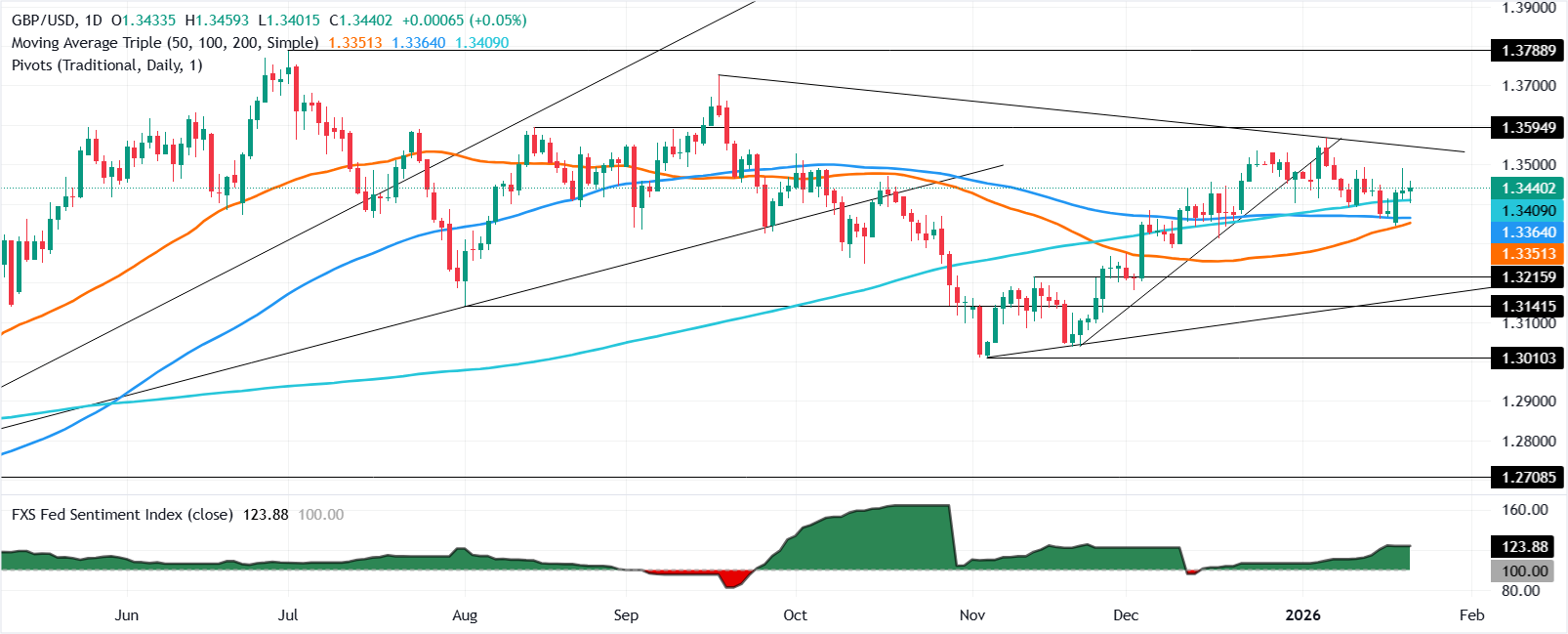
The GBP has failed to extend its uptrend on Wednesday, consolidated within the 200-day SMA and the 20-day SMA at 1.3403 and 1.3455 range, respectively, as the Dollar trims some of its earlier losses. Nevertheless, buyers remain in charge as the Relative Strength Index (RSI) is bullish, but it has turned flat, an indication of sideways price action.
If GBP/USD clears the 20-day SMA at 1.3455, the next key resistance would be the January 20 high at 1.3491, ahead of 1.3500. A breach of the latter will expose the January 6 peak at 1.3567. Conversely, if the pair slides below the 200-day SMA, the next support would be the January 19 swing low of 1.3338.
Pound Sterling FAQs
The Pound Sterling (GBP) is the oldest currency in the world (886 AD) and the official currency of the United Kingdom. It is the fourth most traded unit for foreign exchange (FX) in the world, accounting for 12% of all transactions, averaging $630 billion a day, according to 2022 data. Its key trading pairs are GBP/USD, also known as ‘Cable’, which accounts for 11% of FX, GBP/JPY, or the ‘Dragon’ as it is known by traders (3%), and EUR/GBP (2%). The Pound Sterling is issued by the Bank of England (BoE).
The single most important factor influencing the value of the Pound Sterling is monetary policy decided by the Bank of England. The BoE bases its decisions on whether it has achieved its primary goal of “price stability” – a steady inflation rate of around 2%. Its primary tool for achieving this is the adjustment of interest rates. When inflation is too high, the BoE will try to rein it in by raising interest rates, making it more expensive for people and businesses to access credit. This is generally positive for GBP, as higher interest rates make the UK a more attractive place for global investors to park their money. When inflation falls too low it is a sign economic growth is slowing. In this scenario, the BoE will consider lowering interest rates to cheapen credit so businesses will borrow more to invest in growth-generating projects.
Data releases gauge the health of the economy and can impact the value of the Pound Sterling. Indicators such as GDP, Manufacturing and Services PMIs, and employment can all influence the direction of the GBP. A strong economy is good for Sterling. Not only does it attract more foreign investment but it may encourage the BoE to put up interest rates, which will directly strengthen GBP. Otherwise, if economic data is weak, the Pound Sterling is likely to fall.
Another significant data release for the Pound Sterling is the Trade Balance. This indicator measures the difference between what a country earns from its exports and what it spends on imports over a given period. If a country produces highly sought-after exports, its currency will benefit purely from the extra demand created from foreign buyers seeking to purchase these goods. Therefore, a positive net Trade Balance strengthens a currency and vice versa for a negative balance.
Author

Christian Borjon Valencia
FXStreet
Markets analyst, news editor, and trading instructor with over 14 years of experience across FX, commodities, US equity indices, and global macro markets.