GBP/USD slides below 1.3780 as Fed hold lifts the Dollar
- GBP/USD drops as the US Dollar surges after the Fed holds rates and downplays labor market risks.
- Powell’s neutral tone pushes the DXY higher, amid ongoing selloffs in Gold, crypto and equities.
- Focus turns to the BoE decision and UK political risks as potential headwinds for Sterling.

GBP/USD tumbles during the North American session on Thursday after the US Federal Reserve (Fed) held rates unchanged and revealed a stabilization of the jobs market. At the time of writing, the pair trades at 1.3779, down 0.18%
Sterling tumbles as the Fed signals labor market stability, lifting the Dollar and pressuring risk assets
On an abrupt move, the US Dollar Index (DXY), which tracks the performance of the buck’s value against six currencies, is up 0.65% to 96.40, a headwind for Sterling.
The US Dollar’s gains and the fall of US equities sent Gold, Silver and risk assets like Bitcoin and Ethereum plunging across the board.
Aside from this, on Wednesday, the Fed held rates unchanged at the 3.50%-3.75% range to assess the impact of 75 basis points of easing during the second half of 2026. The decision was by majority on a 10-2 vote split, with Governors Waller and Miran opting for a quarter of a percentage point cut.
Fed Chair Jerome Powell dodged political questions, like the US Dollar’s value and whether he would stay as Governor towards the end of his period in 2028. Nevertheless, he advised his successor, saying, “Stay out of elected politics.”
Regarding the economy, Powell commented that it remains solid, that the risks of a jump in the unemployment rate have diminished, but not so high prices. Hence, he shifted towards a neutral stance, as he wants to assess the impact of last year’s three rate cuts and see what data warrants, regarding setting monetary policy.
On the data front, US Initial Jobless Claims for the week ending January 24, exceeded estimates of 205K, rose by 209K, below the previous print of 210K.
Across the pond, the UK docket remains absent with traders' focus on the Bank of England’s (BoE) monetary policy decision next week. Meanwhile, domestic political issues inside the Labour Party. Chris Turner, head of forex strategy at ING, mentioned that “UK politics may well take its toll on sterling again over the coming months.”
GBP/USD Price Forecast: Technical outlook
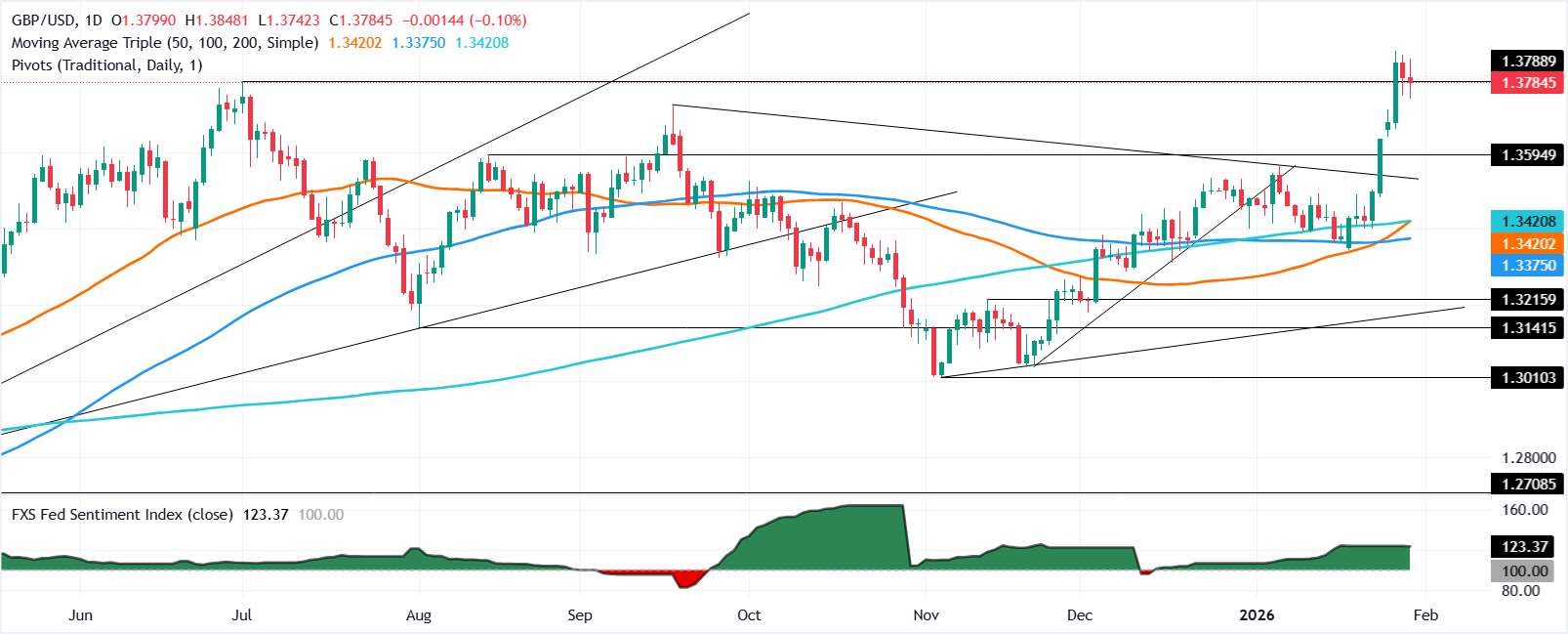
GBP/USD remains upwardly biased, despite falling to a two-day low of 1.3742, before recovering some ground. For a bullish resumption, the pair needs to close daily above 1.3800, keeping buyers hopeful of testing higher prices. On the downside, buyers’ last line of support would be the January 27 daily low of 1.3668, before clearing the path towards 1.3600.
Pound Sterling Price Today
The table below shows the percentage change of British Pound (GBP) against listed major currencies today. British Pound was the strongest against the Australian Dollar.
| USD | EUR | GBP | JPY | CAD | AUD | NZD | CHF | |
|---|---|---|---|---|---|---|---|---|
| USD | 0.06% | 0.11% | -0.32% | -0.19% | 0.29% | 0.06% | -0.21% | |
| EUR | -0.06% | 0.05% | -0.37% | -0.25% | 0.24% | 0.00% | -0.27% | |
| GBP | -0.11% | -0.05% | -0.42% | -0.30% | 0.16% | -0.06% | -0.32% | |
| JPY | 0.32% | 0.37% | 0.42% | 0.12% | 0.60% | 0.36% | 0.11% | |
| CAD | 0.19% | 0.25% | 0.30% | -0.12% | 0.49% | 0.25% | -0.02% | |
| AUD | -0.29% | -0.24% | -0.16% | -0.60% | -0.49% | -0.23% | -0.49% | |
| NZD | -0.06% | -0.00% | 0.06% | -0.36% | -0.25% | 0.23% | -0.28% | |
| CHF | 0.21% | 0.27% | 0.32% | -0.11% | 0.02% | 0.49% | 0.28% |
The heat map shows percentage changes of major currencies against each other. The base currency is picked from the left column, while the quote currency is picked from the top row. For example, if you pick the British Pound from the left column and move along the horizontal line to the US Dollar, the percentage change displayed in the box will represent GBP (base)/USD (quote).
Author

Christian Borjon Valencia
FXStreet
Markets analyst, news editor, and trading instructor with over 14 years of experience across FX, commodities, US equity indices, and global macro markets.

















