GBP/USD slides below 1.29 on soft UK CPI, budget presentation
- UK inflation dips to 2.8%, fueling BoE rate cut bets despite cautious central bank messaging.
- Reeves’ Spring Budget delivers £7bn in cuts, sticking to fiscal rules amid downgraded growth outlook.
- US Durable Goods data beats estimates, helping the USD recover ground against the Pound.

The Pound Sterling (GBP) depreciates against the US Dollar (USD) on Wednesday as United Kingdom (UK) inflation came in softer than expected, while investors scrutinized the Spring Budget. Across the pond, mixed US economic data lent a lifeline to the Greenback, which pared losses versus the British pound. GBP/USD is trading at 1.2895, down 0.36%.
Pound drops as inflation cools and Reeves’ budget tightens spending
The UK’s inflation rate dipped below estimates, with headline figures rising 2.8% year-over-year (YoY) in February, compared to 3% in January. The Core CPI for the same period decreased by two-tenths, from 3.7% to 3.5% YoY, also below forecasts of 3.6%.
Even though this adds pressure on the Bank of England (BoE) to cut rates, the bank warned against assuming that rate cuts would be quick.
Regarding the spring budget, the Chancellor of Exchequer, Rachel Reeves, reduced the government’s spending plans and adhered to her fiscal target.
Some primary key takeaways were welfare cuts of over £3.4 billion and cuts to current spending of over £3.6 billion. There were no changes or loosening of the fiscal rules to allow extra borrowing, and spending on defense increased by £6.4bn by 2027.
UK’s Office for Budget Responsibility (OBR) updated their forecasts, with the economy expected to grow 1% in 2025, down from the 2% forecast in October. Inflation is projected to remain around 3.2%, up from 2.6% in the Autumn budget in 2025, and is expected to fall to 2.1% in 2026.
The GBP/USD pair dropped on the news, yet it has trimmed some of its earlier losses.
Across the pond, US Durable Goods Orders were solid in February, according to the US Department of Commerce. Orders rose 0.9% MoM, exceeding the forecast for a 1% contraction. Core Durable Goods Orders, excluding transportation, rose by 0.7% month-over-month (MoM), up from 0.1% in January and above the estimated 0.2% increase.
Recently, Minneapolis Fed President Neel Kashkari said the Fed has made significant progress in bringing inflation down, although more work still needs to be done. He added that policy is complicating the Fed’s job and that in the next year or two, they ought to be able to reduce interest rates.
GBP/USD Price Forecast: Technical outlook
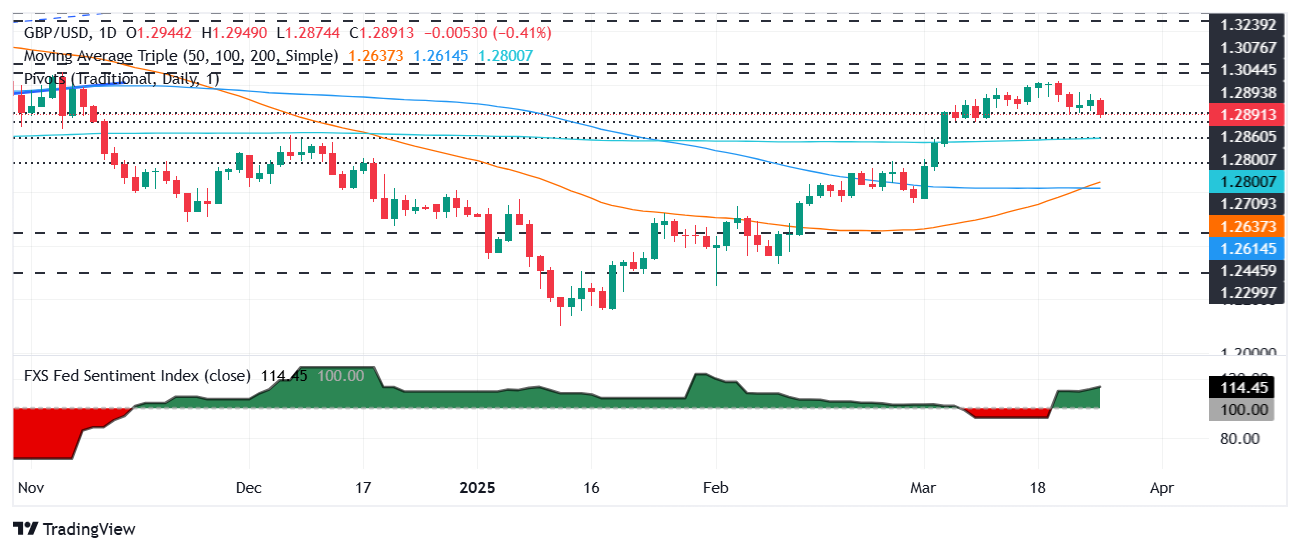
GBP/USD is retracing at the time of writing, with sellers eyeing a decisive break below the March 10 daily low of 1.2861, which, if cleared, could pave the way for a test of the 200-day Simple Moving Average (SMA) at 1.2800. If surpassed, the next stop would be 1.2700. Conversely, if GBP/USD rises past 1.2900, buyers could challenge the current week’s peak at 1.2973, ahead of the 1.30 mark.
British Pound PRICE This week
The table below shows the percentage change of British Pound (GBP) against listed major currencies this week. British Pound was the strongest against the Japanese Yen.
| USD | EUR | GBP | JPY | CAD | AUD | NZD | CHF | |
|---|---|---|---|---|---|---|---|---|
| USD | 0.32% | 0.21% | 0.90% | -0.75% | -0.58% | -0.20% | 0.09% | |
| EUR | -0.32% | -0.22% | 0.07% | -1.02% | -0.92% | -0.47% | -0.18% | |
| GBP | -0.21% | 0.22% | 0.70% | -1.42% | -0.73% | -0.24% | -0.07% | |
| JPY | -0.90% | -0.07% | -0.70% | -1.64% | -1.50% | -1.08% | -0.82% | |
| CAD | 0.75% | 1.02% | 1.42% | 1.64% | 0.22% | 0.55% | 0.85% | |
| AUD | 0.58% | 0.92% | 0.73% | 1.50% | -0.22% | 0.46% | 0.74% | |
| NZD | 0.20% | 0.47% | 0.24% | 1.08% | -0.55% | -0.46% | 0.36% | |
| CHF | -0.09% | 0.18% | 0.07% | 0.82% | -0.85% | -0.74% | -0.36% |
The heat map shows percentage changes of major currencies against each other. The base currency is picked from the left column, while the quote currency is picked from the top row. For example, if you pick the British Pound from the left column and move along the horizontal line to the US Dollar, the percentage change displayed in the box will represent GBP (base)/USD (quote).
Author

Christian Borjon Valencia
FXStreet
Markets analyst, news editor, and trading instructor with over 14 years of experience across FX, commodities, US equity indices, and global macro markets.