GBP/USD rebounds as trade woes weigh on Greenback
- GBP/USD climbed back above 1.3550 on Monday as risk sentiment drags down the US Dollar.
- The Trump administration is poised to raise steel tariffs and has given a “last call” for trade deal offers.
- The BoE is set to deliver its latest update to the British Parliament on Tuesday.

GBP/USD jumped on Monday, kicking off the June trading window by climbing back above 1.3550 after a broad-market weakening in Greenback flows. Trade frictions continue to weigh on the US Dollar, and Cable traders are leaning into the bullish side ahead of the Bank of England’s (BoE) latest Monetary Policy Report hearings before British parliament on Tuesday.
The Trump administration hit another flurry of trade headlines on Monday; Donald Trump announced late lasts week that he intended to double tariffs on all steel imported into the US to 50% beginning next week. President Trump announced the new trade measure during a speech to a United Auto Workers union rally last Friday. China has responded to the Trump administration’s accusations that China is violating early trade terms that the two countries tentatively reached during sideline meetings in Switzerland in May.
Read more tariff news: Trump gives Wednesday deadline for trading partners to table their best offers
Donald Trump expressed frustration at China’s apparent slow-rolling of approvals for rare earths exports bound for the US; China fired back early this week, stating that they are operating within the initial timelines agreed to in Switzerland, and fired back that the US is actually the one violating trade terms by introducing new curbs on tech exports targeting China specifically. Despite constant claims from Trump staffers that deal talks are progressing, tensions between the US and China appear to be mounting.
The BoE remains increasingly cautious in the face of potential fallout from whiplash tariff policies from the US. The BoE’s latest Monetary Policy Report statements, being delivered to the British parliament on Tuesday, are expected to reinforce rate-hold rhetoric from policymakers. The Pound Sterling caught a firm bid through the first and second quarters after the BoE shifted its stance to delivering far fewer rate cuts this year than many market participants had initially expected.
GBP/USD price forecast
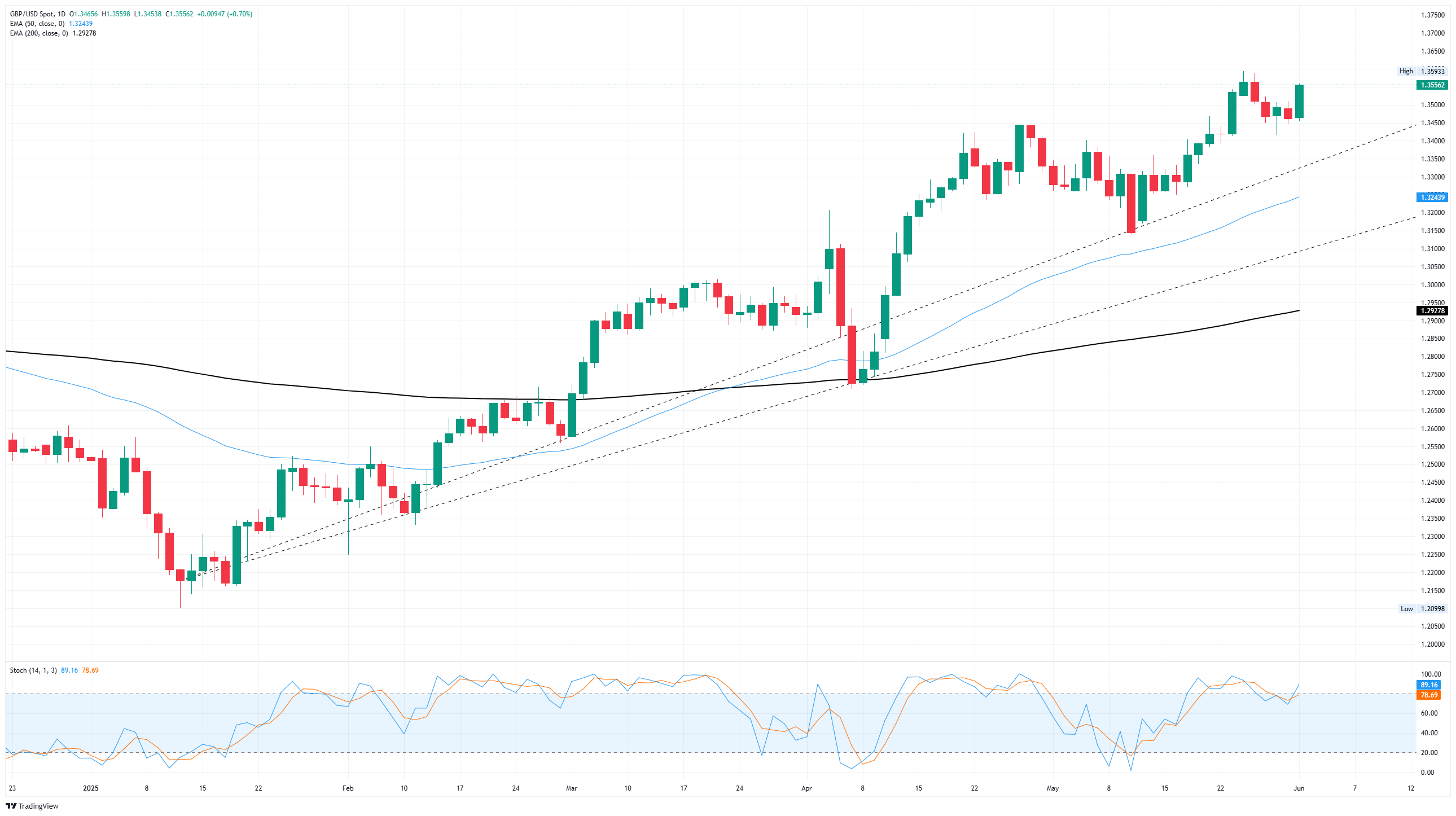
Despite a near-term pullback, Cable continues to trade firmly into the bullish side. Bids have outrun both rising trendlines and the 200-day Exponential Moving Average (EMA), which is currently rising above 1.2900. Price action caught another leg up to reclaim chart territory north of the 1.3500 handle on Monday, and bids are within a stone’s throw of setting fresh two-year highs near 1.3600.
GBP/USD daily chart
Pound Sterling FAQs
The Pound Sterling (GBP) is the oldest currency in the world (886 AD) and the official currency of the United Kingdom. It is the fourth most traded unit for foreign exchange (FX) in the world, accounting for 12% of all transactions, averaging $630 billion a day, according to 2022 data. Its key trading pairs are GBP/USD, also known as ‘Cable’, which accounts for 11% of FX, GBP/JPY, or the ‘Dragon’ as it is known by traders (3%), and EUR/GBP (2%). The Pound Sterling is issued by the Bank of England (BoE).
The single most important factor influencing the value of the Pound Sterling is monetary policy decided by the Bank of England. The BoE bases its decisions on whether it has achieved its primary goal of “price stability” – a steady inflation rate of around 2%. Its primary tool for achieving this is the adjustment of interest rates. When inflation is too high, the BoE will try to rein it in by raising interest rates, making it more expensive for people and businesses to access credit. This is generally positive for GBP, as higher interest rates make the UK a more attractive place for global investors to park their money. When inflation falls too low it is a sign economic growth is slowing. In this scenario, the BoE will consider lowering interest rates to cheapen credit so businesses will borrow more to invest in growth-generating projects.
Data releases gauge the health of the economy and can impact the value of the Pound Sterling. Indicators such as GDP, Manufacturing and Services PMIs, and employment can all influence the direction of the GBP. A strong economy is good for Sterling. Not only does it attract more foreign investment but it may encourage the BoE to put up interest rates, which will directly strengthen GBP. Otherwise, if economic data is weak, the Pound Sterling is likely to fall.
Another significant data release for the Pound Sterling is the Trade Balance. This indicator measures the difference between what a country earns from its exports and what it spends on imports over a given period. If a country produces highly sought-after exports, its currency will benefit purely from the extra demand created from foreign buyers seeking to purchase these goods. Therefore, a positive net Trade Balance strengthens a currency and vice versa for a negative balance.
Author

Joshua Gibson
FXStreet
Joshua joins the FXStreet team as an Economics and Finance double major from Vancouver Island University with twelve years' experience as an independent trader focusing on technical analysis.
















