|

GBP/USD Price Analysis: Remains bearish, falls below 1.2700

  • GBP/USD trades below 1.2700 after hitting a two-day high of 1.2720.
  • Resistance at a broken support trendline could lead to further price drops.
  • Key support levels: 1.2656 (June 14 low) and 1.2643/34 (100-DMA confluence and May 3 high).

The Pound Sterling creeps lower against the US Dollar on Tuesday, amid a scarce economic docket in the UK following the release of mixed data in the United States. At the time of writing, the GBP/USD trades at 1.2688, down 0.12%.

GBP/USD Price Analysis: Technical outlook

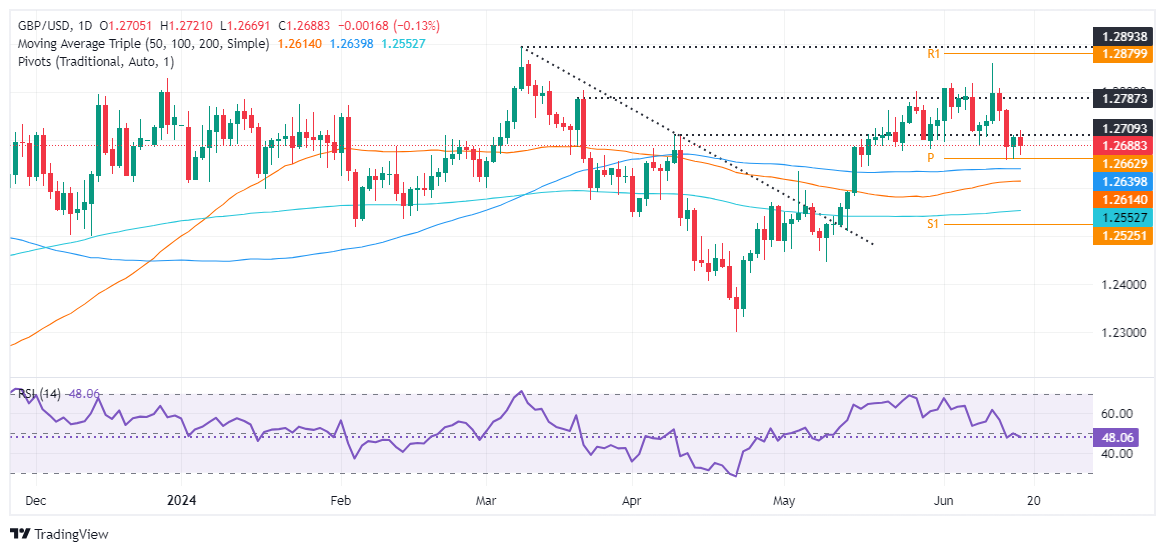
Following a dip to a multi-week low of 1.2656, the GBP/USD has shown signs of resilience, managing to regain some ground. However, it's important to note that it still hovers below a one-month broken support trendline turned resistance, which could potentially lead to further price drops.

Momentum shows that sellers remained unchanged, as revealed by the Relative Strength Index (RSI).

If GBP/USD drops below 1.2700, the exchange rate will continue to fall and face the first support, at 1.2656, the June 14 low. Once cleared, the next stop would be the 100-day moving average (DMA) confluence and the May 3 high at 1.2643/34, ahead of 1.2600.

Conversely, if GBP/USD climbs past 1.2720/30, that could exacerbate a rally toward 1.2800.

GBP/USD Price Action – Daily Chart
GBP/USD

Overview
Today last price1.2689
Today Daily Change-0.0016
Today Daily Change %-0.13
Today daily open1.2705
 
Trends
Daily SMA201.2743
Daily SMA501.2614
Daily SMA1001.264
Daily SMA2001.2552
 
Levels
Previous Daily High1.271
Previous Daily Low1.2659
Previous Weekly High1.286
Previous Weekly Low1.2657
Previous Monthly High1.2801
Previous Monthly Low1.2446
Daily Fibonacci 38.2%1.269
Daily Fibonacci 61.8%1.2678
Daily Pivot Point S11.2673
Daily Pivot Point S21.2641
Daily Pivot Point S31.2622
Daily Pivot Point R11.2723
Daily Pivot Point R21.2742
Daily Pivot Point R31.2774

Author

Christian Borjon Valencia

Markets analyst, news editor, and trading instructor with over 14 years of experience across FX, commodities, US equity indices, and global macro markets.


More from Christian Borjon Valencia
Share:

Editor's Picks

AUD/USD bounces off multi-month low, nears 0.6900

AUD/USD edges higher toward 0.6900 in the Asian session on Wednesday, recovering some of the previous day’s losses to its lowest level since March as the US Dollar stalls the hot US CPI-inspired rally amid hopes of a US-Iran peace deal. Meanwhile, hawkish comments from FOMC members have almost confirmed another December rate hike, which favors USD bulls and should cap the Aussie.

USD/JPY remains capped below 159.00 amid looming intervention risks

USD/JPY struggles to build on the previous day’s strong gains to a near one-month top as intervention risk supports the Japanese Yen while hopes of a US-Iran peace deal cap the safe-haven US Dollar. That keeps the pair's upside limited below 159.00, for now.

Gold: The $4,000 mark holds the downside, for now

Gold adds to Tuesday’s small pullback and remains close to the key $4,000 mark per troy ounce on Wednesday. The yellow metal’s continuation of the downward trend comes against the backdrop of a robust performance of the US Dollar, rising US Treasury yields across the board and rising bets of extra rate hikes by the Fed.

Crypto Today: Bitcoin, Ethereum and XRP struggle to find footing amid spot ETF outflows

Cryptocurrency prices are broadly consolidating near key lower support levels on Wednesday, led by Bitcoin, hovering around $74,000. Ethereum sits above $2,000 while its upside remains structurally capped. Ripple, meanwhile, holds delicately above $1.00.

Ten questions for China in 2027

2026 has been a year of slowing growth and increasing divergence within China's economy. We saw the gap between external and domestic demand, as well as between the new economy and the old economy, widen significantly. Here, we look ahead to the key questions facing China in 2027.

What the US CPI headline doesn’t tell you about inflation

Brent crude has fallen about a third since mid-October on hopes the Iran war is ending, but diesel, freight and fertiliser costs haven't followed. Those costs reach US consumer prices in stages through 2027 and could keep inflation high after gasoline gets cheaper.