|

GBP/USD Price Analysis: Inside short-term falling channel

  • GBP/USD struggles around the multi-year low.
  • A short-term bearish technical formation, 100-HMA restrict immediate upside.
  • 1.1400 becomes the key support-confluence.

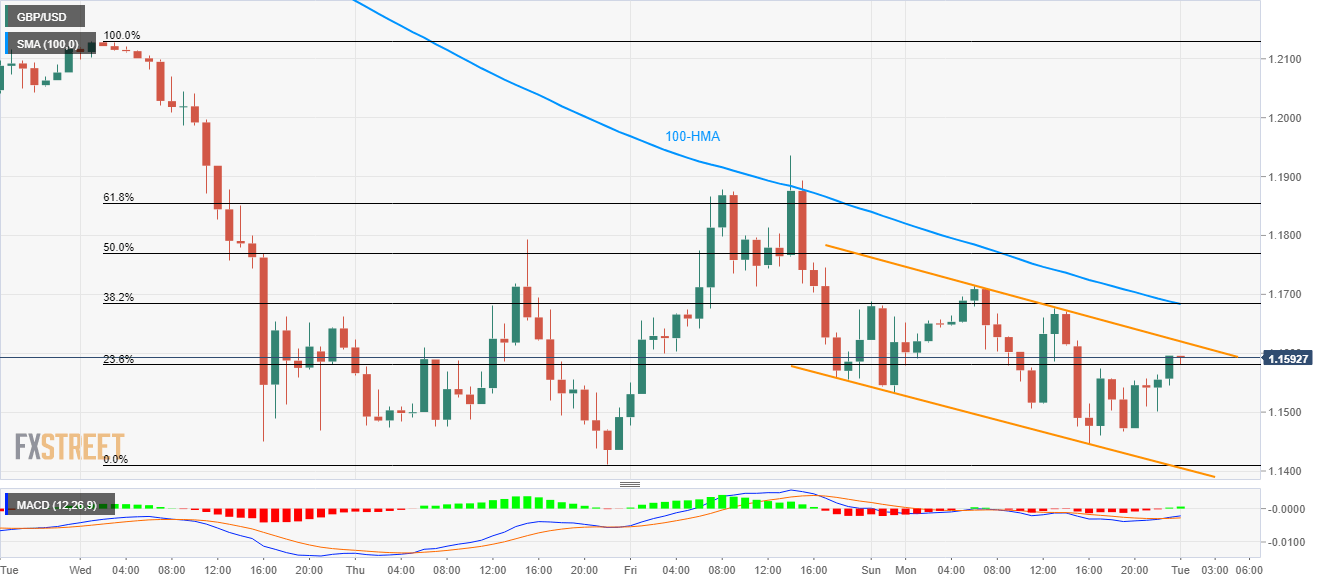
Despite marking 0.40% gains on the daily basis, GBP/USD recovery seems doubtful inside the immediate falling trend channel. The cable pair currently takes rounds to 1.1590 during the Asian session on Tuesday.

Even if the quote manages to cross 1.1620 channel resistance, a confluence of 100-Hour Moving Average (HMA) and 38.2% Fibonacci retracement of March 18/19 declines, around 1.1680/85 could question the buyers afterward.

If the recently bullish MACD help the quote to cross 1.1685, the pair can extend the recovery moves to the last-week top surrounding 1.1935.

Meanwhile, 1.1470 can offer immediate support to the pair during its pullback.

However, the channel’s support and the monthly low, also the lowest since 1985, around 1.1400 becomes the key support.

GBP/USD hourly chart
Trend: Bearish

Additional important levels

Overview
Today last price1.1593
Today Daily Change47 pips
Today Daily Change %0.41%
Today daily open1.1546
 
Trends
Daily SMA201.2518
Daily SMA501.2814
Daily SMA1001.2917
Daily SMA2001.2681
 
Levels
Previous Daily High1.1715
Previous Daily Low1.1447
Previous Weekly High1.24
Previous Weekly Low1.1412
Previous Monthly High1.3204
Previous Monthly Low1.2726
Daily Fibonacci 38.2%1.1549
Daily Fibonacci 61.8%1.1612
Daily Pivot Point S11.1424
Daily Pivot Point S21.1302
Daily Pivot Point S31.1156
Daily Pivot Point R11.1691
Daily Pivot Point R21.1837
Daily Pivot Point R31.1959

Author

Anil Panchal

Anil Panchal

FXStreet

Anil Panchal has nearly 15 years of experience in tracking financial markets. With a keen interest in macroeconomics, Anil aptly tracks global news/updates and stays well-informed about the global financial moves and their implications.


More from Anil Panchal
Share:

Editor's Picks

GBP/USD strengthens to near 1.3400 as UK political risk fades

The GBP/USD pair gathers strength near 1.3395 during the Asian trading hours on Thursday, bolstered by fading domestic political uncertainty. However, hawkish minutes from the Federal Reserve and renewed tensions between the US and Iran might support the US Dollar and cap the upside for the major pair.


EUR/USD sticks to positive bias above 1.1400 vs USD; Mideast tensions cap gains

The EUR/USD pair attracts some buyers for the second straight day, though it lacks follow-through and remains confined within the previous day's range during the Asian session on Thursday. Spot prices currently trade around the 1.1420 area, up less than 0.10% for the day, and remain at the mercy of the US Dollar price dynamics.

Gold sees more pain as Iran tensions revive inflation fears

Gold price reflects signs of softness on Thursday, trading 0.5% lower at around $4,056 during the Asian trading session. The precious metal is under pressure as Middle East hostilities have revived fears of high global inflation, a scenario that discourages major central banks from easing monetary conditions. This framework bodes well for interest-bearing assets, but diminishes the appeal of non-yielding assets, such as Gold.


Bitcoin eyes $60,000 – Jupiter and Pi Network lead losses

Bitcoin is extending its losses on Thursday for the third consecutive day amid renewed tensions between the US and Iran. Risk-off market sentiment intensifies, with Jupiter and Pi Network emerging as the biggest losers over the last 24 hours. CoinMarketCap's Crypto Fear and Greed Index is at 26 on Thursday, down from 29 on Monday, indicating a clear increase in risk-off sentiment.

2.50%: Why the Kiwi's first hike in three years is a wager on a number nobody can see
The Reserve Bank of New Zealand (RBNZ) raised the Official Cash Rate (OCR) by 25 basis points to 2.50% at 02:00 GMT on Wednesday, its first hike in three years and the moment the bank that cut deeper than any G10 peer last cycle turned to face the other way.
Bye, forward guidance: How to trade when central banks choose silence

Central banks have spent years telling markets what might come next. Now, traders face the possibility that they say a lot less. From the Federal Reserve to the European Central Bank and the Bank of England, policymakers are pushing back against forward guidance.