GBP/USD poised for further headline-fueled gains
- GBP/USD roiled on Tuesday, finding support from 1.2300.
- UK labor data came in mixed, flubbing forecasts in both directions.
- With low-tier data on the docket for Wednesday, trade headlines will rule the roost.

GBP/USD spun in a circle on Tuesday, falling and then climbing in lockstep with global money flows into and out of the US Dollar. The Pound Sterling saw mixed labor data results from the UK, but the UK’s own labor department takes the numbers with a grain of salt. On the American side, US President Donald Trump brushed off his own campaign trail promises of instituting sweeping day-one tariffs on all of the US’ trading partners, focusing newer, more refined tariff threats on the US’ North American trade partners Canada and Mexico.
Markets have whipsawed as investors race to catch up with the newest headline generator on the block, President Trump. Investors have been betting big that the newly-minted US President wouldn’t impose day-one tariffs as he had long threatened, however a fresh round of updated trade rhetoric is keeping market sentiment tangled in the midrange.
Only low-tier data is on the offering for Wednesday, leaving Cable traders to focus on developing headlines likely to be concentrated during the US trading hours. Pound Sterling traders will be on the lookout for Friday’s S&P Global Purchasing Managers Index (PMI) figures due on both sides of the Atlantic.
GBP/USD price forecast
GBP/USD continues to grind its way into a half-hearted technical recovery, with bidders struggling to lock their grip on the 1.2300 level convincingly. Price action is tilted into the bullish side with technical oscillators pivoting into buy signals, but the pair remains steeply off of recent highs after knocking into a 15-month low last week.
Topside momentum is set to face firm technical barriers at the 50-day Exponential Moving Average (EMA) falling into 1.2500, the same level that the pair’s last major swing low clocked in late November.
GBP/USD daily chart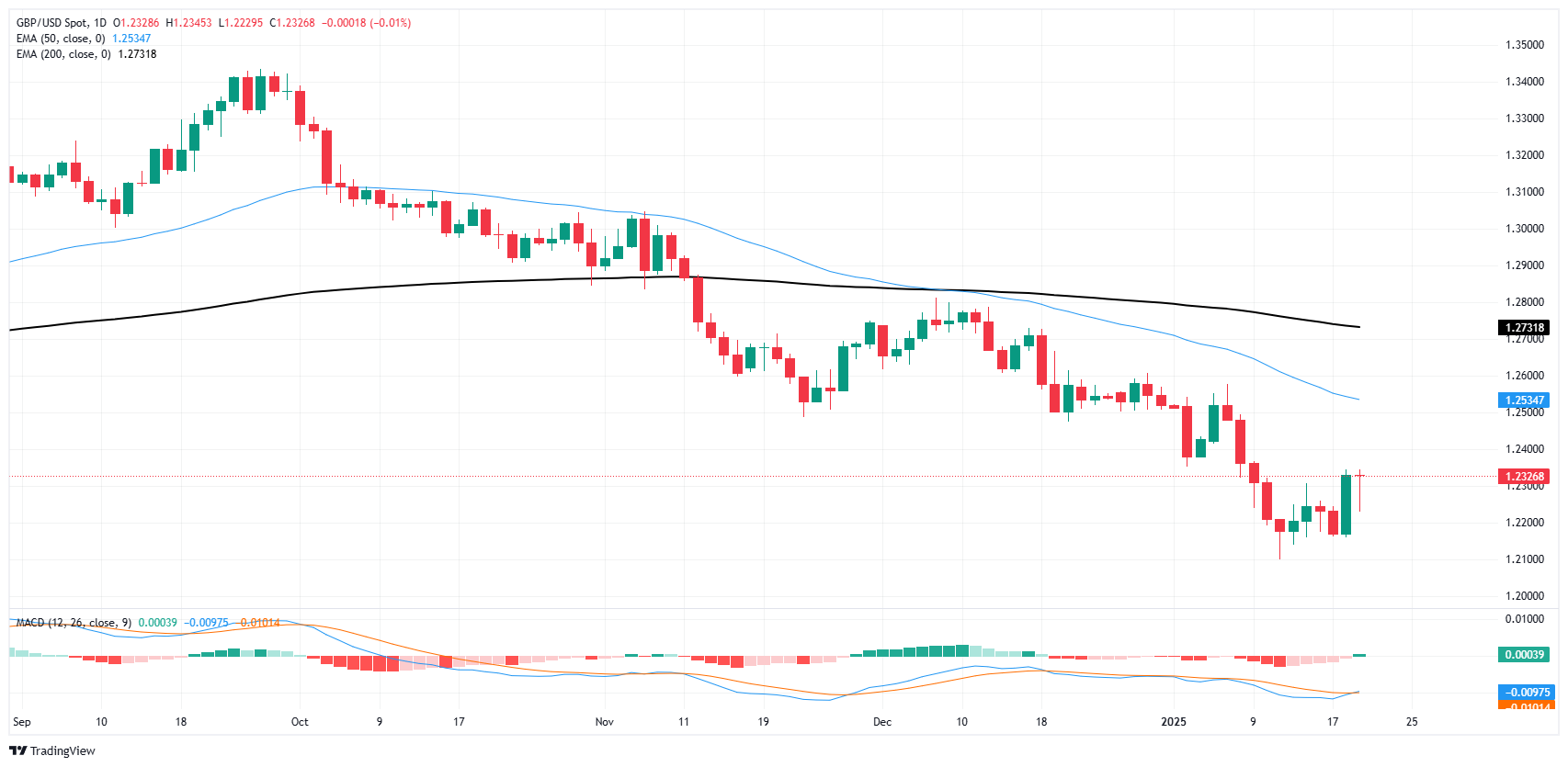
Pound Sterling FAQs
The Pound Sterling (GBP) is the oldest currency in the world (886 AD) and the official currency of the United Kingdom. It is the fourth most traded unit for foreign exchange (FX) in the world, accounting for 12% of all transactions, averaging $630 billion a day, according to 2022 data. Its key trading pairs are GBP/USD, also known as ‘Cable’, which accounts for 11% of FX, GBP/JPY, or the ‘Dragon’ as it is known by traders (3%), and EUR/GBP (2%). The Pound Sterling is issued by the Bank of England (BoE).
The single most important factor influencing the value of the Pound Sterling is monetary policy decided by the Bank of England. The BoE bases its decisions on whether it has achieved its primary goal of “price stability” – a steady inflation rate of around 2%. Its primary tool for achieving this is the adjustment of interest rates. When inflation is too high, the BoE will try to rein it in by raising interest rates, making it more expensive for people and businesses to access credit. This is generally positive for GBP, as higher interest rates make the UK a more attractive place for global investors to park their money. When inflation falls too low it is a sign economic growth is slowing. In this scenario, the BoE will consider lowering interest rates to cheapen credit so businesses will borrow more to invest in growth-generating projects.
Data releases gauge the health of the economy and can impact the value of the Pound Sterling. Indicators such as GDP, Manufacturing and Services PMIs, and employment can all influence the direction of the GBP. A strong economy is good for Sterling. Not only does it attract more foreign investment but it may encourage the BoE to put up interest rates, which will directly strengthen GBP. Otherwise, if economic data is weak, the Pound Sterling is likely to fall.
Another significant data release for the Pound Sterling is the Trade Balance. This indicator measures the difference between what a country earns from its exports and what it spends on imports over a given period. If a country produces highly sought-after exports, its currency will benefit purely from the extra demand created from foreign buyers seeking to purchase these goods. Therefore, a positive net Trade Balance strengthens a currency and vice versa for a negative balance.
Author

Joshua Gibson
FXStreet
Joshua joins the FXStreet team as an Economics and Finance double major from Vancouver Island University with twelve years' experience as an independent trader focusing on technical analysis.