GBP/USD holds steady near fresh highs as markets take a breather
- GBP/USD middled on Wednesday, stuck just south of 1.3000.
- UK data remains underwhelming this week as US data takes center stage.
- US CPI inflation eased in February, helping to cool inflation fears.

GBP/USD cycled near recent highs on Wednesday, building a base near the key 1.3000 handle as markets take a moment after US Consumer Price Index (CPI) inflation chilled even more than expected in February. Markets now await Thursday’s US Producer Price Index (PPI), with key consumer sentiment and consumer inflation expectations due on Friday.
The US imposed a global 25% tariff on all steel and aluminum imported into the US on Wednesday, kicking off the next critical stage of US President Donald Trump’s desire to get into a trade war with all of the US’s allies at once. A recent spat between the US and Canada came to a fizzling close this week after Donald Trump threatened to double metals tariffs on Canada just days before the US’s steel tariffs were slated to come online. After some back-and-forth posturing, both countries settled with the US imposing its “normal” 25% across-the-board tariffs on steel and aluminum, and Canada set to impose its own tariffs on a targeted amount of goods later this week.
In February, US Consumer Price Index (CPI) inflation decreased more sharply than expected, with headline CPI falling to 0.2% month-over-month and 2.8% year-over-year, dipping slightly quicker than market predictions. Although this reading is still above the Federal Reserve’s (Fed) 2% target, it has instilled some optimism that the Fed can adjust policy rates moving forward. Based on the CME’s FedWatch Tool, rate markets now suggest more than even chances of a Fed rate cut occurring in June, up from the previous expectation of July.
Nearly four years have passed since US headline inflation reached “transitory” levels, and aside from a brief slowdown in Q3 2024, key inflation metrics have largely remained consistent since June 2023, when the post-Covid inflation rate first eased to 3% on an annual basis.
Observers of commodities will note that despite the cooler CPI readings in February, there are underlying indicators that may pose challenges for policymakers soon: while gasoline and fuel oil prices generally dropped during this period—falling 3.1% and 5.1% respectively—natural gas prices surged by 6% overall. Additionally, inflation estimates for shelter prices rose by another 4.2% year-over-year, while a small decrease of 0.3% in new vehicle prices masked a rise in food price inflation, which increased by 2.6% compared to the same time last year.
GBP/USD price forecast
The GBP/USD pair is experiencing its second consecutive week of gains, approaching new 18-week highs close to 1.2950. The significant 1.3000 resistance level may limit any additional upward movement, as this key level was previously a notable consolidation point in October and November of 2024.
Currently, demand is strong among buyers, but technical indicators have remained in overbought territory since January, suggesting a potential reversal could happen soon.
GBP/USD daily chart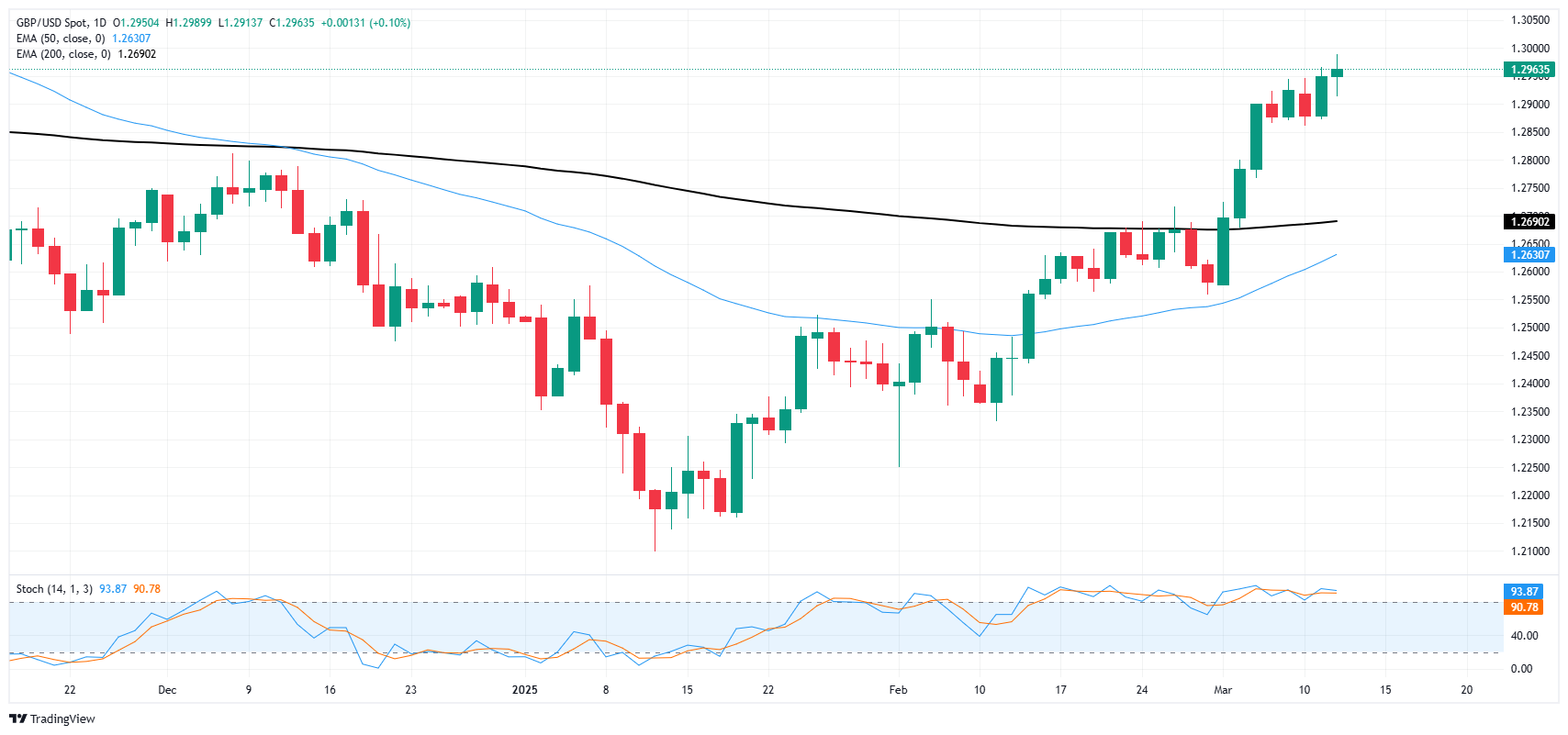
Pound Sterling FAQs
The Pound Sterling (GBP) is the oldest currency in the world (886 AD) and the official currency of the United Kingdom. It is the fourth most traded unit for foreign exchange (FX) in the world, accounting for 12% of all transactions, averaging $630 billion a day, according to 2022 data. Its key trading pairs are GBP/USD, also known as ‘Cable’, which accounts for 11% of FX, GBP/JPY, or the ‘Dragon’ as it is known by traders (3%), and EUR/GBP (2%). The Pound Sterling is issued by the Bank of England (BoE).
The single most important factor influencing the value of the Pound Sterling is monetary policy decided by the Bank of England. The BoE bases its decisions on whether it has achieved its primary goal of “price stability” – a steady inflation rate of around 2%. Its primary tool for achieving this is the adjustment of interest rates. When inflation is too high, the BoE will try to rein it in by raising interest rates, making it more expensive for people and businesses to access credit. This is generally positive for GBP, as higher interest rates make the UK a more attractive place for global investors to park their money. When inflation falls too low it is a sign economic growth is slowing. In this scenario, the BoE will consider lowering interest rates to cheapen credit so businesses will borrow more to invest in growth-generating projects.
Data releases gauge the health of the economy and can impact the value of the Pound Sterling. Indicators such as GDP, Manufacturing and Services PMIs, and employment can all influence the direction of the GBP. A strong economy is good for Sterling. Not only does it attract more foreign investment but it may encourage the BoE to put up interest rates, which will directly strengthen GBP. Otherwise, if economic data is weak, the Pound Sterling is likely to fall.
Another significant data release for the Pound Sterling is the Trade Balance. This indicator measures the difference between what a country earns from its exports and what it spends on imports over a given period. If a country produces highly sought-after exports, its currency will benefit purely from the extra demand created from foreign buyers seeking to purchase these goods. Therefore, a positive net Trade Balance strengthens a currency and vice versa for a negative balance.
Author

Joshua Gibson
FXStreet
Joshua joins the FXStreet team as an Economics and Finance double major from Vancouver Island University with twelve years' experience as an independent trader focusing on technical analysis.