GBP/USD hits 6-month high above 1.3200 as markets shun USD amid tariff turmoil
- Sterling rallies despite unchanged UK unemployment at 4.4% as strong wage growth complicates BoE’s easing path.
- The US Dollar Index drops over 5% in three weeks as safe-haven demand fades and tariff risks grow.
- UK inflation data and Powell’s speech are in focus; the UK remains exempt from US tariffs for now.

The Pound Sterling (GBP) rose and refreshed six-month highs against the US Dollar (USD) on Tuesday as the financial markets' narrative remains linked to the US imposing tariffs. Cable shrugged off soft United Kingdom (UK) jobs data; hence, GBP/USD rallied 0.36% and is trading at 1.3233.
GBP/USD climbs shrugging off soft UK jobs data as BoE rate cut bets build and USD continues to slide
Market mood remains positive, to the detriment of safe-haven currencies like the Greenback, which has depreciated over 5.34% during the last three weeks, according to the US Dollar Index (DXY).
The UK’s labor market data showed that the Unemployment Rate remained unchanged at 4.4% in February, as expected and aligned with analysts' estimates. Nevertheless, wages remained strong, exerting pressure on the Bank of England (BoE), which had refrained from easing policy, justifying that salaries remained high.
Despite this, market participants had primarily prized in a 90% chance that the BoE will cut rates at the May meeting, followed by another two cuts, via the interest rates futures market.
In the meantime, the UK has remained outside US President Donald Trump's scope to apply tariffs on British goods, which would exert pressure on the economy, opening the door for a slowdown.
Nevertheless, growing concerns about a global recession spurred by the trade war keep investors' sentiments deteriorating.
GBP/USD traders are looking for the release of the latest inflation figures in the UK. Across the pond, the US docket will feature Federal Reserve (Fed) speakers, with investors focused on Fed Chair Jerome Powell's speech on Wednesday.
GBP/USD Price Forecast: Technical outlook
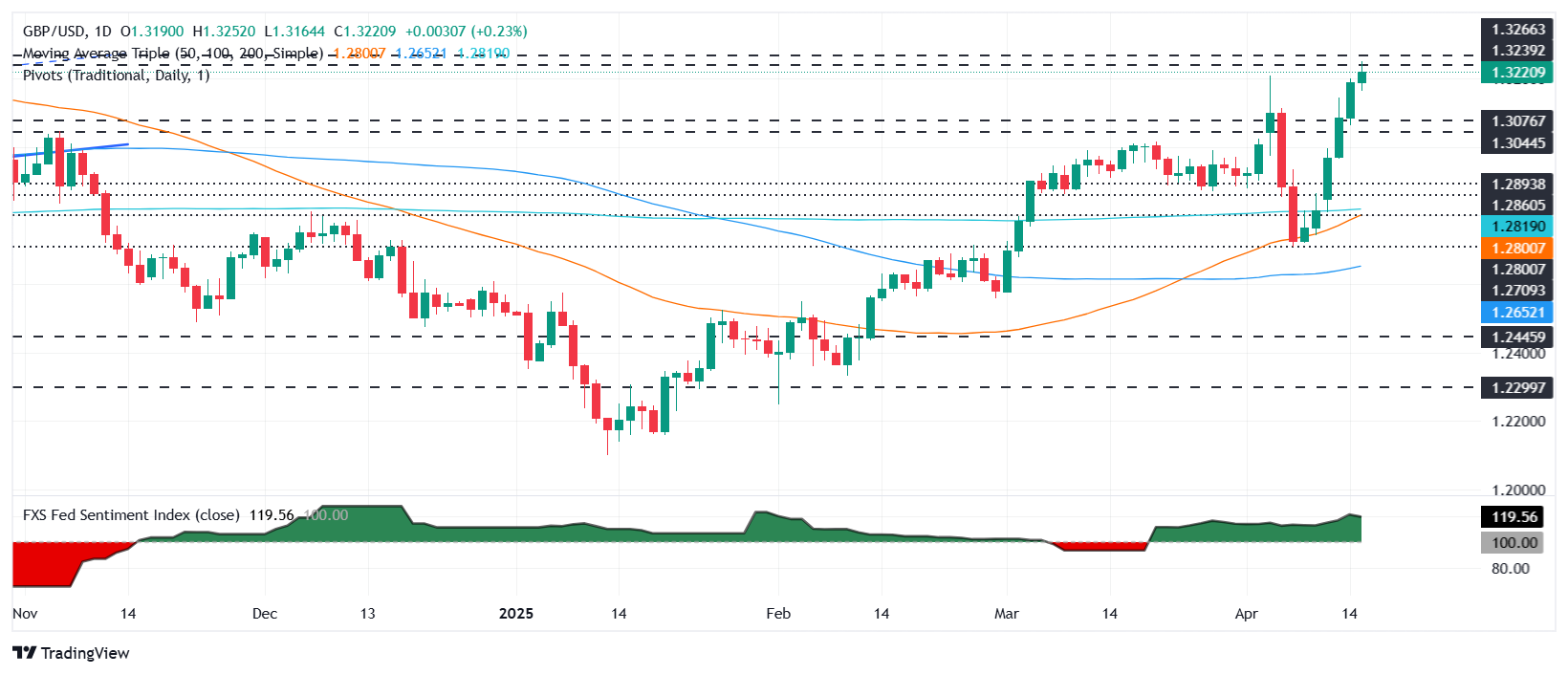
After climbing for six straight days, the GBP/USD pair has hit a year-to-date (YTD) high of 1.3251, but traders have retreated somewhat to the 1.3220 area. A daily close above the YTD high will expose the 1.3300 mark. On the flip side, the first support would be the April 14 high of 1.3200, followed by the same day low of 1.3163.
British Pound PRICE Today
The table below shows the percentage change of British Pound (GBP) against listed major currencies today. British Pound was the strongest against the Swiss Franc.
| USD | EUR | GBP | JPY | CAD | AUD | NZD | CHF | |
|---|---|---|---|---|---|---|---|---|
| USD | 0.55% | -0.25% | 0.10% | 0.58% | -0.52% | -0.62% | 0.76% | |
| EUR | -0.55% | -0.79% | -0.42% | 0.04% | -1.00% | -1.16% | 0.23% | |
| GBP | 0.25% | 0.79% | 0.38% | 0.83% | -0.20% | -0.37% | 1.02% | |
| JPY | -0.10% | 0.42% | -0.38% | 0.47% | -0.59% | -0.87% | 0.64% | |
| CAD | -0.58% | -0.04% | -0.83% | -0.47% | -1.05% | -1.20% | 0.19% | |
| AUD | 0.52% | 1.00% | 0.20% | 0.59% | 1.05% | -0.17% | 1.23% | |
| NZD | 0.62% | 1.16% | 0.37% | 0.87% | 1.20% | 0.17% | 1.40% | |
| CHF | -0.76% | -0.23% | -1.02% | -0.64% | -0.19% | -1.23% | -1.40% |
The heat map shows percentage changes of major currencies against each other. The base currency is picked from the left column, while the quote currency is picked from the top row. For example, if you pick the British Pound from the left column and move along the horizontal line to the US Dollar, the percentage change displayed in the box will represent GBP (base)/USD (quote).
Author

Christian Borjon Valencia
FXStreet
Markets analyst, news editor, and trading instructor with over 14 years of experience across FX, commodities, US equity indices, and global macro markets.