GBP/USD trades steady after initial UK election results deliver few surprises
- GBP/USD claws back towards 1.2800, extends into a thin but determined recovery.
- Political risk weighed on Cable, crimping volatility but remained subdued after no surprises.
- US markets are dark for the Independence Day holiday, and volumes remain thin.

GBP/USD is fighting back into the high end as the Greenback broadly recedes on Thursday. Market volumes are drawn tight with US exchanges shuttered in observation of the US Independence Day holiday, and Cable traders found little reason to head for the hills after UK Parliamentary Election results came in broadly as-expected.
The UK’s Labour Party isexpected to sweep to a massive victory on Thursday, upending 14 consecutive years of Conservative Party leadership. According to advance polling released just before election day, the British populace is forecast to reject current Prime Minister Rishi Sunak’s Tories roundly. US Nonfarm Payrolls (NFP) jobs data is also slated for release on Friday, promising a heady end to the trading week.
Daily digest market movers: Darkened US markets leave UK elections front and center
- UK Parliamentary Election is widely expected to unseat the long-running Conservative Party and incumbent Prime Minister Rishi Sunak in favor of the Labour Party’s Keir Starmer.
- Advance polling suggested Labour is going on a strong sweep this election, projected to win around four hundred seats out of the UK’s 650 available seats.
- PM Rishi Sunak marks the fourth straight Tory leader in just eight years.
- UK Exit polling revealed projected Labour victory, Keir Starmer expected to win the Prime Minister's seat and form next UK government.
- US NFP net job gains are forecast to ease to 190K in June, down from the previous 272K.
- US Average Hourly Earnings are also expected to moderate further, forecast to tick down to 0.3% MoM in June, down from the previous 0.4%.
British Pound PRICE Today
The table below shows the percentage change of British Pound (GBP) against listed major currencies today. British Pound was the strongest against the US Dollar.
| USD | EUR | GBP | JPY | CAD | AUD | NZD | CHF | |
|---|---|---|---|---|---|---|---|---|
| USD | -0.22% | -0.14% | -0.32% | -0.20% | -0.32% | -0.24% | -0.20% | |
| EUR | 0.22% | 0.08% | -0.10% | 0.02% | -0.06% | -0.05% | 0.07% | |
| GBP | 0.14% | -0.08% | -0.21% | -0.07% | -0.17% | -0.13% | -0.04% | |
| JPY | 0.32% | 0.10% | 0.21% | 0.12% | -0.01% | 0.06% | 0.14% | |
| CAD | 0.20% | -0.02% | 0.07% | -0.12% | -0.11% | -0.05% | 0.02% | |
| AUD | 0.32% | 0.06% | 0.17% | 0.00% | 0.11% | 0.07% | 0.14% | |
| NZD | 0.24% | 0.05% | 0.13% | -0.06% | 0.05% | -0.07% | 0.07% | |
| CHF | 0.20% | -0.07% | 0.04% | -0.14% | -0.02% | -0.14% | -0.07% |
The heat map shows percentage changes of major currencies against each other. The base currency is picked from the left column, while the quote currency is picked from the top row. For example, if you pick the British Pound from the left column and move along the horizontal line to the US Dollar, the percentage change displayed in the box will represent GBP (base)/USD (quote).
Technical analysis: GBP/USD tests higher, clawing back ground amid thin recovery
GBP/USD is extending into a thin but determined recovery on Thursday, stretching into a third day of gains after arresting near-term declines just north of the 200-day Exponential Moving Average (EMA) at 1.2610.
Cable has drifted into the low end after seeing a technical rejection from a supply zone priced in above 1.2800, but unmotivated bears have failed to spark a meaningful decline into the last major swing low into the 1.2300 handle.
GBP/USD hourly chart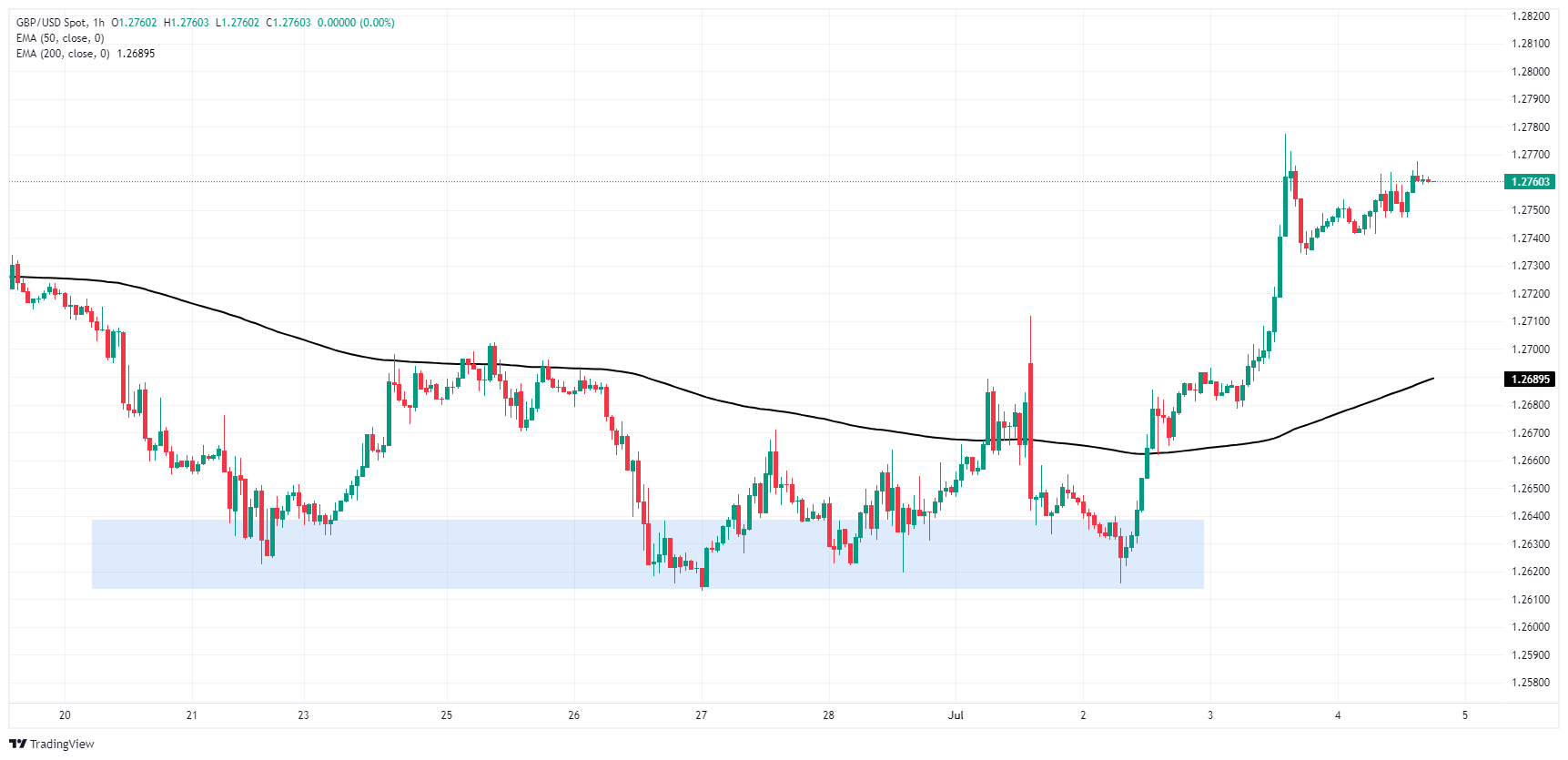
GBP/USD daily chart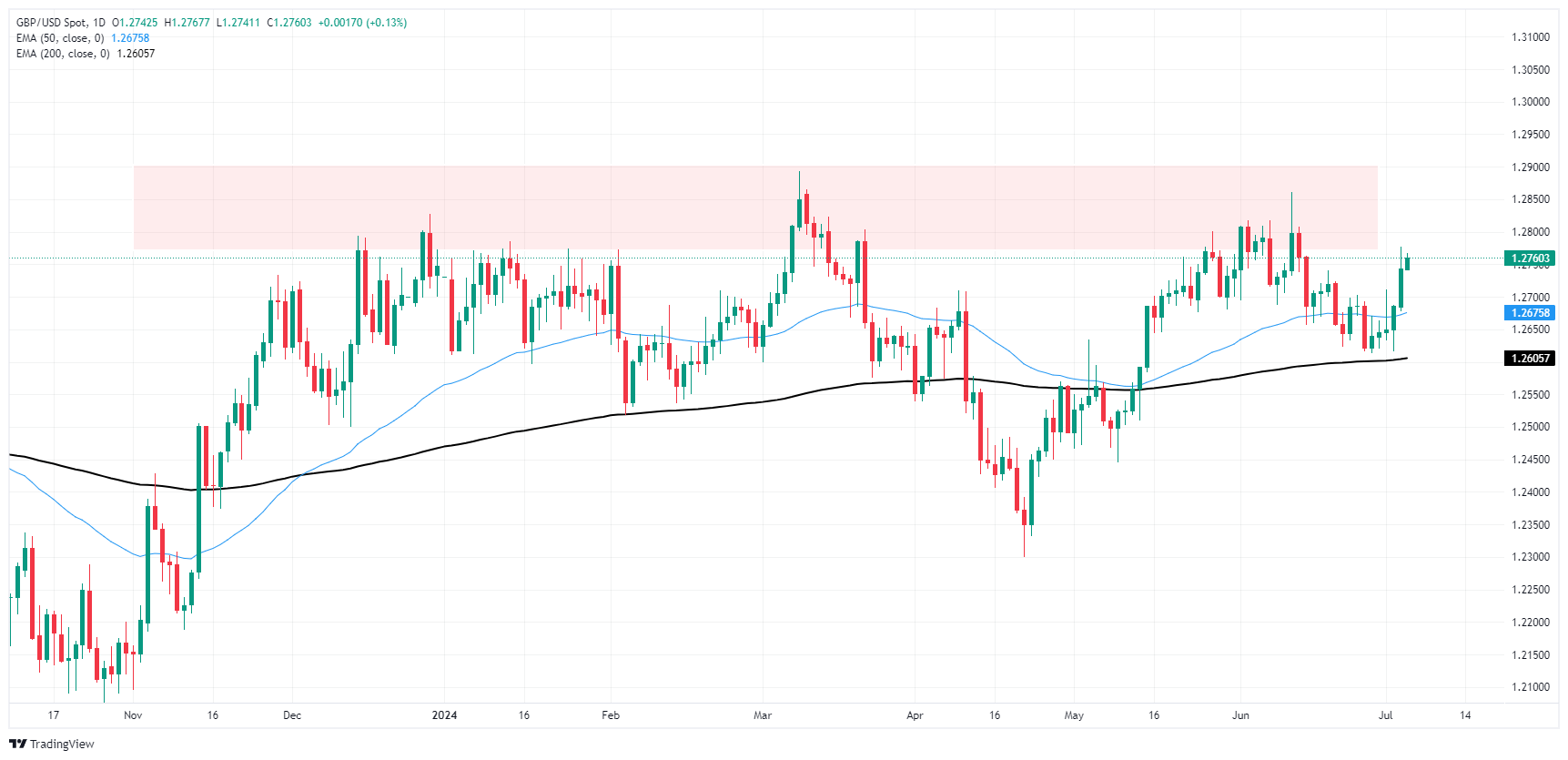
Pound Sterling FAQs
The Pound Sterling (GBP) is the oldest currency in the world (886 AD) and the official currency of the United Kingdom. It is the fourth most traded unit for foreign exchange (FX) in the world, accounting for 12% of all transactions, averaging $630 billion a day, according to 2022 data. Its key trading pairs are GBP/USD, aka ‘Cable’, which accounts for 11% of FX, GBP/JPY, or the ‘Dragon’ as it is known by traders (3%), and EUR/GBP (2%). The Pound Sterling is issued by the Bank of England (BoE).
The single most important factor influencing the value of the Pound Sterling is monetary policy decided by the Bank of England. The BoE bases its decisions on whether it has achieved its primary goal of “price stability” – a steady inflation rate of around 2%. Its primary tool for achieving this is the adjustment of interest rates. When inflation is too high, the BoE will try to rein it in by raising interest rates, making it more expensive for people and businesses to access credit. This is generally positive for GBP, as higher interest rates make the UK a more attractive place for global investors to park their money. When inflation falls too low it is a sign economic growth is slowing. In this scenario, the BoE will consider lowering interest rates to cheapen credit so businesses will borrow more to invest in growth-generating projects.
Data releases gauge the health of the economy and can impact the value of the Pound Sterling. Indicators such as GDP, Manufacturing and Services PMIs, and employment can all influence the direction of the GBP. A strong economy is good for Sterling. Not only does it attract more foreign investment but it may encourage the BoE to put up interest rates, which will directly strengthen GBP. Otherwise, if economic data is weak, the Pound Sterling is likely to fall.
Another significant data release for the Pound Sterling is the Trade Balance. This indicator measures the difference between what a country earns from its exports and what it spends on imports over a given period. If a country produces highly sought-after exports, its currency will benefit purely from the extra demand created from foreign buyers seeking to purchase these goods. Therefore, a positive net Trade Balance strengthens a currency and vice versa for a negative balance.
Author

Joshua Gibson
FXStreet
Joshua joins the FXStreet team as an Economics and Finance double major from Vancouver Island University with twelve years' experience as an independent trader focusing on technical analysis.

















