GBP/USD drops to weekly low ahead of the UK services PMI
- The GBP/USD extends previous declines by being under 1.3030 on early Tuesday.
- The UK services PMI will be in focus for the Pound traders.
- The 1.3000 round-figure seems immediate Cable support while 1.3100 may act as nearby resistance.

The GBP traded a shade weaker than the US Dollar around 1.3030 in Tuesday's Asian trading. Overall improvement in the risk appetite helped the greenback extend its previous upmove while the Pound traders remained cautious before the January month UK services purchasing manager index (PMI) release.
The Cable gained in early Monday trading after the Sun reported that the EU goods to Britain will have fewer customs check in case of “no-deal” Brexit. The news was later confirmed by the British government and marked lesser hardships in case of a chaotic exit.
However, the Pound failed to hold its strength after December month UK construction PMI dropped to the lowest level of 50.6 since March compared to 52.6 market consensus. The weakness then stretched the pair towards the day’s low of 1.3028 as US open praised the greenback on weekend updates favoring brighter chances of the US & China trade deal, not to forget Friday’s robust nonfarm payrolls (NFP).
Looking forward, the headline UK services PMI for January month will be on traders’ radar for now. The key indicator of service-oriented growth may soften to 51.0 versus 51.2 registered during December last year.
While recent statistics from the UK haven’t been so upbeat and Brexit progress is minimal, the GBP/USD may remain under pressure if the UK services PMI join the league of weak data.
GBP/USD: Technical Analysis
Daily chart
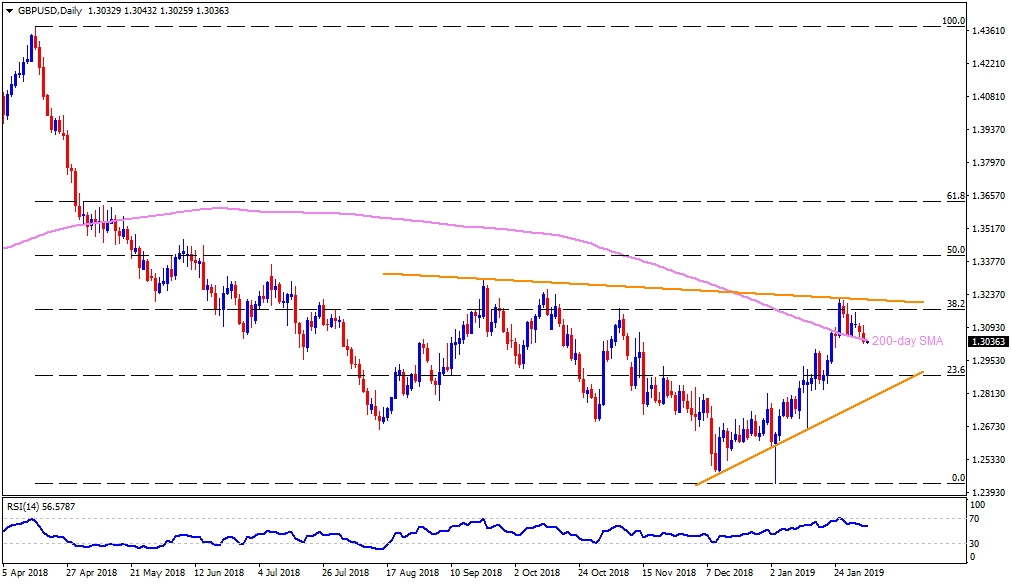
A daily closing under 200-day simple moving average (SMA) refrained to help the GBP/USD extend its recent pullback as investors await headline British services PMI. The pair has 1.3000 as immediate downside support in case of another data driven disappointment. However, the 1.2930 and the 23.6% Fibonacci retracement of its April 2018 to January 2019 downturn, near 1.2890, may limit the pair’s further declines.
Should the prices continue trading southwards past-1.2890, the 1.2810 and an upward sloping trend line at 1.2780 might confine the pair’s downside.
Alternatively, the 1.3100 and the 38.2% Fibonacci retracement level of 1.3170 can limit the pair’s immediate advances before highlighting the 1.3215 trendline resistance.
Moreover, pair’s successful trading beyond 1.3215 opens the door for its rally to 1.3300.
Author

Anil Panchal
FXStreet
Anil Panchal has nearly 15 years of experience in tracking financial markets. With a keen interest in macroeconomics, Anil aptly tracks global news/updates and stays well-informed about the global financial moves and their implications.