GBP/USD climbs as US Dollar weakens due to falling yields
- Trump reiterates tariffs on Canada and Mexico, fueling trade concerns.
- UK retailers slash investment as consumer spending weakens.
- Markets expect BoE to hold rates at 4.50% in March, cut by Q2.

The Pound Sterling (GBP) advanced early in the North American session, bouncing off a two-day low of 1.2605, as the Greenback weakened due to falling US Treasury yields. The GBP/USD pair trades at 1.2669, gaining 0.37%.
Sterling bounces off 1.2605, gaining 0.37% amid sour market mood
The market mood shifted sour amid US President Donald Trump's threats of tariffs. On Monday, he reiterated that duties on Canadian and Mexican products would be enacted as planned. In the meantime, weaker-than-expected data from the United States (US) has begun to take its toll on the US Dollar (USD) and is also sending US Treasury bond yields plunging. The US 10-year Treasury note plummets 10 basis points (bps) to 4.30% at the time of writing.
Data in the US revealed the S&P/Case-Shiller Home Prices for December rose by 4.5% YoY, up from November 4.3%. Ahead in the day, Fed Governor Michael Barr and Richmond Fed President Thomas Barkin would cross the wires.
In the United Kingdom (UK), the Confederation of British Industry (CBI) revealed that British retailers plan to cut investment by the most in more than five years due to weak consumer spending and elevated prices.
Recently, a Reuters poll revealed that 65 economists estimate the Bank of England (BoE) would keep rates unchanged at 4.50% in March and expect a cut to 4.25% in Q2.
A day ago, Swati Dhingra, a BoE external member, said that the policy would still be restrictive even if the bank cut rates by 0.25% quarterly. Meanwhile, traders await BoE chief economist Huw Pill, who sits in the hawkish aisle of the BoE.
Ahead of the day, traders will watch the Conference Board (CB) 's announcement of US Consumer Confidence.
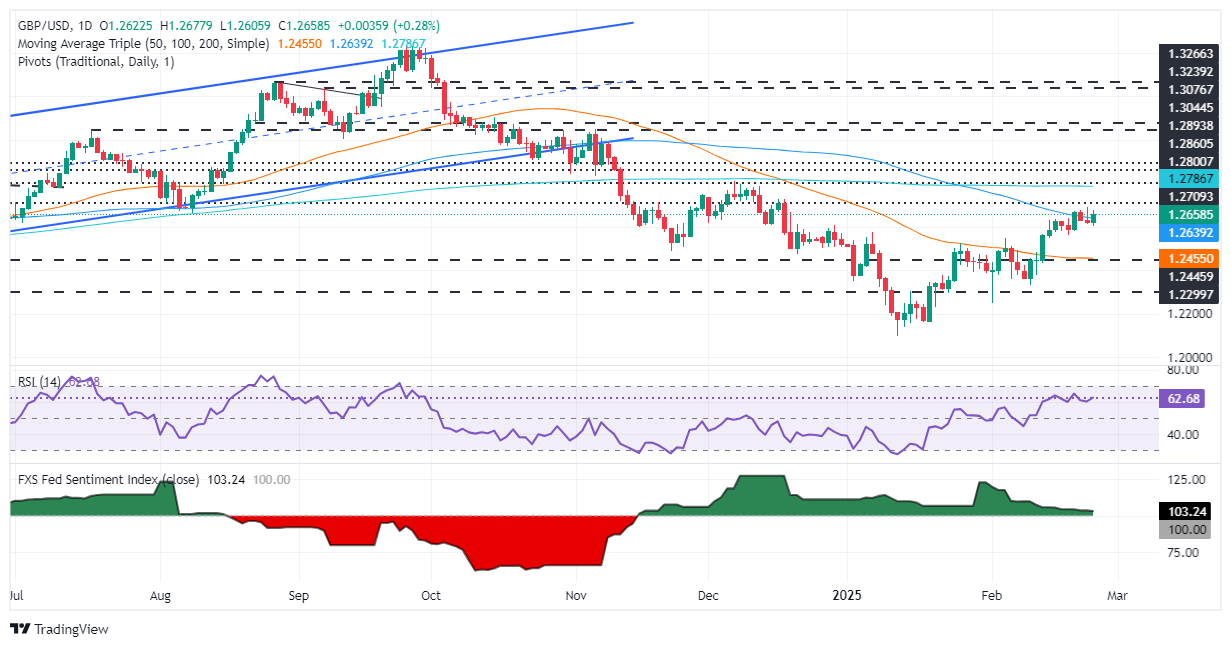
GBP/USD Price Forecast: Technical outlook
GBP/USD is neutral to upward biased, exchanging hands above the 100-day Simple Moving Average (SMA) at 1.2648. A daily close above the latter could open the door to clear 1.2700, followed by the 200-day SMA at 1.2786. On the other hand, if GBP/USD struggles at 100-day SMA and drops below 1.2600, sellers could drive prices toward the February 5 peak turned support at 1.2549.
British Pound PRICE Today
The table below shows the percentage change of British Pound (GBP) against listed major currencies today. British Pound was the strongest against the New Zealand Dollar.
| USD | EUR | GBP | JPY | CAD | AUD | NZD | CHF | |
|---|---|---|---|---|---|---|---|---|
| USD | -0.36% | -0.30% | -0.49% | 0.06% | 0.19% | 0.21% | -0.43% | |
| EUR | 0.36% | 0.06% | -0.11% | 0.42% | 0.56% | 0.57% | -0.07% | |
| GBP | 0.30% | -0.06% | -0.19% | 0.36% | 0.49% | 0.51% | -0.14% | |
| JPY | 0.49% | 0.11% | 0.19% | 0.54% | 0.68% | 0.68% | 0.05% | |
| CAD | -0.06% | -0.42% | -0.36% | -0.54% | 0.14% | 0.15% | -0.49% | |
| AUD | -0.19% | -0.56% | -0.49% | -0.68% | -0.14% | 0.01% | -0.62% | |
| NZD | -0.21% | -0.57% | -0.51% | -0.68% | -0.15% | -0.01% | -0.64% | |
| CHF | 0.43% | 0.07% | 0.14% | -0.05% | 0.49% | 0.62% | 0.64% |
The heat map shows percentage changes of major currencies against each other. The base currency is picked from the left column, while the quote currency is picked from the top row. For example, if you pick the British Pound from the left column and move along the horizontal line to the US Dollar, the percentage change displayed in the box will represent GBP (base)/USD (quote).
Author

Christian Borjon Valencia
FXStreet
Markets analyst, news editor, and trading instructor with over 14 years of experience across FX, commodities, US equity indices, and global macro markets.