GBP/USD bulls move in on a critical area on the charts ahead of the key Consumer Price Index
- United Kingdom's Unemployment Rate data gave rise to a rally in the British Pound with Bank of England in focus.
- GBP/USD is in the hands of the bulls on the front side of an hourly trendline ahead of key Consumer Price Index inflation data Wednesday.
- GBP/USD bears eye a break of the solid trendline support and 1.2170 structure that could then result in a cascade of stops being triggered.

GBP/USD is higher by 0.6% at the time of writing, 14.00hrs New york time. The British Pound moved from a low of 1.2168 to a high of 1.2300 on Tuesday after Britain's Unemployment Rate data showed a tight labour market and accelerating pay growth. The Bank of England, BoE, is in focus in this regard as it battles with inflation at multi-decade highs.
Britain's Unemployment Rate held at 3.7%, close to its lowest level in almost 50 years. This was in line with the consensus and signalled a continued tight labour market. Pay excluding bonuses increased by an annual 6.4% in the September-to-November period, the Office for National Statistics (ONS) said. This was the largest increase since records began in 2001. For ex-bonus wage growth, this is the strongest number outside the COVID distortions. ''Overall, today's strong data should see lower odds of a 25bps hike from the Bank of England, BoE, at its February meeting, and further support our call for a 50bps hike instead,'' analysts at TD Securities said.
UK Consumer Price Index will be key for Bank of England sentiment
The British Pound is the best performing G10 currency on a 1-day view following the data due to the implication that this may mean higher for longer Bank of England, BoE, interest rates. Additionally, the strength of today’s UK earnings data could with hawkish comments by the BoE's Governor Andrew Bailey mean that tomorrow's UK December Consumer Price Index inflation data will be the highlight of the week in the forex space.
The Bank of England Governor Andrew Bailey said on Monday that inflation looks set to fall markedly this year as energy prices decrease. However, he said that a shortage of workers in the labour market poses a "major risk" to this scenario.
"I think that going forwards the major risk to inflation coming down ... is the supply side - and in this country particularly, the question of the shrinkage of the labour force," Bailey told lawmakers on parliament's Treasury Committee.
The ONS's inflation data on Wednesday is expected to be the next major trigger for the pound ahead of the BoE's meeting next month. The consumer price index is expected to have eased to 10.5% on an annual basis last month from 10.7% in November, according to a survey of economists polled by Reuters.
''We look for UK (Consumer Price Index) inflation to continue to soften, with the headline falling to 10.5% YoY (market: 10.5%, Bank of England: 10.9%) and core coming down to a five-month low of 6.2% YoY (market: 6.2%, Bank of England implied forecast of 6.3%),'' analysts at TD Securities said.
''Driving our forecast is primarily a near-5% MoM drop in petrol prices, however, we also look for a notable softness in the core goods component as retailers pushed through significant discounts in an attempt to rid themselves of high inventory levels ahead of Christmas,'' the analysts added.
''While our headline inflation forecast is quite significantly below the Bank of England's, a sizeable chunk of that difference comes from lower petrol prices, which the Bank will look through. Therefore, we think that data in line with our forecasts still supports another 50bps hike in February,'' the analysts at TD Securities concluded.
All eyes on the Bank of England
Meanwhile, looking ahead to next month's meeting, a tenth consecutive hike is expected and the money markets are pricing in a 65% chance of a 50 basis point (bps) hike and a 35% chance of a 25 bps increase.
''Even if the BoE has good reason to step up a hawkish tone, there were various instances last year when this failed to boost GBP, given the backdrop of weak investment growth, low productivity and overhanging uncertainties about the UK’s post-Brexit relationship with the EU,'' analysts at Rabobank said. Money markets are fully pricing in a 25 basis points (bps) rate hike at that meeting, with a roughly 75% chance of a larger 50 bps increase, according to Refinitiv data.
GBP/USD technical analysis
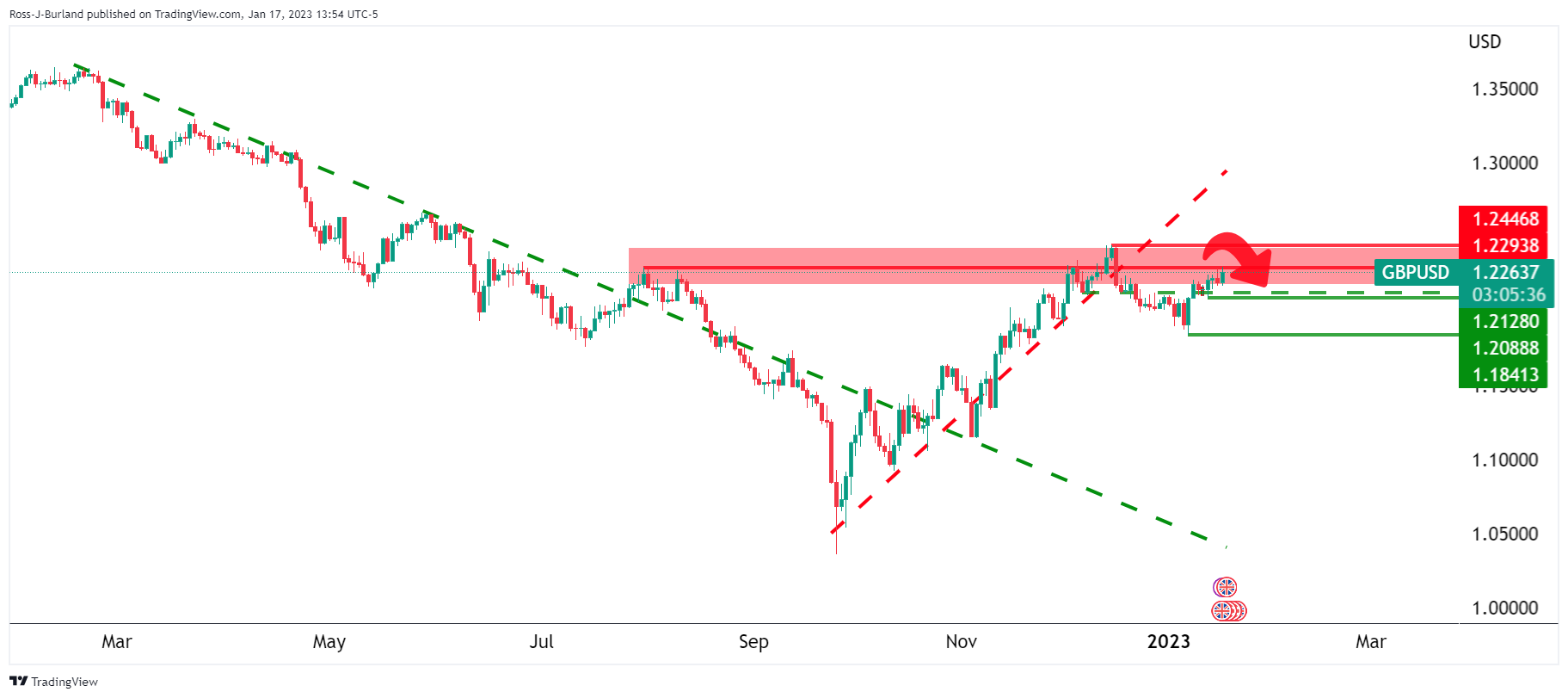
GBP/USD is on the backside of both the bearish trend and the bullish corrective trend making for a mixed outlook longer term, but potentially bearish for the nearer term.
The British Pound bulls are moving in following a break of the 1.2128 structure from swing lows of 1.1841. However, the bulls will need to get GBP/USD over the 1.2294 resistance and then 1.2446 swing highs if they are going to leave any significant spanner in the works for in-the-money shorts. Instead, this could be a typical distribution schematic playing out offering the bears a discount, resulting in a fade on rallies play for the days ahead:
GBP/USD H1 chart
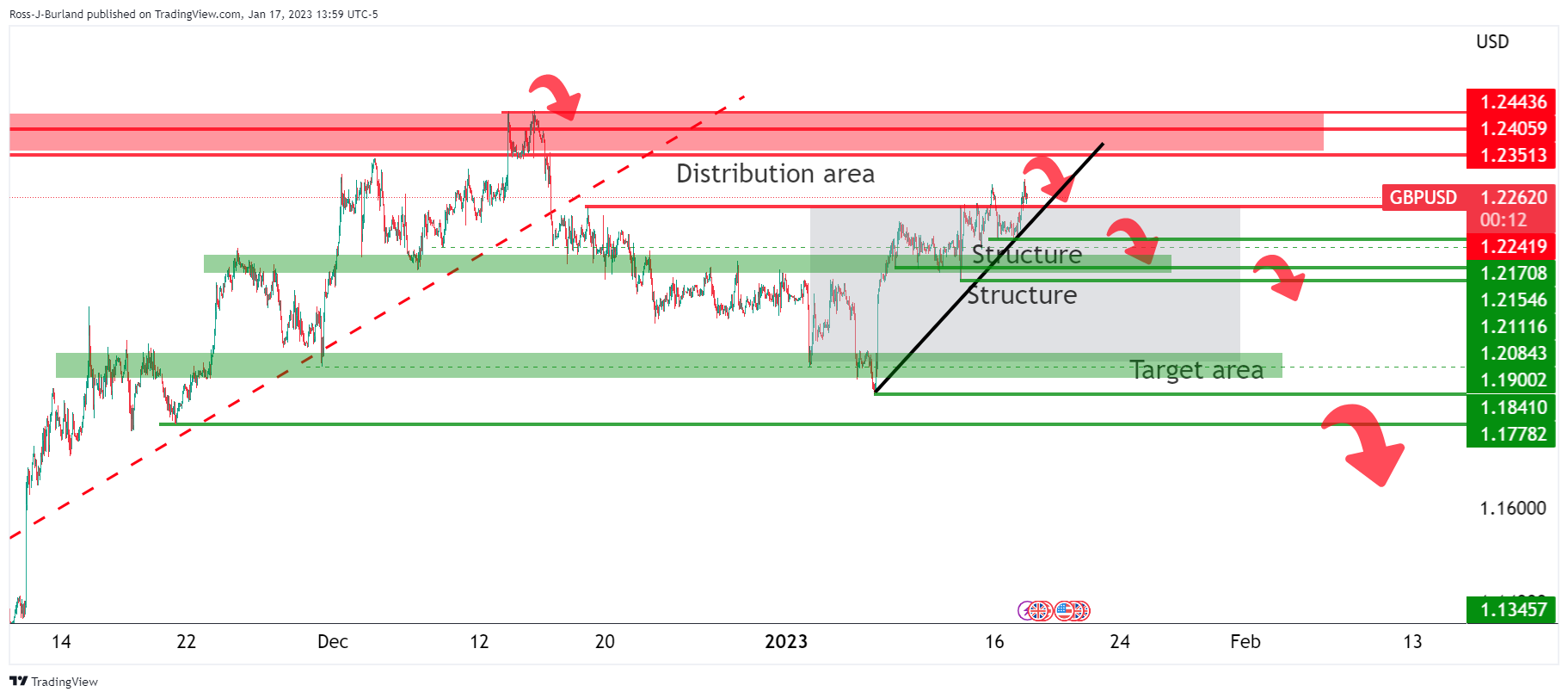
On the hourly chart, GBP/USD bears need to break the solid trendline support and 1.2170 structure that could then result in a cascade of stops being triggered in a waterfall sell-off below 1.2080 to test 1.1900 and below target areas.
Author

Ross J Burland
FXStreet
Ross J Burland, born in England, UK, is a sportsman at heart. He played Rugby and Judo for his county, Kent and the South East of England Rugby team.

















