GBP/USD bounces from key levels as US Dollar falters on geopolitics
- GBP/USD gave a strong bounce on Monday, rebounding from the 1.3350 region.
- Broad market flows sharply sold off the US Dollar to open the new trading week.
- The Trump administration is chasing a hardline policy on forcibly declaring themselves the owners of foreign countries.

GBP/USD caught a much-needed bullish bounce on Monday, driven higher by a broad-market decline in the US Dollar (USD) rather than any particular strength behind the Pound Sterling (GBP). US President Donald Trump has informed the world that he wants to own Greenland, a proposal that has met stiff opposition from the European Union, including the Kingdom of Denmark, of which Greenland is an autonomous territory, and Greenland itself.
Donald Trump has escalated rhetoric about the US “owning” Greenland, hinting at a more aggressive stance that he partially attributes to being snubbed for the Nobel Peace Prize, despite being reminded by Norway’s prime minister that the prize is awarded by an independent committee. He has also threatened to impose a 10% tariff on US exports to European countries starting February 1, rising to 25% by summer, unless the European Union cedes an entire nation to the United States. European leaders swiftly responded with reciprocal tariff threats, which are expected to further strain already pressured American industries.
Trade war headlines to mix with a full data schedule
Cable traders are heading into a hectic midweek. Over and above the ongoing trade war headlines, the UK opens up Tuesday with the latest Claimant Count Change and Employment Change figures from December and November, respectively. Wednesday will follow up with the latest UK Consumer Price Index (CPI) inflation figures from December, and UK Purchasing Manager Index (PMI) survey results will trail along on Friday.
On the US side, traders will see the latest ADP Employment Change 4-week average numbers on Tuesday, followed by a scheduled speech from President Trump on Wednesday. A hot update to US Personal Consumption Expenditure Price Index (PCE) inflation is slated for Thursday. Friday will wrap up the trading week with a fresh round of S&P Global US PMI survey results for January.
GBP/USD price forecast
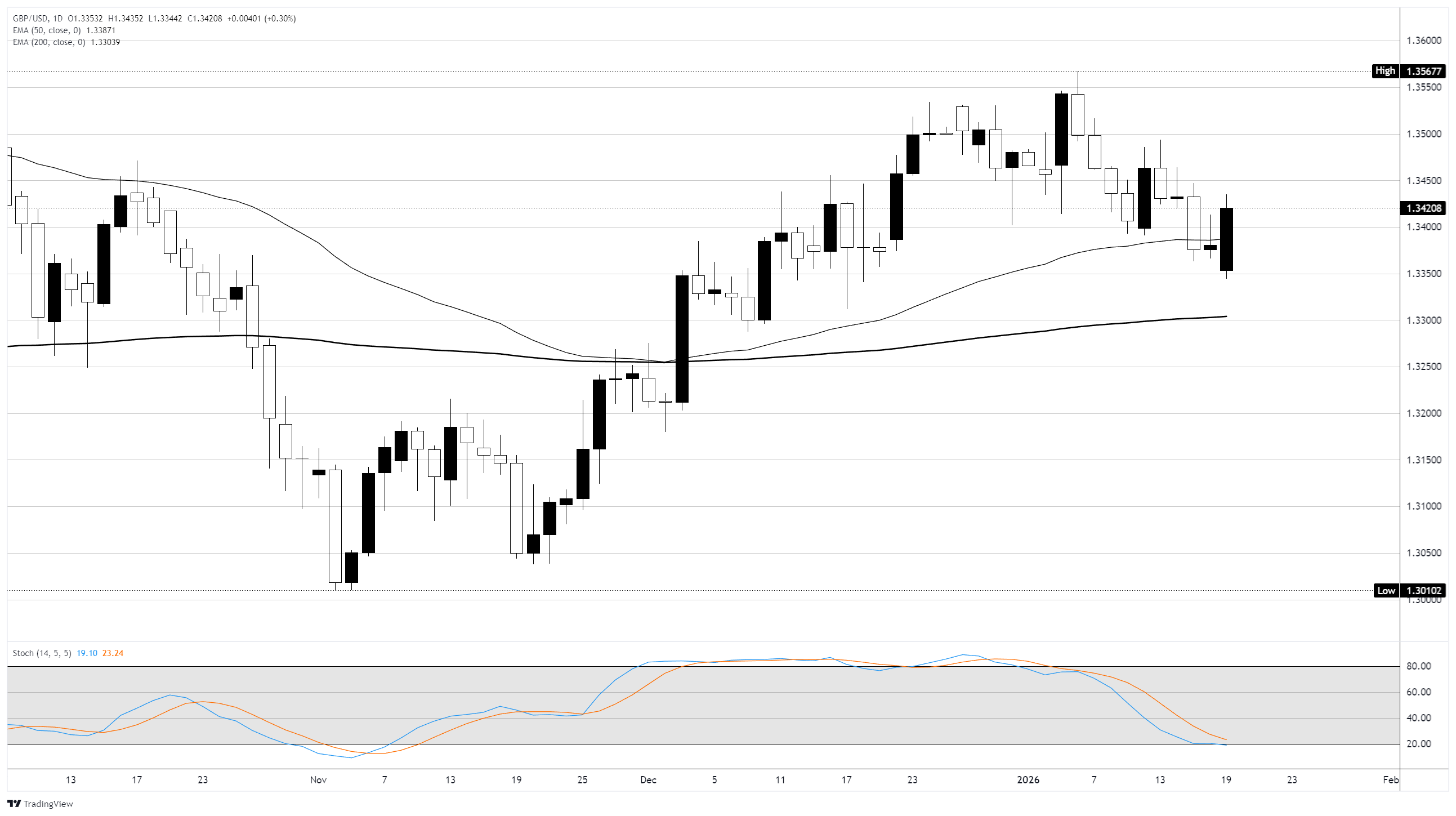
Monday’s early-week bullish bounce has given GBP/USD a fresh foothold on the high side of the 50-day Exponential Moving Average (EMA) just below 1.3400, but overall price action is still leaning into the bearish side. Cable has been on a slow grind lower since flubbing the 1.3550 level in early January, and the Stochastic Oscillator is still showing some room to run lower despite knocking on the oversold barrier.
GBP/USD daily chart
Pound Sterling FAQs
The Pound Sterling (GBP) is the oldest currency in the world (886 AD) and the official currency of the United Kingdom. It is the fourth most traded unit for foreign exchange (FX) in the world, accounting for 12% of all transactions, averaging $630 billion a day, according to 2022 data. Its key trading pairs are GBP/USD, also known as ‘Cable’, which accounts for 11% of FX, GBP/JPY, or the ‘Dragon’ as it is known by traders (3%), and EUR/GBP (2%). The Pound Sterling is issued by the Bank of England (BoE).
The single most important factor influencing the value of the Pound Sterling is monetary policy decided by the Bank of England. The BoE bases its decisions on whether it has achieved its primary goal of “price stability” – a steady inflation rate of around 2%. Its primary tool for achieving this is the adjustment of interest rates. When inflation is too high, the BoE will try to rein it in by raising interest rates, making it more expensive for people and businesses to access credit. This is generally positive for GBP, as higher interest rates make the UK a more attractive place for global investors to park their money. When inflation falls too low it is a sign economic growth is slowing. In this scenario, the BoE will consider lowering interest rates to cheapen credit so businesses will borrow more to invest in growth-generating projects.
Data releases gauge the health of the economy and can impact the value of the Pound Sterling. Indicators such as GDP, Manufacturing and Services PMIs, and employment can all influence the direction of the GBP. A strong economy is good for Sterling. Not only does it attract more foreign investment but it may encourage the BoE to put up interest rates, which will directly strengthen GBP. Otherwise, if economic data is weak, the Pound Sterling is likely to fall.
Another significant data release for the Pound Sterling is the Trade Balance. This indicator measures the difference between what a country earns from its exports and what it spends on imports over a given period. If a country produces highly sought-after exports, its currency will benefit purely from the extra demand created from foreign buyers seeking to purchase these goods. Therefore, a positive net Trade Balance strengthens a currency and vice versa for a negative balance.
Author

Joshua Gibson
FXStreet
Joshua joins the FXStreet team as an Economics and Finance double major from Vancouver Island University with twelve years' experience as an independent trader focusing on technical analysis.