|

GBP/JPY Price Analysis: Pound looks vulnerable below 181.00

  • The Sterling is under increasing bearish pressure aiming to levels sub-180.
  • Trading volume is light in the last session of the year.
  • Below 180.00 the target will be October and November lows at the 178.10/30 area.

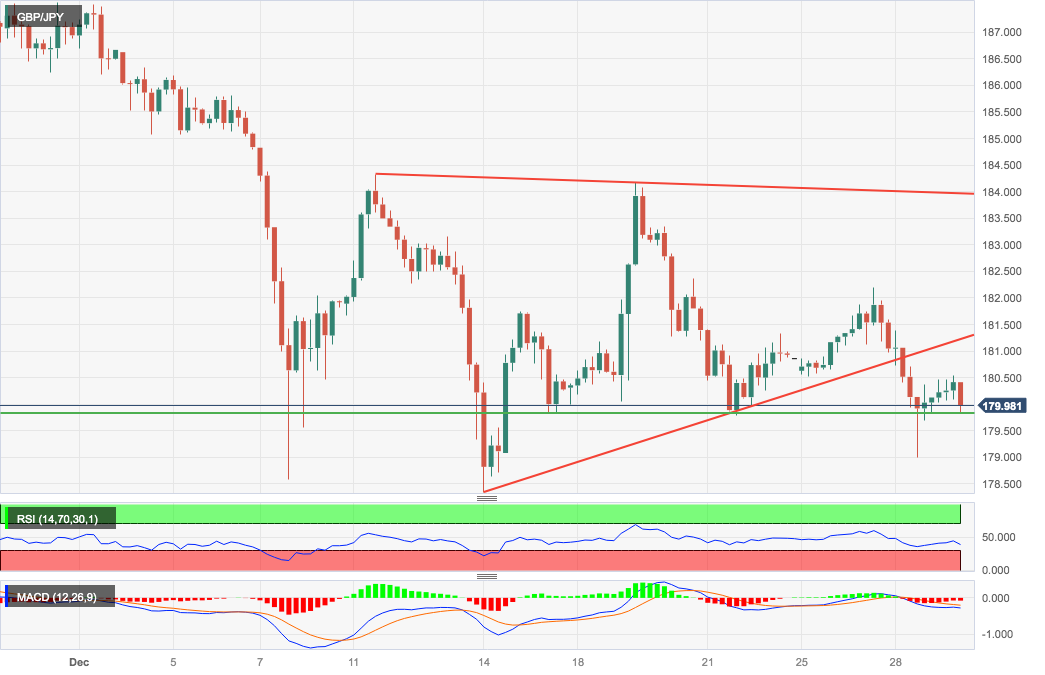
The Sterling trades under increasing bearish pressure after breaking below the base of a triangle pattern, at 180.80. The frail upside attempt seen on early Friday Trading has remained limited at the mid-range of 180.00, and the pair is testing support at the 179.85 level at the moment of writing.

Trading volume is very light on the last working day of the year, leading to choppy movement in most of the major pairs.

Technical indicators point lower, with the RSI well below the 50 level. Bears would need to confirm below the mentioned 179.45 which would expose the mid-December low, at 178.30, and the October 3 low, at 178.10.

On the upside, a bullish reaction above the reverse trendline, now at 181.00 would ease downside pressure and put the 182.35 resistance level back into play.

GBP/JPY 4-hour chart
GBPJPY Chart

Technical levels to watch

GBP/JPY

Overview
Today last price179.92
Today Daily Change-0.09
Today Daily Change %-0.05
Today daily open180.01
 
Trends
Daily SMA20182.24
Daily SMA50184.02
Daily SMA100183.69
Daily SMA200179.07
 
Levels
Previous Daily High181.58
Previous Daily Low179
Previous Weekly High184.18
Previous Weekly Low179.79
Previous Monthly High188.67
Previous Monthly Low182.75
Daily Fibonacci 38.2%179.99
Daily Fibonacci 61.8%180.59
Daily Pivot Point S1178.82
Daily Pivot Point S2177.62
Daily Pivot Point S3176.24
Daily Pivot Point R1181.39
Daily Pivot Point R2182.77
Daily Pivot Point R3183.96

Author

Guillermo Alcala

Graduated in Communication Sciences at the Universidad del Pais Vasco and Universiteit van Amsterdam, Guillermo has been working as financial news editor and copywriter in diverse Forex-related firms, like FXStreet and Kantox.


More from Guillermo Alcala
Share:

Editor's Picks

GBP/USD extends the drop to 1.3360

GBP/USD builds on Monday’s decline and briefly clinches five-day lows near 1.3360 on Tuesday. Cable’s extra pullback follows the better tone in the Greenback as uncertainty in the Middle East prompts investors to adopt a cautious stance. Meanwhile, an apathetic UK labour market report also collaborates with the selling pressure on the British Pound.

EUR/USD stays offered just above 1.1400

EUR/USD keeps the downtrend well in place for yet another day, challenging the 1.1400 contention zone on Tuesday. The continuation of the selling impulse in spot comes amid decent gains in the US Dollar, which continues to find support in the persistent effervescence surrounding the US-Iran crisis.

Middle East crisis intensifies, Gold up

Gold now seems to have embarked on a consolidative phase below the key $4,100 mark per troy ounce in the latter part of Tuesday’s session. Meanwhile, uncertainty surrounding the Middle East conflict and rising expectations for a hawkish Fed policy outlook are expected to limit the precious metal’s bullish momentum in the near term.

XRP rebounds on rising on-chain activity
Ripple (XRP) ticks up and trades around $1.13 at the time of writing on Tuesday. This rebound aligns with a broader recovery in the cryptocurrency market, attributed to reports that mediators between the United States (US) and Iran are seeking a 10-day cessation of strikes to find a way back to the signed Memorandum of Understanding (MoU).
The Iranian war has again risen
The Iranian war has again risen to the top of the economics factor list. There is no end in sight. Intelligence experts say the current level of offense/retaliation will not change minds in Tehran, while in Washington, Trump fears all-out war, which would mean boots on the ground.
US Dollar mid-year outlook: Exceptional currency, exceptional risks?
The US Dollar enters the second half of 2026 in a markedly different position from a year ago. The King currency has recovered, reflecting persistent US inflation, changing expectations for Fed policy, geopolitical tensions and renewed demand for defensive assets.