France FX Today: The Euro in turbulent territory amid growing political uncertainty

The Euro (EUR) trades in a climate of growing nervousness on the markets on Monday, with the EUR/USD pair close to 1.1750, down a slight 0.15% on the session.
The single currency remains under pressure following the expected defeat of the French Prime Minister François Bayrou in a vote of confidence, accentuating the political uncertainty in Paris.
Attention now turns to the forthcoming national events scheduled for September 10 and 18, and above all to the outcome of the 2026 budget process.
Investors remain cautious in the short term, awaiting signs of political stability in France, an element deemed essential for the Eurozone's fiscal credibility and economic trajectory.
In addition, the meeting of the European Central Bank (ECB) on Thursday could set a course for the currency, although little change is expected on interest rates.
Technical analysis of EUR/USD: The uptrend is weakening
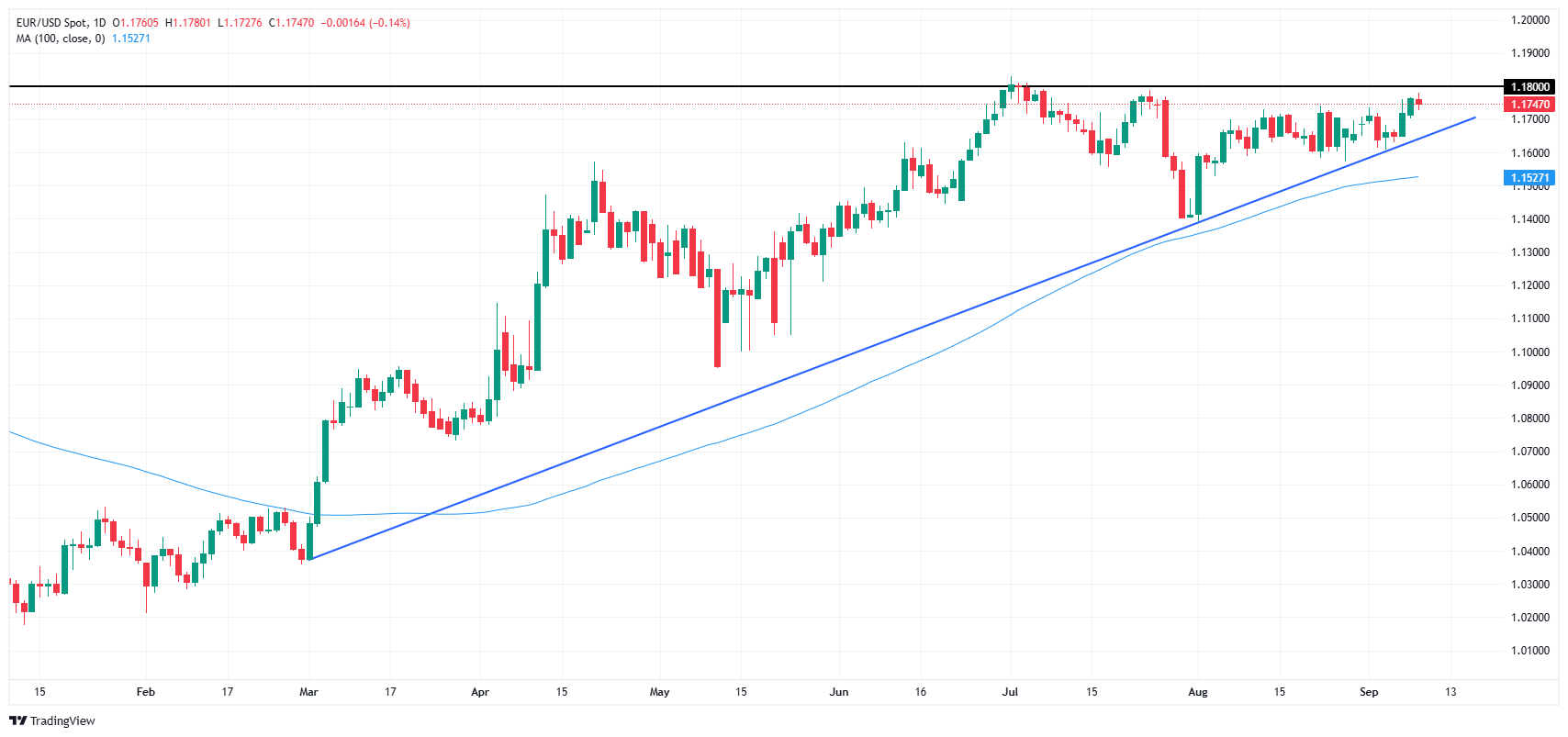
EUR/USD daily chart. Source: FXStreet
Despite political uncertainty in France, the Euro remains on an upward trajectory against the US Dollar (USD) in the short term, underlined by the uptrend line and the 100-day moving average on the daily chart.
However, the uptrend is losing strength, as EUR/USD finds solid resistance at around 1.1800.
The currency pair thus finds itself in an ascending triangle, whose exit – whether from above or below – could be decisive for the Euro's next direction.
A break above 1.1800 could put 1.1900 in the bulls' sights, while a break from below could encourage a reversal towards 1.1600, then the 100-day moving average currently at 1.1527.
Euro Price Today
The table below shows the percentage change of Euro (EUR) against listed major currencies today. Euro was the strongest against the Swiss Franc.
| USD | EUR | GBP | JPY | CAD | AUD | NZD | CHF | |
|---|---|---|---|---|---|---|---|---|
| USD | 0.25% | 0.01% | -0.34% | 0.12% | -0.16% | -0.02% | 0.24% | |
| EUR | -0.25% | -0.24% | -0.59% | -0.13% | -0.34% | -0.24% | -0.01% | |
| GBP | -0.01% | 0.24% | -0.38% | 0.11% | -0.10% | -0.00% | 0.22% | |
| JPY | 0.34% | 0.59% | 0.38% | 0.44% | 0.23% | 0.33% | 0.57% | |
| CAD | -0.12% | 0.13% | -0.11% | -0.44% | -0.24% | -0.10% | 0.13% | |
| AUD | 0.16% | 0.34% | 0.10% | -0.23% | 0.24% | 0.10% | 0.33% | |
| NZD | 0.02% | 0.24% | 0.00% | -0.33% | 0.10% | -0.10% | 0.25% | |
| CHF | -0.24% | 0.00% | -0.22% | -0.57% | -0.13% | -0.33% | -0.25% |
The heat map shows percentage changes of major currencies against each other. The base currency is picked from the left column, while the quote currency is picked from the top row. For example, if you pick the Euro from the left column and move along the horizontal line to the US Dollar, the percentage change displayed in the box will represent EUR (base)/USD (quote).
Political uncertainty and a tense budget
Since the fall of the Bayrou government, the scenario of a rapid return to stability seems less and less likely. The French President Emmanuel Macron is currently looking for a successor to form a government in a fractured parliament with no clear majority.
As TD Securities points out, this process could last from a few days to several months, leaving France under an interim government that would be unable to pass a budget within the usual time frame.
The draft budget for 2026 was due to be presented to Parliament by October 7, before being submitted to the European Commission. However, according to Danske Bank, this timetable now appears to be in jeopardy.
The risk, therefore, is that the State could temporarily operate on the basis of the 2025 budget, by means of an exceptional extension, pending a way out of the crisis. Such an outcome would further weaken France's position vis-à-vis the rating agencies, while a downgrade of the sovereign rating by Fitch seems likely by the weekend.
On the macroeconomic front, rising political uncertainty is having a tangible, albeit moderate, impact on activity. Deutsche Bank estimates that the wait-and-see climate could cost GDP up to 0.3 percentage points of growth this year, while noting that the French economy has learned to operate in an unstable environment.
"The current uncertainty shock is less damaging than before," write Deutsche Bank economists Yacine Rouimi, Mark Wall and Clément Delucia in their note.
The draft budget: Between austerity and explosive negotiations
Although the initial version of the Finance Bill for 2026 has been prepared in advance, its adoption is far from a foregone conclusion. The plan presented by François Bayrou included 44 billion euros in savings, with the abolition of two public holidays, a freeze on social benefits, and reduced transfers to local authorities. An ambitious fiscal consolidation effort, but politically explosive.
The opposition, from both left and right, is gearing up for the battle. The Socialist Party is pushing for a higher deficit target of 5% of GDP, as well as a new tax on large fortunes, expected to raise up to 15 billion euros, although its feasibility is still uncertain.
For its part, the far-right Rassemblement National has set four red lines: immigration, the cost of government, fraud, and France's contribution to the European budget (around 27.6 billion euros).
Any attempt at compromise will therefore have to deal with these antagonistic positions, making the budget vote highly uncertain.
Euro in search of stability
In the run-up to the demonstrations scheduled to take place in France on September 10 and 18, the Euro is operating in a zone of political turbulence, where every declaration and appointment can affect its trajectory.
In the short term, volatility should remain contained as long as the ECB stays the course and the situation does not degenerate into an institutional crisis.
But in the medium term, France's ability to return to a coherent budgetary course and restore the confidence of its European partners and the markets will be crucial to the Euro's stability.
As Deutsche Bank sums up, "France seems to have learned to live with chronic uncertainty, but that doesn't mean it can afford to stand still".
For the Euro, market patience has its limits, and this is beginning to show on the Bond market, where France is now borrowing more expensively than Italy on 10-year Bonds, the first time this has happened in twenty years.
Author

Ghiles Guezout
FXStreet
Ghiles Guezout is a Market Analyst with a strong background in stock market investments, trading, and cryptocurrencies. He combines fundamental and technical analysis skills to identify market opportunities.