First Republic Bank Stock News: FRC crashes 39% as FDIC takes over, sells assets to JPMorgan
- First Republic Bank is no more.
- FRC Branches will reopen as JPMorgan Chase branches on Monday.
- FRC stock tanks by 39% to $2.14 in Monday's premarket.
- FDIC and JPMorgan enter into loss-share transaction.

First Republic Bank (FRC), one of the fastest growing major banks of the past decade, has reached the conclusion of its story. Early Monday, the Federal Deposit Insurance Corporation (FDIC) announced that JPMorgan had won the bid to buy the bank's assets and assume resposibility for all deposits.
First Republic had $229.1 billion in assets and $103.9 billion in deposits. As of Monday all despositors and borrowers will now be banking with JPMorgan.
In a press release on Monday the FDIC stated: "JPMorgan Chase Bank, National Association submitted a bid for all of First Republic Bank’s deposits. As part of the transaction, First Republic Bank’s 84 offices in eight states will reopen as branches of JPMorgan Chase Bank, National Association, today during normal business hours. All depositors of First Republic Bank will become depositors of JPMorgan Chase Bank, National Association, and will have full access to all of their deposits."
First Republic Stock News: Yet another bank falls to House of Morgan
The FDIC did not specify JPMorgan's winning bid price, but on Sunday it was reported by several outlets that both PNC Financial Services (PNC) and Citizens Financial Group (CFG) were also in the running. Bids had been requested by noon on Sunday. Both Bank of America (BAC) and US Bancorp (USB) chose not to enter a bid. JPMorgan has more than 10% of all US deposits, so it required a waiver from regulators on Sunday in order to assume First Republic deposits.
The FDIC said it forecasts a $13 billion hit to the Deposit Insurance Fund, which is funded by banks across the US.
The agreement also specifies that JPMorgan and the FDIC enter into a loss-share transaction on "single family, residential and commercial loans" assumed by the bank, which should protect JPMorgan in the case some loans sour.
First Republic does carry a heavy load of low-interest rate residential mortgages, but loan quality is not what got it into trouble. March's bank run on Silicon Valley Bank, which failed in a matter of days, also led to a large-scale exodus of depositors from First Republic, which appears to be entirely due to its headquarters in San Francisco being near Silicon Valley and sharing some of the same depositors. Worried depositors in the Bay area pulled their money from both banks, largely moving it to money market funds and other larger banks like Wells Fargo (WFC).
The deposit run left a $100 billion hole in First Republic that could not be filled by the $30 billion worth of deposits stemming from 11 large national banks and other borrowing from the Federal Home Loan Bank.
The news is reminiscent of JPMorgan's role in the Great Financial Crisis of 2008. The bank acquired both a failing Bear Stearns investment bank and a failing Washington Mutual that year.
First Republic stock chart
The various announcements have not mentioned the stock, but in cases of FDIC receivership the shareholders typically get zilch. FRC stock tanked 39% on the news to $2.14 a share in Monday's premarket, and the shares will likely only go lower in this week's regular sessions.
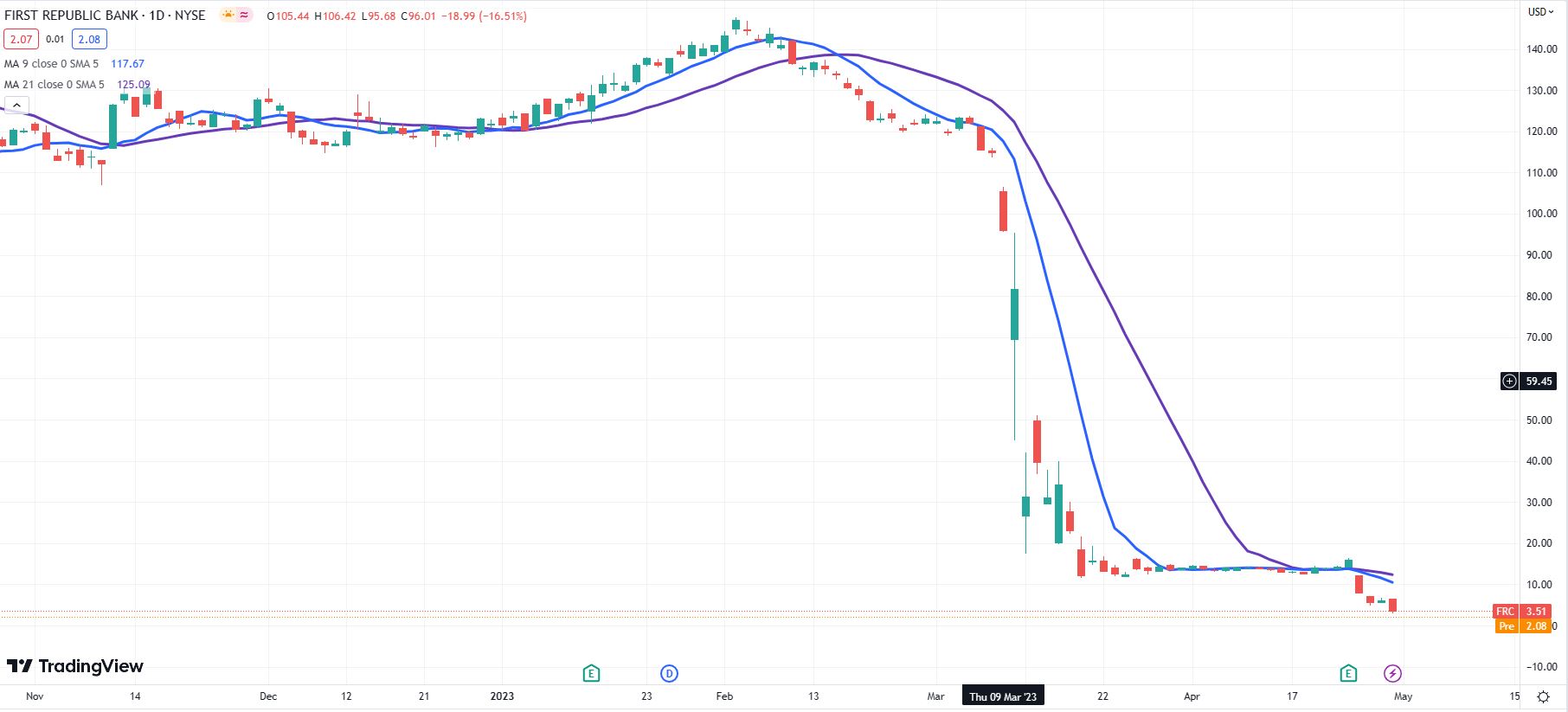
FRC daily chart
Author

Clay Webster
FXStreet
Clay Webster grew up in the US outside Buffalo, New York and Lancaster, Pennsylvania. He began investing after college following the 2008 financial crisis.