|

Fed's Cook: Bond markets were 'orderly' in April, but seeing rising stress in households

Federal Reserve (Fed) Board of Governors member Dr. Lisa Cook noted on Friday during a hosted event at New York University that while US economic factors were strong during the first quarter, Fed policymakers are beginning to see signs of stress in key industries, namely housing and commercial real estate.

Dr. Cook also highlighted that Treasury markets were orderly and functional during April's trade-related volatility, but stopped short of saying that bond market functionality may begin to suffer at the hands of inconsistent policy management from the White House.

Key Cook highlights

According to Dr. Cook, a "sufficiently large income shock could push up defaults, lead to losses for lenders." Fed BoG member Dr. Cook avoided outright stating what a large income shock might look like, but lately, Fedspeak has been notably tilted toward inflationary and downside employment pressures from lopsided trade policies from the Trump administration.

Dr. Cook admitted that she is "watching commercial real estate closely," and acknowledged that she is also beginning to see signs of balance sheet stress among low-to-moderate income households. The Fed's Dr. Cook didn't reveal much that wasn't already known to investors, and market-wide positioning remains largely unchanged on the day as US investors gear up for a long weekend.

Market reaction

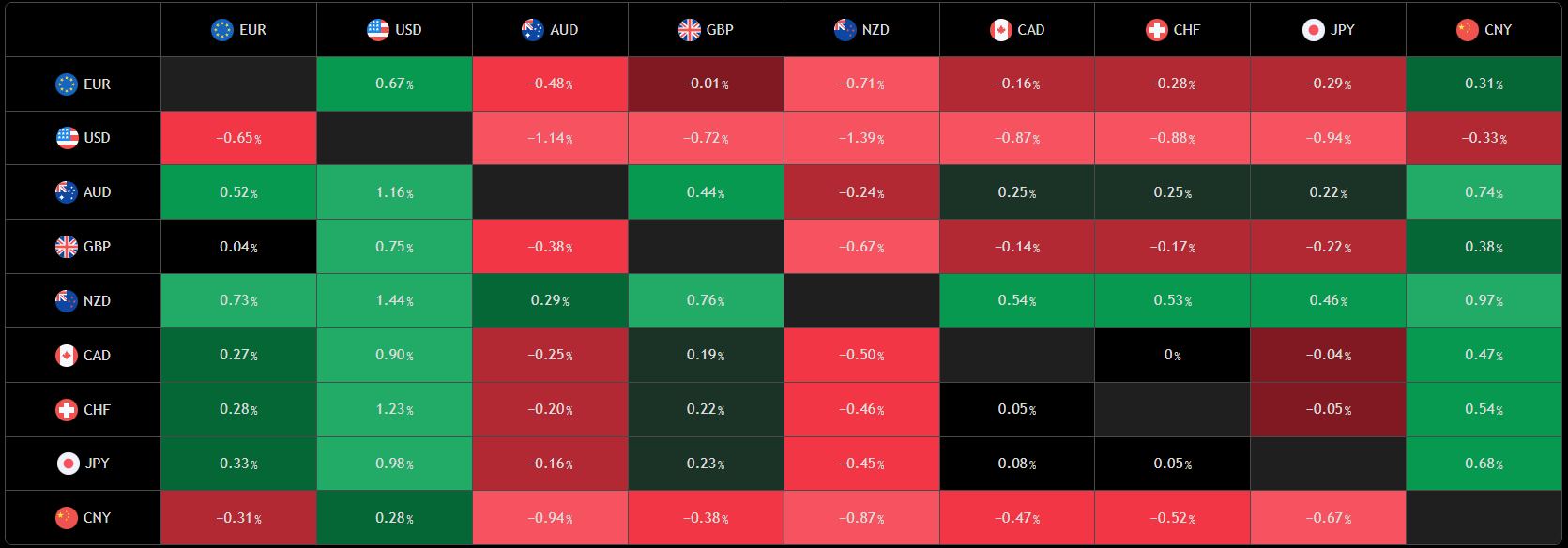
The US Dollar Index (DXY) is sharply lower on Friday, down near 99.20 as of writing as the Greenback falls across the board.


(TradingView forex heatmap, 1D timeframe)
Author

Joshua Gibson

Joshua joins the FXStreet team as an Economics and Finance double major from Vancouver Island University with twelve years' experience as an independent trader focusing on technical analysis.


More from Joshua Gibson
Share:

Markets move fast. We move first.

Orange Juice Newsletter brings you expert driven insights - not headlines. Every day on your inbox.

By subscribing you agree to our Terms and conditions.

Editor's Picks

EUR/USD bounces toward 1.1750 as US Dollar loses strength

EUR/USD returned to the 1.1750 price zone in the American session on Friday, despite falling Wall Street, which indicates risk aversion. Trading conditions remain thin following the New Year holiday and ahead of the weekend, with the focus shifting to US employment and European data scheduled for next week.

GBP/USD nears 1.3500, holds within familiar levels

After testing 1.3400 on the last day of 2025, GBP/USD managed to stage a rebound. Nevertheless, the pair finds it difficult to gather momentum and trades with modest intraday gains at around 1.3490 as market participants remain in holiday mood.

Gold trims intraday gains, approaches $4,300

Gold retreated sharply from the $4,400  area and trades flat for the day in the $4,320 price zone. Choppy trading conditions exacerbated the intraday decline, although XAU/USD bearish case is out of the picture, considering growing expectations for a dovish Fed and persistent geopolitical tensions.

Cardano gains early New Year momentum, bulls target falling wedge breakout

Cardano kicks off the New Year on a positive note and is extending gains, trading above $0.36 at the time of writing on Friday. Improving on-chain and derivatives data point to growing bullish interest, while the technical outlook keeps an upside breakout in focus.

Economic outlook 2026-2027 in advanced countries: Solidity test

After a year marked by global economic resilience and ending on a note of optimism, 2026 looks promising and could be a year of solid economic performance. In our baseline scenario, we expect most of the supportive factors at work in 2025 to continue to play a role in 2026.

Crypto market outlook for 2026

Year 2025 was volatile, as crypto often is.  Among positive catalysts were favourable regulatory changes in the U.S., rise of Digital Asset Treasuries (DAT), adoption of AI and tokenization of Real-World-Assets (RWA).