Facebook's 25% one-day crash shows competition in big tech is alive

Facebook is down 25% on a huge revenue miss. A change by Apple caused this.
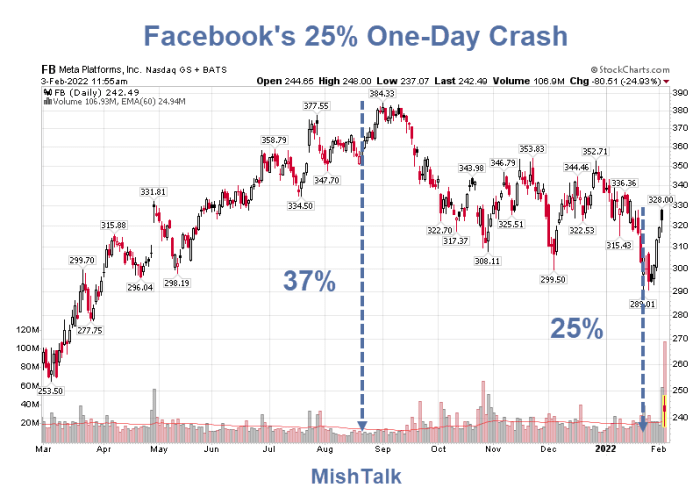
Facebook is down 25%, chart courtesy of StockCharts.Com, annotations by Mish
Facebook Feels $10 Billion Sting From Apple’s Privacy Push
The Wall Street Journal reports Facebook Feels $10 Billion Sting From Apple’s Privacy Push
Facebook’s FB parent company served up the starkest sign yet of how Apple Inc.’s AAPL -0.62% new ad-privacy policy is roiling the digital-advertising world.
Chief Financial Officer David Wehner on Wednesday said the company expects the Apple policy to cost it more than $10 billion in lost sales for 2022. That is equivalent to about 8% of its total revenue last year.
“It’s a pretty significant headwind,” Mr. Wehner said on a call with analysts. Apple introduced the changes last April, altering its iPhone software to require apps to ask users whether they want to be tracked. The move seriously limited the ability to gather data through apps that is used to target digital ads and drove advertisers to alter spending patterns. Meta had said previously that the Apple move was hurting its ad business, but it hadn’t given an estimate for how much.
Meta also reported losing about a million daily users globally in the last quarter, and its sales outlook for the current quarter fell short of Wall Street expectations. The company expects expenses to jump around $20 billion or more this year as it pursues Chief Executive Mark Zuckerberg’s bet on the metaverse, the online virtual world some see as the next evolution of the internet.
Booming digital ad spending has been a boon for Mr. Zuckerberg’s company. Facebook, as the company was known before its renaming last year to Meta, enjoyed years of strong revenue driven in significant part by its ability to track the behavior of users of apps and websites and enable advertisers to deliver highly targeted ads based on that information.
Huge Warning Signal
In retrospect, Facebook renaming itself to Meta was a huge warning signal that something was wrong.
Soft Wars and Capital as Power
Please consider Soft-Wars, a Capital-as-Power Analysis of Google’s Differential Power Trajectory.
On August 3, 2011, David Drummond wrote a blog post claiming that Microsoft was waging “a hostile, organized campaign” against Google’s Android operating system. At the time, Drummond was Google’s Senior Vice President and Chief Legal Officer. The ‘hostile campaign’ he was referring to was Microsoft’s recent purchase (made through consortiums that included Apple) of a large number of patents from Novell Inc. and Nortel Networks Corporation. The goal of this purchase, Drummond argued, was to control two large blocks of patents around mobile technology (Drummond, 2011).
Purchased for $4.5 billion, the Nortel block consisted of some 6000 patents that, according to the Los Angeles Times, were considered “crucial to the future of mobile computing” (Olivarez-Giles, 2012). Later that year, Google responded by buying Motorola Mobility for $12.9 billion (Larry Page, 2011). Yet shortly after the deal, Google began selling off parts of the company. By 2014, all that remained of Google-owned Motorola were its patents. According to Google founder Larry Page, these patents would “create a level playing field” and “protect the Android ecosystem”
When Google began operations in the late 1990s, Microsoft was a tech titan. But it would take only a decade for Google to catch up.
As Google’s profits became comparable to Microsoft’s, the two companies became engaged in mutually antagonistic competition. Both firms attempted to gain breadth by “augmenting the relative size of [their] corporate organs”
As they foray into mobile computing, cloud computing, and everything in between, Google and Microsoft now compete directly with one another.
Battle of Titans Net Income as Percentage of Sales
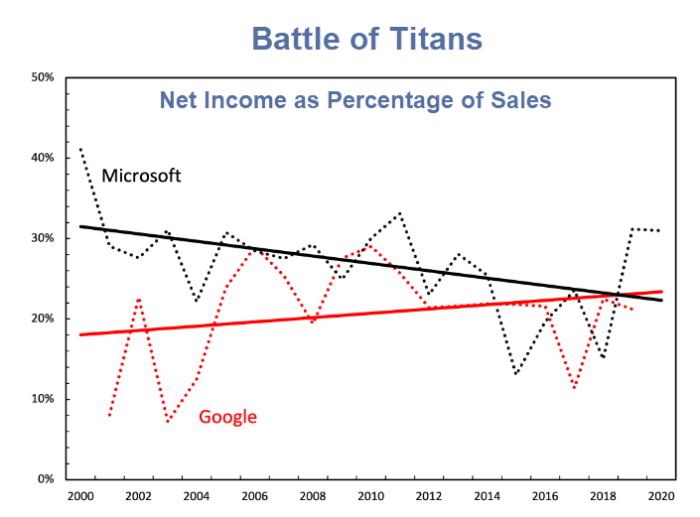
Chart courtesy of Capital as Power, Annotations by Mish
Continuing the analysis of Microsoft and Google’s antagonistic relationship, Figure 6 [above] shows the markup of the two firms — their net income as a percentage of sales. Over the last 20 years, Microsoft’s markup trended slightly downward, while Google’s trended slightly upward. The two trends converged around 2018.
A War for Patents
According to Google’s Chief Legal Officer (David Drummond), Microsoft’s purchase of mobile patents was a form of strategic sabotage.
By buying patents for mobile technology, Microsoft was encroaching on Google’s turf. Importantly, it was an encroachment not on a territory of current profitability, but on an area of perceived future profitability. In other words, Drummond chastised Microsoft for attempting to cut off Google’s path to future differential earnings.
Since 2010, the expansion of Google’s profits came at the cost of Microsoft’s profits (and vice versa). So it seems plausible that both firms are locked in a battle of strategic sabotage. Both firms dominate their core areas of profitability, and so are looking to expand to new territory. As they do, they encroach on each other’s turf. In this respect, mobile computing may be just one aspect of the Microsoft-Google turf struggle.
Having analyzed the competition between Microsoft and Google, it is important to acknowledge the limitations of studying these two firms in isolation. There are now other big players in the tech industry — notably Apple, Facebook, and Amazon. In the future, similar methods could be used to study the mutual conflict between these tech giants.
Soft War Fallout
Today we see the fallout of soft-war competition between Facebook and Apple.
Similarly, there is extreme competition for online sales. Amazon is the Godzilla, but faces huge competition from Walmart and Google.
In turn, Microsoft faces competition from Amazon's cloud services.
Competition Alive and Well
Closely analyzed, competition is alive and well. Moreover, consumers benefit from this.
Yet, the cat calls are our to bust up these tech giants in the name of fostering competition.
Widely loved Google Maps, is potentially a casualty in these bust up proposals. And Facebook, seems to be disintegrating on its own, with the help of Apple, but also a shrinking subscriber base.
Google started as a search engine but fostered Google Maps, self driving cars, and countless other smaller things.
As I have pointed out before, these companies exist in the US because we have relatively open, free markets. The EU would bust these companies up in the name of competition before they ever got big.
Splitting the goose because it lays too many golden eggs is exactly the wrong thing to do. The best thing for Congress to do is next to nothing, if not nothing at all.
Author

Mike “Mish” Shedlock's
Sitka Pacific Capital Management,Llc
Mike “Mish” Shedlock is a registered investment advisor for SitkaPacific Capital Management.