EURUSD recovered ground towards the end of the NY session, despite hot US Core PCE
- The US Dollar got bolstered by US core PCE but weakened towards the close of Wall Street.
- GDP in France and Spain weakened, while inflation in Germany continued its uptrend, above 10%.
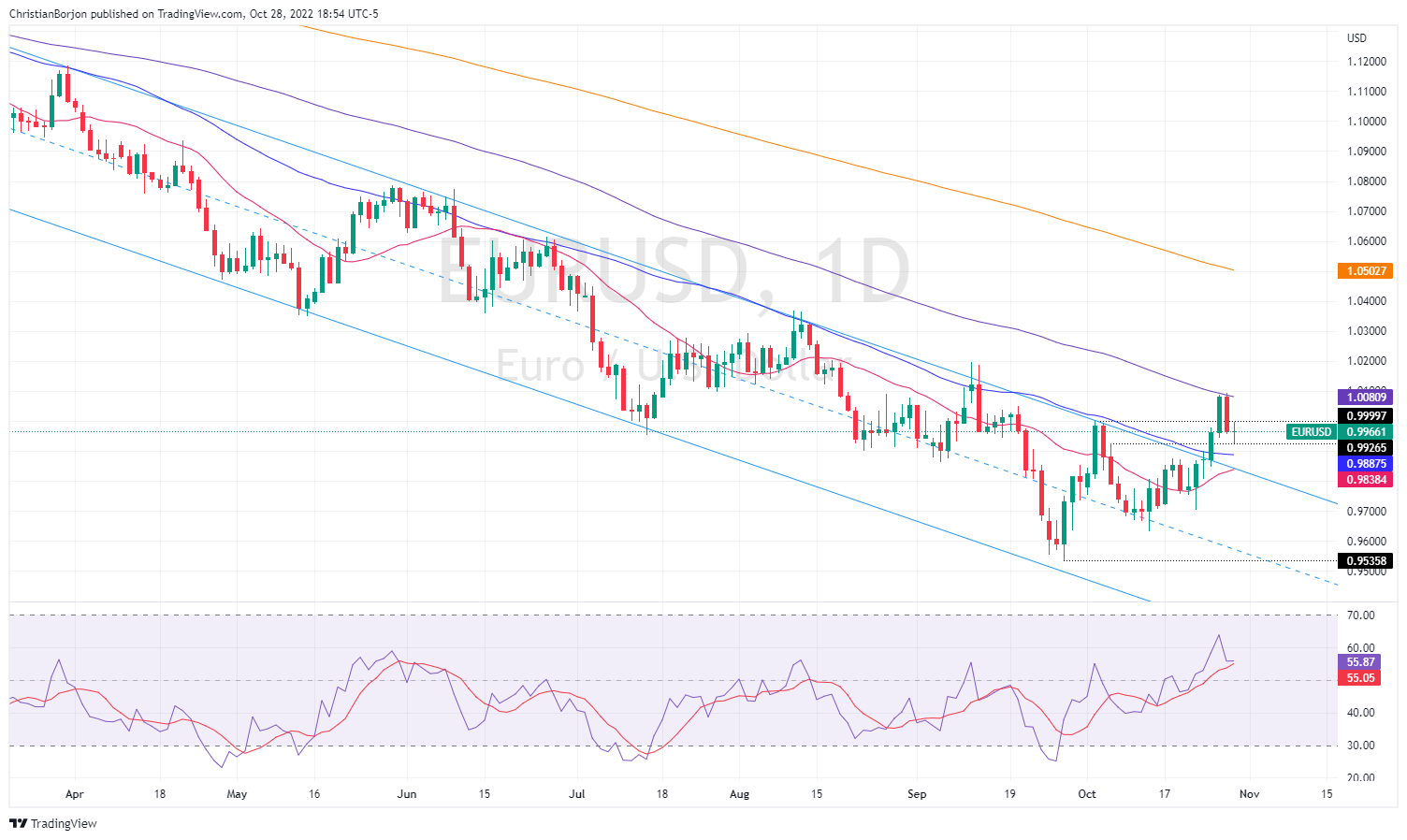
- EURUSD is neutral-to-downward biased, though slightly tilted to the upside, facing strong resistance at the 100-DMA.

The EURUSD finished Friday’s session almost flat at around 0.9960s with minuscule gains of 0.02%. US economic data bolstered the US Dollar due to further action warranted by the Fed; as its preferred gauge of inflation, the core Personal Consumption Expenditure (PCE) jumped above August’s figures, a headwind for the EUR. Nevertheless, the Shared currency recovered some ground against the USD at the New York close. At the time of writing, the EURUSD is trading at 0.9966, slightly above its opening price.
The Federal Reserve’s gauge of inflation jumps the 5% threshold
Wall Street finished the day with solid gains. Even though the narrative of a possible Federal Reserve pivot circulates in the financial markets, US economic data, particularly inflation, could prove it wrong.
The US Department of Commerce revealed that the US core PCE expenditure for September expanded by 0.5% MoM, in line with estimates, while the year-over-year reading increased by 5.1%, below expectations but above the previous month’s 4.9%, on Friday. Another report revealed by the US Labor Department reported that the Employment Cost Index (ECI) for Q3 increased by 1.2%, in line with Bloomberg’s estimates, and lower than the second quarter by 1.4%.
Data did not surprise traders, which turned to risk-perceived assets, speculating that a Fed pivot is imminent. Nevertheless, Friday’s data further justified the case for the Fed’s 75 bps interest-rate hike at the November meeting, while odds for another significant increase at the December meeting jumped from yesterday’s 34.1% to 44.9%.
The markets’ reaction to the headlines witnessed the EURUSD sliding from the daily high of 0.9989 to the daily low of around 0.9920s. However, as the North American session progressed, the EURUSD bounced off the lows and finished the session around the 0.9960s.
Consumer sentiment is unchanged, while US inflation expectations ease
Aside from US inflation data, the University of Michigan Consumer Sentiment October’s final reading came at 59.9, while inflation expectations barely moved. According to the survey, expectations for inflation in a one-year horizon rose to 5% from 5.1%, while for five years is estimated at 2.9%.
Of late, the Dallas Fed Trimmed Mean PCE for September edged lower from 6% to 4.3%. At the same time, the Atlanta Fed GDPNow Forecast for Q4 is 3.1%.
Growth in France and Spain decelerated, and Germany’s inflation spiked
In the meantime, the European economic calendar reported Gross Domestic Product (GDP), inflation, and the EU’s Economic Sentiment, for France, Spain, Germany, and the Euro area, respectively. Growth in France and Spain for the Q3 came in line with estimations, though they flashed recession signs as both countries trail the second quarter readings.
At the same time, Germany reported inflation for October on its preliminary reading, increasing by 10.4% YoY, vs. estimates of 10.1%, and exceeding the previous month’s reading.
Therefore, estimations for further tightening by the European Central Bank (ECB) are warranted, as some ECB speakers, namely Muller, Vasle, and Villeroy, commented that interest rates are still low, not at a restrictive level. It’s worth pointing out that Vasle said he expects further rate increases, while Villeroy added that the ECB will decide on interest rate increases, meeting by meeting.
Given the abovementioned backdrop, the ECB and the Federal Reserve will continue to tighten monetary conditions, which is positive for both the Euro and the US Dollar. Nevertheless, interest rate differentials and peak objectives amid the current high inflationary outlook would favor the US Dollar, so the EURUSD would likely be under selling pressure, keeping the exchange rates below parity.
EURUSD Price Forecast: Technical outlook
Despite closing in an upbeat tone on Friday, the EURUSD remains neutral-to-downward biased, as depicted by the daily chart. Traders should note that the EUR had risen in four of the last five trading days and stayed above the 50-day Exponential Moving Average (EMA). Nevertheless, on the only day that the EURUSD climbed toward the 100-day EMA, it was rejected, and the pair tumbled toward the October 27 daily low at 0.9957.
The Relative Strength Index (RSI) oscillates in bullish territory, which suggests that buyers are gathering momentum. However, to shift the bias to neutral, EURUSD buyers must conquer the 100-day EMA and 1.0100. And if the Euro clears 1.0200, a move towards the 200-EMA is on the cards.
On the flip side, key support levels lie at the 50-day EMA at 0.9887. Once cleared, the following support would be the 20-day EMA at 0.9838, ahead of 0.9800, followed by October’s monthly low of 0.9631.
Author

Christian Borjon Valencia
FXStreet
Markets analyst, news editor, and trading instructor with over 14 years of experience across FX, commodities, US equity indices, and global macro markets.

















