Eurozone FX Today: The ECB's pause comes under scrutiny

The Euro (EUR) is holding steady against the US Dollar (USD), trading at 1.1710 on Wednesday. A wait-and-see attitude prevails ahead of the European Central Bank's (ECB) monetary policy meeting, scheduled for Thursday at 12:15 GMT.
Markets are widely expecting interest rates to remain unchanged. The deposit rate is expected to remain at 2.00%, while the main refinancing rate will remain at 2.15%.
However, behind this apparent immobility lurks a wealth of monetary news signals, economic projections and political uncertainties, notably in France, which are likely to influence the Euro, especially during the press conference of ECB President Christine Lagarde.
A status quo widely anticipated, but not without tensions
After eight successive rate cuts since June 2024, the ECB interrupted its easing cycle in July.
The consensus is now almost unanimous: The September meeting should mark a further pause, with no change in rates.
According to Michael Brown, strategist at Pepperstone, "the easing cycle now seems to be over", a view widely shared by economists, with 66 out of 69 expecting a status quo in rates, according to a Reuters poll quoted by Morningstar.
For Konstantin Veit, manager at Pimco, "the ECB has reached the end of its easing cycle. The bar is now high to justify a new move", notes Morningstar.
Inflation under control, resilient growth
The macroeconomic environment offers little reason for immediate action. Eurozone inflation stood at 2.1% in August, according to Eurostat's flash estimate, while core inflation slowed to 2.3%, below forecasts.
These figures confirm the ECB's "meeting by meeting" approach, which has now become its official course of action.
On the growth front, projections are unlikely to change much either. The Frankfurt-based institution is likely to confirm its expectations of GDP growth of 0.9% in 2025 and 1.1% in 2026.
Indeed, the composite Purchasing Managers Index (PMI) index, a key gauge of economic activity, rose to 51.0 in August, its highest level for a year, and the manufacturing sector returned to expansion territory for the first time in three years. These data go some way to dispelling fears of stagnation.
The French political factor: A shadow in the picture
However, the apparent stability of the market should not obscure certain fragilities, notably political. In France, Prime Minister François Bayrou's recent loss of confidence in the National Assembly has rekindled investors' concerns.
Although French President Emmanuel Macron has appointed a new Prime Minister, he still has to pass the crucial parliamentary vote. The situation is therefore far from stabilized.
While Bond spreads between France and Germany have tightened slightly, they have not reached systemic stress levels.
The tension on French Bonds can, however, be highlighted by the historical fact of a crossover with Italian rates. For the first time in 20 years, French 10-year yields are higher than the Italian ones, underlining a higher risk premium on French debt.
Christine Lagarde will no doubt be asked about this at the press conference, but it would be surprising if she promised any imminent action, such as recourse to the TPI (Transmission Protection Instrument), especially as France, in an excessive deficit situation, does not meet the eligibility criteria.
The Euro in the face of trade and market uncertainties
Another point of vigilance: international trade. While the July agreement between the EU and the US has reduced the risk of a trade war, European companies, particularly in the automotive, pharmaceutical and semiconductor sectors, continue to face high tariffs.
Potential import tax hikes on Chinese or Indian products, under US pressure, could also further complicate the Eurozone's trade landscape.
On the currency front, the Euro remains supported by favorable spreads against the US Dollar, although the gap is narrowing with the approach of the Fed meeting on September 17.
Euro Price Today
The table below shows the percentage change of Euro (EUR) against listed major currencies today. Euro was the strongest against the US Dollar.
| USD | EUR | GBP | JPY | CAD | AUD | NZD | CHF | |
|---|---|---|---|---|---|---|---|---|
| USD | -0.10% | -0.21% | 0.01% | -0.05% | -0.59% | -0.56% | -0.10% | |
| EUR | 0.10% | -0.11% | 0.03% | 0.04% | -0.53% | -0.47% | 0.00% | |
| GBP | 0.21% | 0.11% | 0.20% | 0.17% | -0.41% | -0.35% | 0.15% | |
| JPY | -0.01% | -0.03% | -0.20% | 0.04% | -0.65% | -0.56% | 0.20% | |
| CAD | 0.05% | -0.04% | -0.17% | -0.04% | -0.60% | -0.54% | -0.02% | |
| AUD | 0.59% | 0.53% | 0.41% | 0.65% | 0.60% | 0.07% | 0.57% | |
| NZD | 0.56% | 0.47% | 0.35% | 0.56% | 0.54% | -0.07% | 0.65% | |
| CHF | 0.10% | -0.01% | -0.15% | -0.20% | 0.02% | -0.57% | -0.65% |
The heat map shows percentage changes of major currencies against each other. The base currency is picked from the left column, while the quote currency is picked from the top row. For example, if you pick the Euro from the left column and move along the horizontal line to the US Dollar, the percentage change displayed in the box will represent EUR (base)/USD (quote).
EUR/USD technical analysis: Wait and see before a key trading day
The Euro has been correcting downwards against the US Dollar since Tuesday, but the current overall upward momentum is not yet in doubt.
Indeed, EUR/USD has still found solid resistance around 1.1800 since the beginning of July, but the declines remain moderate and follow a bullish trend line in place since March.
Events on Thursday's economic calendar, namely the ECB meeting and the release of US inflation data, could offer catalysts to help the currency pair break out of the recent consolidation phase and provide a clearer short-term trend.
A break above 1.1800 could put 1.1900 in the bulls' sights, while a break from below could encourage a reversal towards 1.1600, then the 100-day moving average currently at 1.1527.
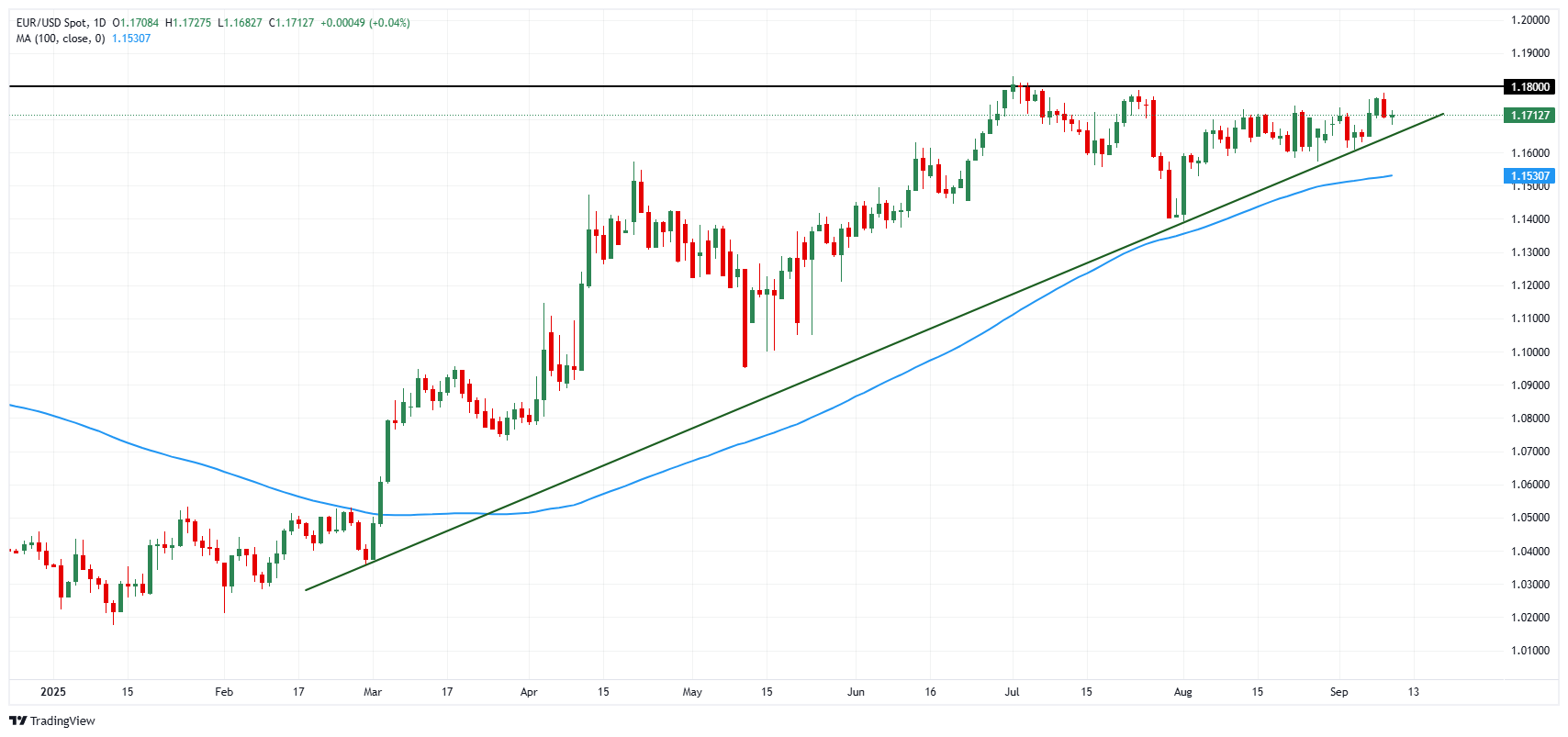
EUR/USD daily chart. Source: FXStreet
Low-stakes ECB meeting, but watch out for surprises
On the face of it, the ECB's September meeting is unlikely to change anything. But in an environment where Christine Lagarde's every word can steer the markets, the status quo can also be an event.
Rate stability masks an ECB that is listening, moving in a precarious balance between monetary normalization, internal political pressures and geopolitical uncertainties. For the Euro, what happens next will depend as much on Frankfurt as on Washington... and perhaps Paris.
Author

Ghiles Guezout
FXStreet
Ghiles Guezout is a Market Analyst with a strong background in stock market investments, trading, and cryptocurrencies. He combines fundamental and technical analysis skills to identify market opportunities.
















