ECB Press Conference: Lagarde speaks on policy outlook and Euro exchange rate

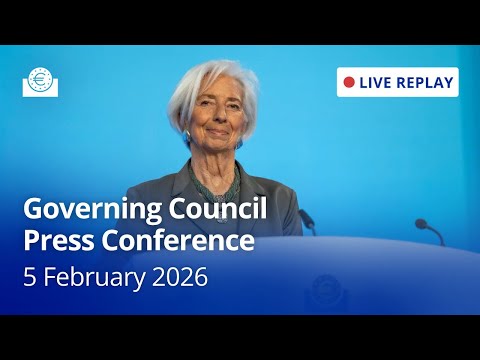
Christine Lagarde, President of the European Central Bank (ECB), explains the ECB's decision to leave key rates unchanged at the February policy meeting and responds to questions from the press.
Follow FXStreet's ECB Live Coverage here
ECB press conference key takeaways
"Growth is driven by services, notably in IT."
"Manufacturing is resilient."
"Construction momentum is picking up."
"Government spending should contribute to domestic demand."
"Business investment should strengthen further."
"Firms increasingly investing in digital tech."
"Indicators of underlying inflation have changed little."
"Forward looking indicators and surveys point to continued moderation in labour costs."
"Most measures of longer term inflation expectations stand around 2%."
"Euro area faces volatile policy environment."
"Uncertainty could weigh on demand."
"Friction in international trade could disrupt supply chains, weaken exports."
"Planned fiscal spending boost could drive up growth by more than expected."
"Outlook for inflation more uncertain than usual."
"Stronger Euro could bring inflation down more than now expected."
"Inflation could turn out to be higher if there is a persistent upward shift in energy prices."
"Decision was unanimous."
"We are in a broadly balanced situation in terms of risks."
"We have no exchange rate target."
"Recognized that FX is important."
"We keep a close eye on FX, we discussed FX today."
"We observed that Dollar depreciated measurably but not in last few days."
"Dollar has fluctuated in a range since last summer."
"Impact of FX rate incorporated into baseline."
"Current range is very much in line with overall average for as long as Euro has been around."
"We are not seeing reduction in range of risk."
"We are still in a good place, inflation is in a good place."
"We see inflation at target in medium term."
"We have for a long time projected 2026 inflation undershooting."
"Particularly attentive to services prices, wages."
"Wage tracker guiding us to moderation."
"Nothing that is really changing the baseline."
"Policy is agile, prepared to do what is necessary."
This section below was published at 13:15 GMT to cover the European Central Bank's (ECB) monetary policy announcements and the immediate market reaction.
The European Central Bank (ECB) announced on Thursday that it left key rates unchanged following the February policy meeting, as expected. With this decision, the interest rate on the main refinancing operations, the interest rates on the marginal lending facility and the deposit facility stood at 2.15%, 2.4% and 2%, respectively.
ECB policy statement key takeaways
"Economy remains resilient in a challenging global environment."
"Low unemployment, solid private sector balance sheets, gradual rollout of public spending on defence and infrastructure and supportive effects of past interest rate cuts are underpinning growth."
"At the same time, outlook is still uncertain, owing particularly to ongoing global trade policy uncertainty and geopolitical tensions."
"ECB is determined to ensure that inflation stabilises at its 2% target in medium term."
"Will follow a data-dependent and meeting-by-meeting approach to determining appropriate monetary policy stance."
"In particular, ECB’s interest rate decisions will be based on its assessment of inflation outlook and risks surrounding it, in light of incoming economic and financial data, as well as dynamics of underlying inflation and strength of monetary policy transmission."
"ECB is not pre-committing to a particular rate path."
"APP and Pandemic Emergency Purchase Programme (PEPP) portfolios are declining at a measured and predictable pace, as Eurosystem no longer reinvests principal payments from maturing securities."
Market reaction to ECB policy decision
The ECB policy announcements don't seem to be having a noticeable impact on the Euro's performance. As of writing, EUR/USD was trading marginally lower on the day at 1.1795.
Euro Price This week
The table below shows the percentage change of Euro (EUR) against listed major currencies this week. Euro was the weakest against the Australian Dollar.
| USD | EUR | GBP | JPY | CAD | AUD | NZD | CHF | |
|---|---|---|---|---|---|---|---|---|
| USD | 0.45% | 0.87% | 1.22% | 0.57% | -0.24% | 0.33% | 0.56% | |
| EUR | -0.45% | 0.38% | 0.81% | 0.11% | -0.69% | -0.11% | 0.10% | |
| GBP | -0.87% | -0.38% | 0.30% | -0.27% | -1.06% | -0.49% | -0.28% | |
| JPY | -1.22% | -0.81% | -0.30% | -0.65% | -1.47% | -0.85% | -0.93% | |
| CAD | -0.57% | -0.11% | 0.27% | 0.65% | -0.77% | -0.21% | -0.01% | |
| AUD | 0.24% | 0.69% | 1.06% | 1.47% | 0.77% | 0.58% | 0.80% | |
| NZD | -0.33% | 0.11% | 0.49% | 0.85% | 0.21% | -0.58% | 0.22% | |
| CHF | -0.56% | -0.10% | 0.28% | 0.93% | 0.01% | -0.80% | -0.22% |
The heat map shows percentage changes of major currencies against each other. The base currency is picked from the left column, while the quote currency is picked from the top row. For example, if you pick the Euro from the left column and move along the horizontal line to the US Dollar, the percentage change displayed in the box will represent EUR (base)/USD (quote).
(This story was corrected at 13:24 GMT to note that the European Central Bank left key rates unchanged after the February meeting, not December).
This section below was published as a preview of the European Central Bank's policy decisions at 05:00 GMT.
- The European Central Bank is widely anticipated to keep interest rates on hold.
- ECB President Lagarde is likely to reiterate the meeting-by-meeting approach.
- EUR/USD remains stable above 1.1800, with buyers looking to return.
The European Central Bank (ECB) is holding its two-day meeting and will announce its monetary policy decision on Thursday. The ECB is widely expected to keep interest rates on hold for the fifth consecutive meeting, leaving the main refinancing operations, the marginal lending facility, and the deposit facility at 2.15%, 2.4%, and 2%, respectively.
Additionally, ECB President Christine Lagarde will hold a press conference afterward to explain policymakers’ reasoning behind the decision.
Ahead of the announcement, the EUR/USD pair trades above the 1.1800 mark, stabilizing after retracing sharply from January’s peak at 1.2082.
What to expect from the ECB interest rate decision?
The ECB is in a good position and plans to remain there, refraining from any further monetary policy action. The ECB was among the first major central banks to cut rates after post-pandemic inflation peaks that drove multi-decade highs in rates. President Christine Lagarde's latest mantra has been that monetary policy is in a “good place,” and is expected to repeat the message.
The Governing Council decided to keep rates unchanged at its December meeting, offering no fresh clues about future action. As ING noted, “The minutes of the ECB’s December meeting confirm the ECB’s wait-and-see stance in a macro environment, in which the base case looks very benign, but risks remain unusually high.”
In the meantime, macroeconomic data released in the last couple of months confirm officials’ stance. The Euro area economy has not only been resilient but is finally showing signs of improvement.
According to the latest Eurostat data, the European Union (EU) grew by 0.3% quarter-on-quarter in the three months to December, while the 2025 Gross Domestic Product (GDP) grew by 1.6% year-on-year.
In the meantime, inflation cooled down in January, as expected. Eurostat reported that the Harmonized Index of Consumer Prices (HICP) rose 1.7% in the year to January as expected, while easing from the 1.9% posted in December. The core HICP, which excludes volatile components such as food or energy, rose by 2.3% as anticipated, matching the previous month’s figure.
Finally, it is worth remembering that, speaking after the ECB’s final Governing Council meeting, President Lagarde made it clear that, given that monetary policy is in a “good place,” this does not imply a fixed or predictable path for rates. She also emphasised the ECB’s meeting-by-meeting approach.
In this scenario, the upcoming monetary policy decision is likely to be a non-event. The general consensus is that the ECB will maintain its hawkish stance and that President Lagarde will repeat the message that the ECB is in wait-and-see mode, attentive to economic developments without a pre-set monetary path.
How could the ECB meeting impact EUR/USD?
As previously noted, the EUR/USD pair is stable above 1.1800 ahead of the announcement, following volatile price action over the previous two weeks. The EUR/USD pair also trades roughly 300 pips below its recent peak, yet retains most of its 2025 gains.
Valeria Bednarik, FXStreet Chief Analyst, notes: “Technically speaking, the EUR/USD pair bearish case seems well-limited. In the daily chart, the pair holds well above all its moving averages, with a bullish 20-day Simple Moving Average (SMA) heading north above the 100 and 200 SMAs while providing support at around 1.1760. At the same time, technical indicators have picked up after nearing their midlines, presenting uneven upward strength at the time of writing.”
Bednarik adds: “The EUR/USD pair bottomed at around 1.1775 earlier in the week, making the 1.1760-1.1770 area the immediate downward barrier. A slide below the level exposes the 1.1700 threshold, en route to the 1.1640 price zone. Bulls will be looking for a recovery beyond 1.1920 to add longs, aiming for a test of the 1.2000 mark.”
Euro FAQs
The Euro is the currency for the 20 European Union countries that belong to the Eurozone. It is the second most heavily traded currency in the world behind the US Dollar. In 2022, it accounted for 31% of all foreign exchange transactions, with an average daily turnover of over $2.2 trillion a day. EUR/USD is the most heavily traded currency pair in the world, accounting for an estimated 30% off all transactions, followed by EUR/JPY (4%), EUR/GBP (3%) and EUR/AUD (2%).
The European Central Bank (ECB) in Frankfurt, Germany, is the reserve bank for the Eurozone. The ECB sets interest rates and manages monetary policy. The ECB’s primary mandate is to maintain price stability, which means either controlling inflation or stimulating growth. Its primary tool is the raising or lowering of interest rates. Relatively high interest rates – or the expectation of higher rates – will usually benefit the Euro and vice versa. The ECB Governing Council makes monetary policy decisions at meetings held eight times a year. Decisions are made by heads of the Eurozone national banks and six permanent members, including the President of the ECB, Christine Lagarde.
Eurozone inflation data, measured by the Harmonized Index of Consumer Prices (HICP), is an important econometric for the Euro. If inflation rises more than expected, especially if above the ECB’s 2% target, it obliges the ECB to raise interest rates to bring it back under control. Relatively high interest rates compared to its counterparts will usually benefit the Euro, as it makes the region more attractive as a place for global investors to park their money.
Data releases gauge the health of the economy and can impact on the Euro. Indicators such as GDP, Manufacturing and Services PMIs, employment, and consumer sentiment surveys can all influence the direction of the single currency. A strong economy is good for the Euro. Not only does it attract more foreign investment but it may encourage the ECB to put up interest rates, which will directly strengthen the Euro. Otherwise, if economic data is weak, the Euro is likely to fall. Economic data for the four largest economies in the euro area (Germany, France, Italy and Spain) are especially significant, as they account for 75% of the Eurozone’s economy.
Another significant data release for the Euro is the Trade Balance. This indicator measures the difference between what a country earns from its exports and what it spends on imports over a given period. If a country produces highly sought after exports then its currency will gain in value purely from the extra demand created from foreign buyers seeking to purchase these goods. Therefore, a positive net Trade Balance strengthens a currency and vice versa for a negative balance.
Author

FXStreet Team
FXStreet
Composed of a group of economic journalists and FX experts, the FXStreet content team produces and oversees all content published on FXStreet. It provides a purely journalistic approach to the Forex market.

















