Euro recovers against Greenback after an early plunge on Wednesday

Most recent article: Euro softens on Thursday, sees broad-market losses on ECB talking points
- The Euro is mixed on Wednesday, sees lopsided gains overall.
- Europe saw a slight uptick in final HICP inflation in December.
- ECB continues to stamp out rate cut bets, US Fed lets data do the work for them.
The Euro (EUR) saw some gains on Wednesday but still found room to the downside against the US Dollar (USD) as hotter-than-expected US Retail Sales triggered safety flows back into the US Dollar.
Final Core Harmonized Index of Consumer Prices (HICP) from Europe saw a slight uptick in the MoM figure in December but overall printed as expected. European Central Bank (ECB) officials continue to bat down rate cut expectations from money markets. On the US side, Retail Sales climbed much more than investors anticipated in December, leaving rate gamblers in the lurch as swaps trim bets on how many rate cuts the Federal Reserve (Fed) will see in 2024.
Daily digest market movers: Euro sees some gains but declines further against USD
- Finalized Core HICP inflation from Europe saw a slight uptick in December MoM, up to 0.5% from the preliminary 0.4%.
- Annualized Core HICP inflation held steady at 3.4%.
- ECB officials continue to run the circuit of talking down market expectations of ECB rate cuts.
- On Wednesday, ECB’s President Lagarde made her first of three appearances at the World Economic Forum in Davos, Switzerland.
- ECB President Lagarde didn’t rule out the possibility of a rate cut either before or during the summer season but leaned heavily into “data-dependency” rhetoric, highlighting that Services sector inflation remains near 4%, well above targets.
- US Retail Sales figures dominated market flows in the mid-week market session, climbing to 0.6% in December, well above the previous print of 0.3% and beating the forecast of 0.4%.
- With retail activity on the rise and the US economy still posting healthy employment figures, market expectations of several rate cuts from the Fed are coming under intense pressure.
- Fed swaps have trimmed bets of a March cut from the Fed to just 50%, well down from the peak of 90% in December.
Canadian Dollar price today
The table below shows the percentage change of Canadian Dollar (CAD) against listed major currencies today. Canadian Dollar was the strongest against the Japanese Yen.
| USD | EUR | GBP | CAD | AUD | JPY | NZD | CHF | |
| USD | -0.03% | -0.31% | 0.16% | 0.59% | 0.64% | 0.47% | 0.34% | |
| EUR | 0.03% | -0.29% | 0.19% | 0.62% | 0.68% | 0.51% | 0.37% | |
| GBP | 0.32% | 0.28% | 0.46% | 0.90% | 0.95% | 0.78% | 0.65% | |
| CAD | -0.15% | -0.18% | -0.47% | 0.43% | 0.48% | 0.32% | 0.17% | |
| AUD | -0.59% | -0.62% | -0.91% | -0.43% | 0.05% | -0.12% | -0.25% | |
| JPY | -0.66% | -0.68% | -0.97% | -0.50% | -0.05% | -0.18% | -0.30% | |
| NZD | -0.50% | -0.52% | -0.82% | -0.34% | 0.09% | 0.10% | -0.16% | |
| CHF | -0.34% | -0.37% | -0.65% | -0.18% | 0.25% | 0.30% | 0.16% |
The heat map shows percentage changes of major currencies against each other. The base currency is picked from the left column, while the quote currency is picked from the top row. For example, if you pick the Euro from the left column and move along the horizontal line to the Japanese Yen, the percentage change displayed in the box will represent EUR (base)/JPY (quote).
Technical Analysis: EUR/USD touches below 1.0850 for the first time in over a month
The Euro (EUR) remains well-bid on Wednesday, climbing around two-thirds of a percent against the Australian Dollar (AUD) and the Japanese Yen (JPY). The Euro clipped into the low side against the US Dollar before recovering to mostly flat for Wednesday, and declining around four-tenths of a percent against the Pound Sterling (GBP).
The EUR/USD tumbled into the 1.0850 region in intraday action on Wednesday, getting pushed further away from the 200-hour Simple Moving Average (SMA) near 1.0940. The pair is testing into one-month lows, down about 1.3% from early January’s test into the 1.1000 major handle.
Wednesday’s downside momentum sees the EUR/USD exploring the 200-day Simple Moving Average, running into technical support at the key moving average and falling into a potential congestion zone between the 50-day and 200-day SMAs just below 1.0900.
EUR/USD Hourly Chart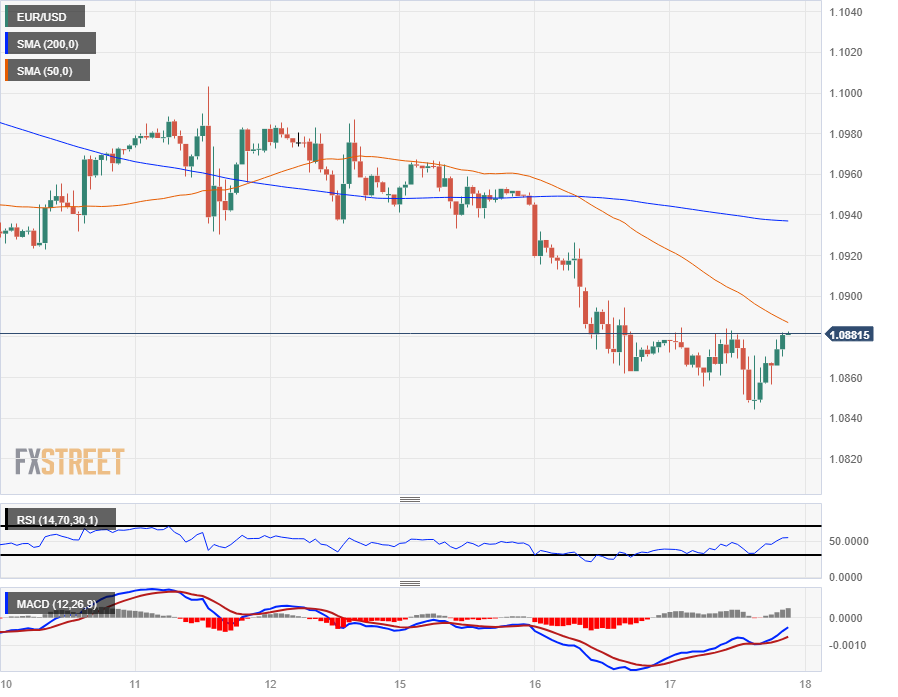
EUR/USD Daily Chart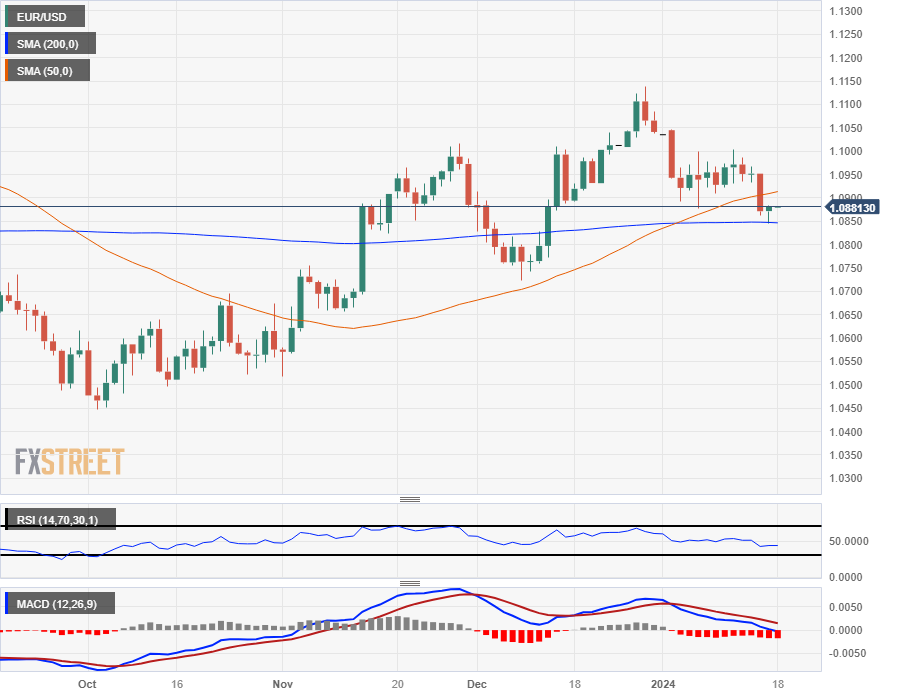
Euro FAQs
What is the Euro?
The Euro is the currency for the 20 European Union countries that belong to the Eurozone. It is the second most heavily traded currency in the world behind the US Dollar. In 2022, it accounted for 31% of all foreign exchange transactions, with an average daily turnover of over $2.2 trillion a day.
EUR/USD is the most heavily traded currency pair in the world, accounting for an estimated 30% off all transactions, followed by EUR/JPY (4%), EUR/GBP (3%) and EUR/AUD (2%).
What is the ECB and how does it impact the Euro?
The European Central Bank (ECB) in Frankfurt, Germany, is the reserve bank for the Eurozone. The ECB sets interest rates and manages monetary policy.
The ECB’s primary mandate is to maintain price stability, which means either controlling inflation or stimulating growth. Its primary tool is the raising or lowering of interest rates. Relatively high interest rates – or the expectation of higher rates – will usually benefit the Euro and vice versa.
The ECB Governing Council makes monetary policy decisions at meetings held eight times a year. Decisions are made by heads of the Eurozone national banks and six permanent members, including the President of the ECB, Christine Lagarde.
How does inflation data impact the value of the Euro?
Eurozone inflation data, measured by the Harmonized Index of Consumer Prices (HICP), is an important econometric for the Euro. If inflation rises more than expected, especially if above the ECB’s 2% target, it obliges the ECB to raise interest rates to bring it back under control.
Relatively high interest rates compared to its counterparts will usually benefit the Euro, as it makes the region more attractive as a place for global investors to park their money.
How does economic data influence the value of the Euro?
Data releases gauge the health of the economy and can impact on the Euro. Indicators such as GDP, Manufacturing and Services PMIs, employment, and consumer sentiment surveys can all influence the direction of the single currency.
A strong economy is good for the Euro. Not only does it attract more foreign investment but it may encourage the ECB to put up interest rates, which will directly strengthen the Euro. Otherwise, if economic data is weak, the Euro is likely to fall.
Economic data for the four largest economies in the euro area (Germany, France, Italy and Spain) are especially significant, as they account for 75% of the Eurozone’s economy.
How does the Trade Balance impact the Euro?
Another significant data release for the Euro is the Trade Balance. This indicator measures the difference between what a country earns from its exports and what it spends on imports over a given period.
If a country produces highly sought after exports then its currency will gain in value purely from the extra demand created from foreign buyers seeking to purchase these goods. Therefore, a positive net Trade Balance strengthens a currency and vice versa for a negative balance.
Author

Joshua Gibson
FXStreet
Joshua joins the FXStreet team as an Economics and Finance double major from Vancouver Island University with twelve years' experience as an independent trader focusing on technical analysis.