Euro looks firm near 1.1240 despite Dollar gains
- Euro trades within a tight range vs. the US Dollar.
- Stocks in Europe close Friday's session in a mixed note.
- EUR/USD treads water around 1.1240/45 amidst the monthly rally.
- EMU Balance of Trade showed a €0.3B deficit in May.
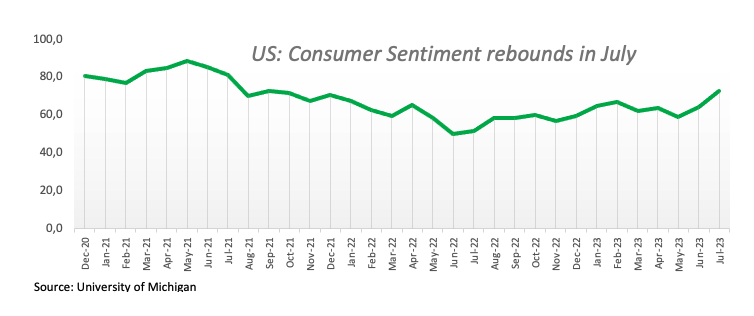
- Flash US Consumer Sentiment surprises to the upside in July.

The Euro (EUR) seems to have met some initial resistance around the 1.1240 region vs. the US Dollar (USD) so far on Friday.
In fact, after reaching new highs in the 1.1240/45 band earlier in the Asian trading hours, EUR/USD now seems to have taken a breather amidst a marginal recovery attempt in the Greenback.
Despite the so-far lacklustre bounce, the US Dollar remains under heavy pressure as investors continue to anticipate the likelihood that the Federal Reserve might be nearing the end of its tightening campaign. This view has been reinforced as of late on the back of further signs of cooling US consumer prices as well as the persistent downtrend in producer prices.
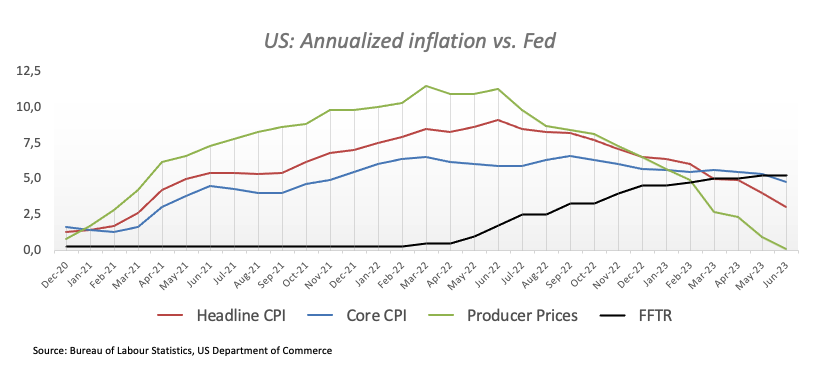
In the meantime, comments by the FOMC’s Governor Christopher Waller late on Thursday fell in line with the persevering hawkish narrative from his colleagues at the Committee after he suggested that the Fed might need two more rate hikes this year.
The strong upside impulse in the pair has been reinvigorated in response to lower-than-expected US inflation figures for the month of June, which, firstly, confirm that disinflationary forces remain well in place in the US economy and, secondly, underpin expectations that the Federal Reserve might end its ongoing hiking campaign sooner rather than later.
So far, market participants have already largely priced in a quarter-point rate hike by both the European Central Bank (ECB) and the Fed at their meetings later in the month, in a context where the potential future actions of the Fed and the ECB in normalizing their monetary policies continue to be a topic of discussion, especially with increasing concerns about an economic slowdown on both sides of the Atlantic.
In the domestic calendar, the euro area printed a €0.3B deficit in May in what was the sole publication in the old continent at the end of the week. In the US docket, the preliminary readings of the Michigan Consumer Sentiment are expected to see an improvemen to 72.6 in the current month.
Daily digest market movers: Euro keeps the familiar range near 2023 peaks
- The EUR maintains the trade near 1.1240 vs. USD on Friday.
- Fed’s Waller favoured two more rate hikes by the Fed this year.
- The USD Index bounces off new 15-month lows near 99.60.
- The Fed and the ECB are seen hiking rates by 25 bps this month.
- Oil, Gold retreats modestly during the European morning.
Technical Analysis: Euro faces interim contention near 1.0880
The ongoing price action in EUR/USD hints at the idea that further gains might be in store in the short-term horizon. However, the current pair’s overbought condition (as per the daily RSI well above 70) opens the door to a potential near-term corrective move.
The pair printed a new 2023 high at 1.1244 on July 14. Once this level is cleared, there are no resistance levels of significance until the 2022 peak of 1.1495 recorded on February 10.
On the downside, the 1.1000 region emerges as a psychological support seconded by interim contention at the 55-day and 100-day SMAs at 1.0881 and 1.0852, respectively, ahead of the July low of 1.0833 (July 6) . The breakdown of this region should meet the next contention area not before the May low of 1.0635 (May 31), which also looks underpinned by the crucial 200-day SMA (1.0651). South from here emerges the March low of 1.0516 (March 15) prior to the 2023 low of 1.0481 (January 6).
Furthermore, the constructive view of EUR/USD appears unchanged as long as the pair trades above the key 200-day SMA.
Euro FAQs
What is the Euro?
The Euro is the currency for the 20 European Union countries that belong to the Eurozone. It is the second most heavily traded currency in the world behind the US Dollar. In 2022, it accounted for 31% of all foreign exchange transactions, with an average daily turnover of over $2.2 trillion a day.
EUR/USD is the most heavily traded currency pair in the world, accounting for an estimated 30% off all transactions, followed by EUR/JPY (4%), EUR/GBP (3%) and EUR/AUD (2%).
What is the ECB and how does it impact the Euro?
The European Central Bank (ECB) in Frankfurt, Germany, is the reserve bank for the Eurozone. The ECB sets interest rates and manages monetary policy.
The ECB’s primary mandate is to maintain price stability, which means either controlling inflation or stimulating growth. Its primary tool is the raising or lowering of interest rates. Relatively high interest rates – or the expectation of higher rates – will usually benefit the Euro and vice versa.
The ECB Governing Council makes monetary policy decisions at meetings held eight times a year. Decisions are made by heads of the Eurozone national banks and six permanent members, including the President of the ECB, Christine Lagarde.
How does inflation data impact the value of the Euro?
Eurozone inflation data, measured by the Harmonized Index of Consumer Prices (HICP), is an important econometric for the Euro. If inflation rises more than expected, especially if above the ECB’s 2% target, it obliges the ECB to raise interest rates to bring it back under control.
Relatively high interest rates compared to its counterparts will usually benefit the Euro, as it makes the region more attractive as a place for global investors to park their money.
How does economic data influence the value of the Euro?
Data releases gauge the health of the economy and can impact on the Euro. Indicators such as GDP, Manufacturing and Services PMIs, employment, and consumer sentiment surveys can all influence the direction of the single currency.
A strong economy is good for the Euro. Not only does it attract more foreign investment but it may encourage the ECB to put up interest rates, which will directly strengthen the Euro. Otherwise, if economic data is weak, the Euro is likely to fall.
Economic data for the four largest economies in the euro area (Germany, France, Italy and Spain) are especially significant, as they account for 75% of the Eurozone’s economy.
How does the Trade Balance impact the Euro?
Another significant data release for the Euro is the Trade Balance. This indicator measures the difference between what a country earns from its exports and what it spends on imports over a given period.
If a country produces highly sought after exports then its currency will gain in value purely from the extra demand created from foreign buyers seeking to purchase these goods. Therefore, a positive net Trade Balance strengthens a currency and vice versa for a negative balance.
Author

Pablo Piovano
FXStreet
Born and bred in Argentina, Pablo has been carrying on with his passion for FX markets and trading since his first college years.