EUR/USD with losses on Powell's words, bulls take a breather
- EUR/USD trades near the 1.1000 zone after paring back earlier gains from the weekly top.
- Fed’s Powell flags inflation risks and uncertainty due to broader-than-expected tariff impacts.
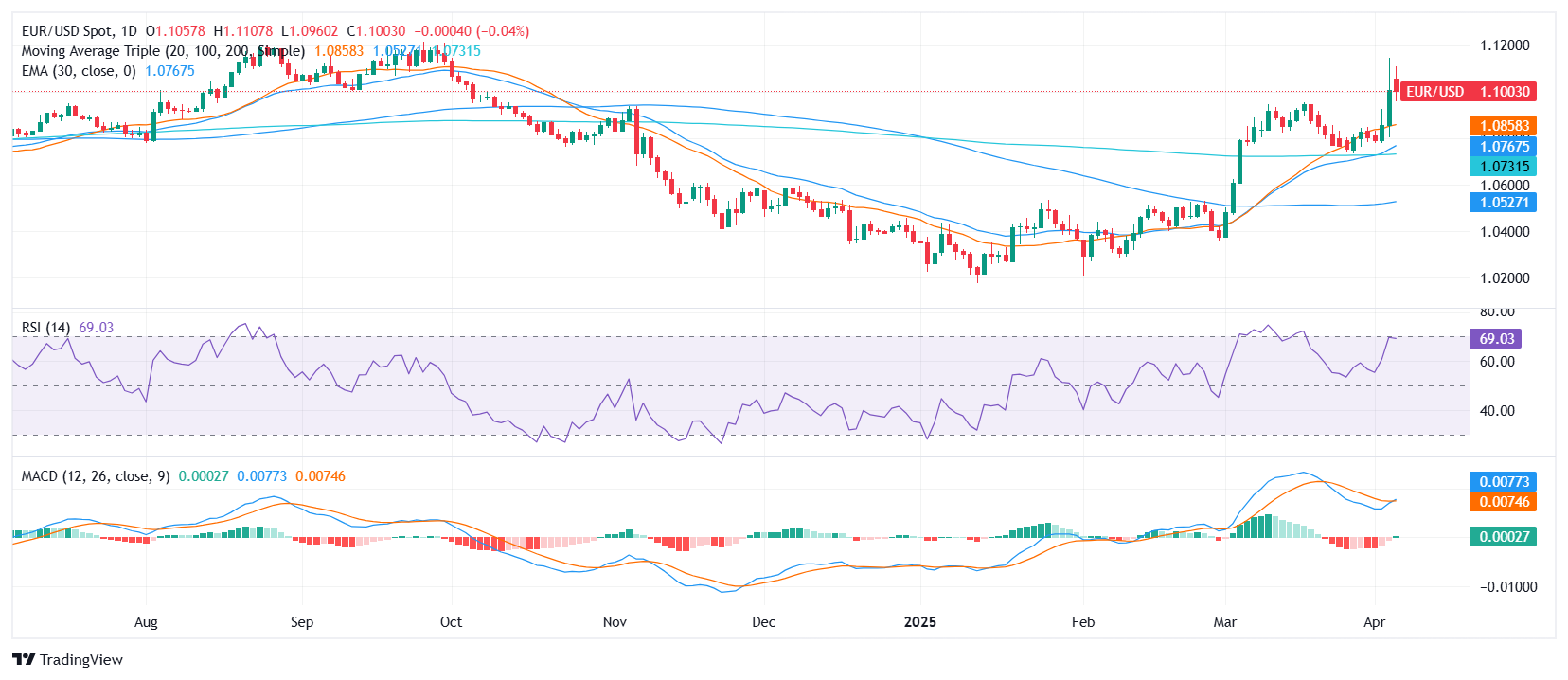
- Support lies near 1.0975 and 1.0880; momentum signals remain mixed despite a bullish moving average structure.

During Friday’s session following the European close, the EUR/USD pair slipped back toward the 1.1000 area, surrendering part of its early-week strength. Despite the setback, the pair remains within a bullish structure, bolstered by key moving averages. The latest downside appears driven by fresh remarks from Fed Chair Jerome Powell, who stressed growing concerns over tariffs raising inflation and clouding the outlook for monetary policy.
Powell’s caution on tariffs unsettles sentiment
Fed Chair Jerome Powell injected a cautious tone into the market by acknowledging that the newly announced tariffs are likely to have a larger and more persistent economic impact than initially expected. He noted that inflationary pressures could rise in the coming quarters and that it remains too early to determine the appropriate direction for interest rates.
Technical overview: Bullish structure under short-term pressure
Technically, the EUR/USD pair still flashes a bullish overall bias despite the recent decline. The Relative Strength Index (RSI) currently hovers near 69, showing waning momentum but still away from overbought territory. The Moving Average Convergence Divergence (MACD) continues to print a positive signal, although fading slightly in intensity. Meanwhile, both the Awesome Oscillator and ADX indicate neutral trends, underscoring the pair’s consolidation phase.
The structure of moving averages supports the bullish narrative. The 10-day Exponential Moving Average and the 10-, 20-, 100-, and 200-day Simple Moving Averages all point to ongoing upward pressure. However, the inability to hold recent highs has pushed the pair closer to immediate support at 1.0975. Below that, additional cushions are seen near 1.0882 and 1.0880. On the upside, a recovery toward the recent peak could open the door for a push toward the 1.1110 region.
Author

Patricio Martín
FXStreet
Patricio is an economist from Argentina passionate about global finance and understanding the daily movements of the markets.

















