|

EUR/USD Technical Analysis: Near term corrective. Could test 1.1590 and above

  • The pair’s recovery has met a strong resistance in the 1.1570 region so far, although the bull run still carries the potential to re-visit the 55-day SMA at 1.1592 ahead of 1.1623, where sits the 21-day SMA.
  • In case the bullish impetus gathers further traction, then the 1.1790 region should return to the radars.
  • On a resumption of the weak note, immediate contention emerges at weekly lows in the 1.1435/30 band ahead of the critical 200-dweek SMA at 1.1326.

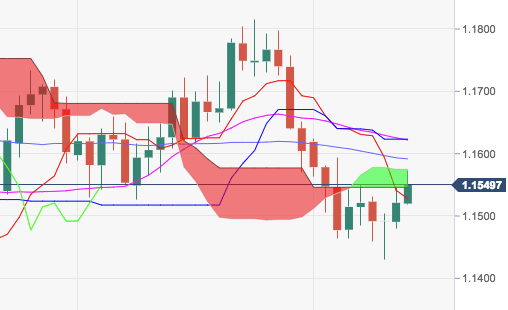
EUR/USD daily chart

EUR/USD

Overview:
    Last Price: 1.1547
    Daily change: 26 pips
    Daily change: 0.226%
    Daily Open: 1.1521
Trends:
    Daily SMA20: 1.1625
    Daily SMA50: 1.1585
    Daily SMA100: 1.163
    Daily SMA200: 1.1925
Levels:
    Daily High: 1.1546
    Daily Low: 1.148
    Weekly High: 1.1625
    Weekly Low: 1.1464
    Monthly High: 1.1816
    Monthly Low: 1.1464
    Daily Fibonacci 38.2%: 1.1521
    Daily Fibonacci 61.8%: 1.1505
    Daily Pivot Point S1: 1.1485
    Daily Pivot Point S2: 1.1449
    Daily Pivot Point S3: 1.1419
    Daily Pivot Point R1: 1.1552
    Daily Pivot Point R2: 1.1582
    Daily Pivot Point R3: 1.1618

Author

Pablo Piovano

Born and bred in Argentina, Pablo has been carrying on with his passion for FX markets and trading since his first college years.


More from Pablo Piovano
Share:

Editor's Picks

AUD/USD languishes near two-month low amid renewed Iran tensions

AUD/USD holds above 0.7000 during the Asian session on Wednesday, though it remains close to a nearly two-month low set the previous day. Fresh US strikes on Iran temper hopes for a peace deal and benefit the safe-haven US Dollar. Furthermore, inflationary concerns continue to fuel hawkish Fed expectations, lending additional support to the buck ahead of the US CPI report. Adding to this, reduced bets on an RBA rate hike in June cap the currency pair.


USD/JPY sits near 160.50 intervention zone as bulls shrug off Japan's strong PPI

USD/JPY consolidates just below mid-160.00s, or its highest level since late April, as economic concerns stemming from the Middle East conflict continue to undermine the Japanese Yen (JPY). Furthermore, a fresh wave of US strikes on Iran benefits the safe-haven US Dollar and acts as a tailwind for the currency pair, countering Japan's hotter-than-expected PPI report. However, intervention fears cap the upside as traders seem hesitant ahead of the US consumer inflation figures later this Wednesday.

Gold flirts with $4,200, lowest since March 23 on hawkish Fed bets

Gold drops to a fresh low since March 23, around the $4,200 mark during the Asian session on Wednesday, as fresh US strikes on Iran fuel inflationary concerns and bolster bets for more hawkish central banks, including the US Fed. Meanwhile, US Dollar bulls are turning cautious ahead of the US CPI report, which could limit bullion losses. However, the recent breakdown below the 200-day SMA suggests that the path of least resistance for the XAU/USD is to the downside.

Bitcoin sell-off pushes over 50% of circulating supply into loss, hinting at market bottom

Bitcoin dropped near $61,000 on Tuesday, with the latest sell-off pushing long-term market indicators toward levels historically associated with bear-market bottoms, according to a report by K33 Research.

When the chips are down, the AI tape starts to shake

The market came into Tuesday trying to sell investors the comforting ”Turnaround Tuesday” idea that Friday’s AI fracture was just another pothole on the road higher. By the close, that story had lost its bid. Monday’s dead cat bounce had done what dead cat bounces always do.

The US economy defies the rules: 100 days into the Oil shock and the recession signal is still missing

More than three months after the start of the Iran war and the resulting disruption to global energy markets, the US economy continues to display remarkable resilience. The conflict has triggered a sharp rise in Oil prices, reignited inflationary pressures and fueled widespread concerns about a potential economic slowdown.