|

EUR/USD surges above 1.1700 as weak US NFP drags US Dollar and yields lower

The Euro (EUR) rallies against the US Dollar (USD) on Friday after the US Nonfarm Payrolls (NFP) report disappointed with just 22K jobs added in August, far below the 75K expected and July’s 79K (revised from 73K).

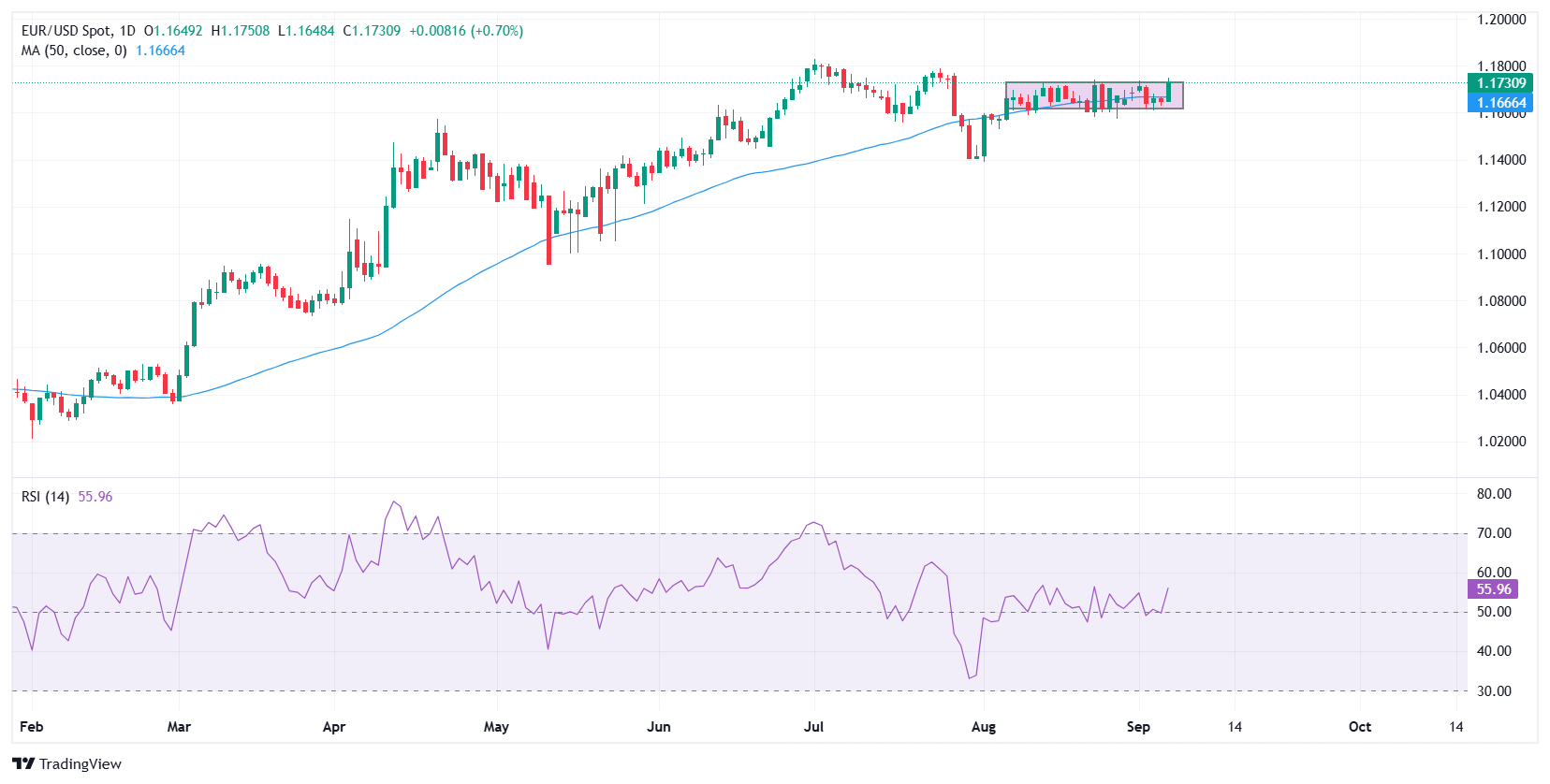
The Unemployment Rate rose to 4.3% from 4.2%, while Average Hourly Earnings rose 0.3% MoM and 3.7% YoY, in line with forecasts. EUR/USD surged over 40 pips to trade around 1.1740, up nearly 0.70% on the day.

The softer jobs data highlighted ongoing weakness in the US labor market, reinforcing expectations that the Federal Reserve (Fed) will cut rates at its September 16-17 meeting. While markets are already pricing in a 25 basis point (bps) cut, the weak headline payrolls print is likely to fuel speculation over the possibility of a larger 50 bps move to counter slowing growth.

US Treasury yields tumbled in response, with the 10-year falling to 4.09% and the rate-sensitive 2-year dropping to 3.50%, both at their lowest levels since April 7. The sharp decline in yields reflected mounting expectations of deeper Fed easing, adding further pressure on the Greenback.

The US Dollar Index (DXY), which tracks the Greenback against six major peers, weakened sharply after the release, slipping below 98.00 to trade near 97.65, down nearly 0.65% on the day. The index is hovering near the lower end of the narrow range established since August.

Meanwhile, EUR/USD is also testing the upper end of its recent range near 1.1730. A breakout above this level could open the way toward the July 24 high at 1.1789, while immediate support is seen at 1.1700 and the 50-day SMA at 1.1666.
Author

Vishal Chaturvedi

I am a macro-focused research analyst with over four years of experience covering forex and commodities market. I enjoy breaking down complex economic trends and turning them into clear, actionable insights that help traders stay ahead of the curve.


More from Vishal Chaturvedi
Share:

Editor's Picks

GBP/USD retreats from weekly high vs firmer USD as focus shifts to BoE, US data

The GBP/USD pair struggles to capitalize on the previous day's strong move up to the weekly high and drifts lower during the Asian session on Thursday. Spot prices currently trade around mid-1.3300s, down over 0.10% for the day, and, for now, seem to have stalled the recovery move from a nearly four-week low, touched on Tuesday.

EUR/USD edges lower to near 1.1450 ahead of German/ EU GDP

EUR/USD trades with mild losses around 1.1450 in the early European hours on Thursday. The US Dollar recovers ground on renewed Mideast hostilities, despite a cautious Fed hold. Traders now brace for preliminary readings of the second-quarter Gross Domestic Product (GDP) from Germany, the Eurozone and the US. 


Gold extends intraday rejection slide from $4,100

Gold extends its intraday rejection slide from the $4,100 mark and moves further away from a one-week high, touched the previous day. The US Dollar regains positive traction following Wednesday's post-FOMC decline and is seen as a key factor weighing on the commodity. 

Mixed signals leave XRP and XLM at crossroads

Ripple and Stellar are trading at critical technical levels on Thursday. XRP has stabilized above the psychological $1.00 support, while XLM is testing support at $0.173. Traders should be cautious as mixed derivatives metrics keep the outlook uncertain for both altcoins. Derivatives data shows mixed sentiment among traders. CoinGlass’ long-to-short ratio for XRP reads 1.02 on Thursday.

Fed review: Reversing course (?)
At face value, the FOMC's 9-3 split decision hold was exactly in line with the expectations we laid out in our Fed preview - a divided hold, 22 July. We also named the three dissenters - Hammack, Logan and Kashkari - as the most likely hawks to support rapid tightening.
US Dollar mid-year outlook: Exceptional currency, exceptional risks?
The US Dollar enters the second half of 2026 in a markedly different position from a year ago. The King currency has recovered, reflecting persistent US inflation, changing expectations for Fed policy, geopolitical tensions and renewed demand for defensive assets.















