|

EUR/USD struggles below 1.2200 ahead of data, Powell

  • The pair remains depressed below the key 1.2200 handle.
  • Decent support appears to have emerged around 1.2180.
  • Spot ignored PMIs, now looks to US ISM and Powell.

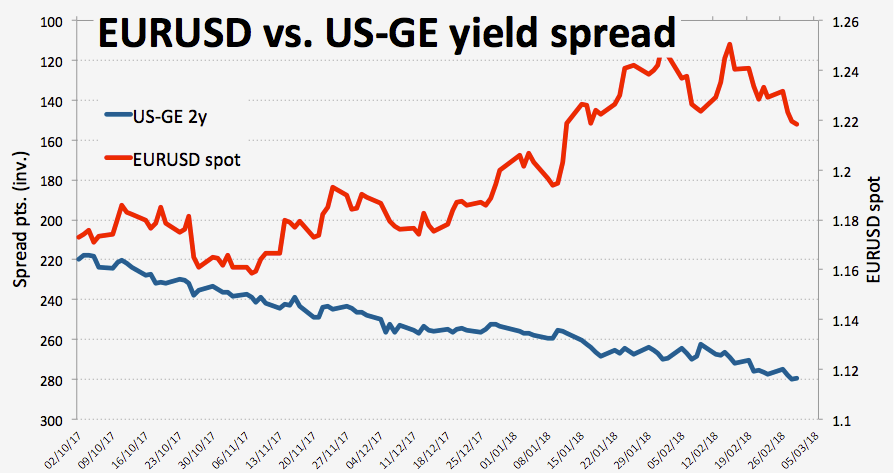
The demand for the single currency remains absent so far this week, forcing EUR/USD to drop to the area of 1.2180 earlier in the session, where it seems to have met some dip-buyers.

EUR/USD now looks to US docket, Powell

After bottoming out in fresh 6-week lows around 1.2180, the pair seems to have found some buying interest and is now looking to regain the 1.2200 neighbourhood amidst the persistent upside pressure in the buck.

Earlier in the session, final manufacturing PMIs in the euro area for the month of January came in on the strong side, although traders largely ignored the results as the focus remain on the US docket and the second testimony by Fed’s Powell.

The current rebound in spot came along a correction lower in yields of the US 10-year reference, which are now navigating session lows near 2.84%.

Later in the NA session, inflation figures tracked by the PCE are due, seconded by Personal Income/Spending, ISM manufacturing and Powell’s testimony before the Senate Banking Committee.

In addition, New York Fed and permanent voter W.Dudley (centrist) is also due to speak later in the NA session.

EUR/USD levels to watch

At the moment, the pair is losing 0.06% at 1.2186 and a breach of 1.2180 (low Mar.1) would target 1.2167 (50% Fibo of 2014-2017 drop) en route to 1.2165 (low Jan.18). On the upside, the immediate hurdle is located at 1.2301 (10-day sma) seconded by 1.2337 (21-day sma) and then 1.2356 (high Feb.26).
Author

Pablo Piovano

Born and bred in Argentina, Pablo has been carrying on with his passion for FX markets and trading since his first college years.


More from Pablo Piovano
Share:

Markets move fast. We move first.

Orange Juice Newsletter brings you expert driven insights - not headlines. Every day on your inbox.

By subscribing you agree to our Terms and conditions.

Editor's Picks

EUR/USD posts modest gains above 1.1700 as ECB signals pause

The EUR/USD pair posts modest gains around 1.1710 during the early Asian session on Monday. The Euro strengthens against the Greenback after the European Central Bank left its policy rates unchanged and took a more positive view on the Eurozone economy, which has shown resilience to global trade shocks. Financial markets are likely to remain subdued as traders book profits ahead of the long holiday period.

GBP/USD gains ground near 1.3400 ahead of UK Q3 GDP data

GBP/USD gains ground after three days of losses, trading around 1.3390 during the Asian hours on Monday. The pair depreciates as the Pound Sterling holds ground ahead of the release of the United Kingdom Gross Domestic Product for the third quarter.

Gold sits at record high near $4,400 amid renewed geopolitical woes

Gold is sitting near $4,400 early Monday, renewing lifetime highs, helped by renewed geopolitical tensions. Israel-Iran conflict and US-Venezuela headlines drive investors toward the traditional store of value, Gold. 

Top Crypto Gainers: Audiera, Midnight, MemeCore sustain weekend gains

Audiera, Midnight, and MemeCore recorded double-digit gains on Sunday and remain top performers over the last 24 hours. Audiera extends the rally while Midnight takes a breather, and MemeCore struggles at a crucial moving average. 

De-dollarisation by design: Gold’s partner in the new system

You don’t need another 2008 for the system to reset. You just need enough nations to stop settling trade in dollars. And that’s already happening. "If gold is the anchor, what actually moves value in a post-dollar world?” It’s a question most gold investors overlook. We think in terms of storage and preservation, but in the new rails being built, settlement speed matters just as much as soundness of money.

XRP rebounds amid ETF inflows and declining retail demand demand

XRP rebounds as bulls target a short-term breakout above $2.00 on Friday. XRP ETFs record the highest inflow since December 8, signaling growing institutional appetite.