|

EUR/USD - Strong EUR call bias & vols pick up, eyes Catalan crisis & ECB

EUR/USD was offered at the 50-day moving average hurdle on Friday as renewed hopes of tax reform in the US put a bid under the US dollar. The currency pair fell to 1.1762 on Friday and extended losses to 1.1751 in Asia.

One-week risk reversals rise, vols pick up
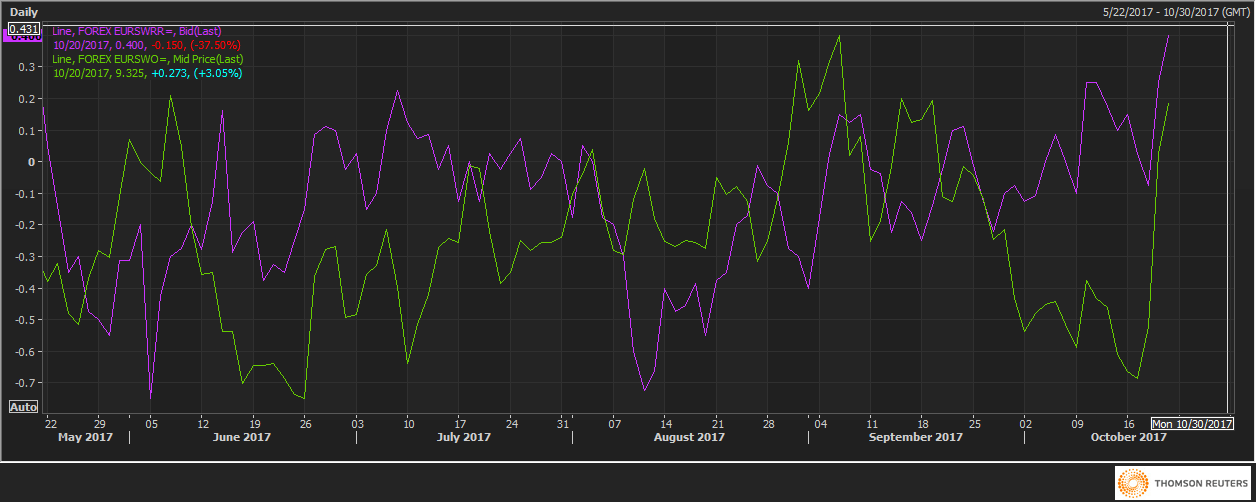
  • The one-week 25-delta risk reversals ticked higher to 0.40 on Friday; the highest since September 2016. It shows a strong EUR call (bullish bets) bias.
  • One-week at the money (ATM) option volatility rose to 9.325; the highest level since Sep. 19

The strong call bias shows could be a sign of complacency in the market. Catalonia parliament is set to meet over the coming days to decide its response to the Spanish government’s unprecedented decision to impose direct rule. The crisis looks poised to escalate further.

Focus on ECB

Kathy Lien from BK Asset Management writes, " we believe that the central bank will opt for a dovish taper - cutting bond purchases by only 20B and extend it to September or beyond because they can always adjust it later and right now there's too much political uncertainty.  If we are right, the euro will fall and if we're wrong and the ECB marries a more aggressive reduction with hawkish comments from Draghi, EUR/USD will hit 1.20 easily."

The increase in demand for EUR calls indicates that investors believe the ECB would deliver a hawkish taper. If the ECB disappoints and/or Catalan crisis escalates, the resulting unwinding of long call positions could feed into the spot (aggravate the drop in the EUR/USD).

EUR/USD Technical Outlook

Friday's move appears to have opened doors for a sell-off to head and shoulder neckline level of 1.1660. A break below the neckline would signal the rally from the January low of 1.0341 has ended. As per the measured height method, the spot could then target 1.1228 levels.

 TREND INDEXOB/OS INDEXVOLATILY INDEX
15MBearishOverbought Shrinking
1HBearishNeutral Low
4HStrongly BearishOversold Expanding
1DStrongly BearishNeutral Low
1WBearishNeutral Shrinking

Author

Omkar Godbole

Omkar Godbole

FXStreet Contributor

Omkar Godbole, editor and analyst, joined FXStreet after four years as a research analyst at several Indian brokerage companies.


More from Omkar Godbole
Share:

Editor's Picks

GBP/USD clings to multi-day peaks below 1.3500

GBP/USD trades with marked gains on Friday, now giving away some gains following an earlier surpass of the key 1.3500 yardstick. Indeed, Cable gathers fresh steam amid the strong offered stance in the Greenback, all after US NFP badly missed expectations in July.

EUR/USD: Post-NFP bounce falters around 1.1580

EUR/USD reverses Thursday’s decline and trades with solid gains in the 1.1560 region, or two-month peaks, on Friday. The pair’s firm performance comes in a context of a sharp correction in the US Dollar as investors continue to assess disheartening US NFP readings.

How Wall Street rigs the game [Video]

In this week’s Live from the Vault, Andrew Maguire is joined by Peter Antico and Sean Stone to discuss the Paradigm of Money - an in-depth expose of financial market corruption, from naked shorting to the two-tier system that protects Wall Street.

XRP Price Forecast: XRP nears critical $1.00 support
Ripple (XRP) remains pressured on Friday, trading around $1.03 at the time of writing. The token appears to hold this current level as support but lacks a catalyst to sustain a knee-jerk rebound toward the next key resistance at $1.10.
Is Gold about to enter its biggest bull run since 2020?
Gold has stormed back into the spotlight and its next move could leave late buyers chasing. On August 5, the yellow metal surged almost 7% – roughly $174 – to close near $4,308 an ounce, posting one of its biggest daily advances in recent history. A weaker U.S dollar, falling Treasury yields, changing Federal Reserve expectations and renewed safe-haven demand all struck at once.
9-3: Is the Federal Reserve’s vote tally Warsh's new forward guidance?
The rate did not move. Neither did the statement, and that’s the more interesting fact. Set the July 29 Federal Open Market Committee (FOMC) statement beside the one issued on June 17, and the two documents are identical apart from a single verb and a paragraph at the bottom naming three dissenters.