EUR/USD steadies below 1.1650 as markets await Powell’s Jackson Hole speech
- EUR/USD holds around 1.1640, consolidating losses as traders await Powell’s speech on Friday.
- Fed cut bets split: CPI fueled talks of 50 bps easing, but hot PPI trimmed expectations back to 25 bps or even a hold.
- Euro's boosted by peace efforts advance as Trump pushes for a Zelenskiy–Putin meeting.

EUR/USD consolidates during the North American session above the 1.1600 figure as traders await the Federal Reserve (Fed) Chair Jerome Powell's speech at Jackson Hole, alongside the outcome of the Ukraine-Russia conflict solution. The pair trades at around 1.1640, down 0.12% at the time of writing.
The economic docket in the United States (US) featured housing data on Tuesday, which was mainly ignored by investors. Last week’s inflation figures on the consumer and producer side generated a two-way pricing for a Fed rate cut.
Initially, after the Consumer Price Index (CPI) release, some traders speculated with a 50 basis points (bps) rate cut —sparked by Bessent’s interview on Fox Business— as figures mainly remained unchanged. Nevertheless, the jump in the Producer Price Index (PPI) triggered a shift in the other direction, with most markets reflecting a 25 bps rate cut, and some players expecting the central bank to hold rates.
Therefore, the Fed Chair Powell’s speech on Friday could set the interest rate path towards the second half of 2025.
Aside from this, upbeat news regarding a possible de-escalation of the conflict in Eastern Europe between Ukraine and Russia could boost the Euro, on a positive outcome. Meanwhile, US President Donald Trump is pushing for a meeting between Zelenskiy and Putin, so they can solve their differences and reach peace.
A scarce economic docket in the European Union (EU) leaves traders adrift to the release of inflation figures in the EU, HCOB Flash PMIs for August, and Germany's Gross Domestic Product (GDP) figures.
Daily digest market movers: EUR/USD dives as the Greenback strengthens
- The recovery of the US Dollar has capped Euro’s advance. The US Dollar Index, which measures the buck’s performance against a basket of peers, is up 0.14% daily to 98.27.
- The direction of EUR/USD is influenced by haven demand and monetary policy divergence between the Fed and the European Central Bank (ECB). Expectations that the Fed will reduce rates at the September meeting remain high at around 86%. Across the Atlantic, the ECB is expected to hold rates unchanged, with odds standing at 92% for the central bank to keep rates unchanged, and a slim 8% chance of a 25 basis points (bps) rate cut.
- Economic data in the US showed mixed signals in housing activity in July. Housing Starts jumped 5.2%, rising from 1.321 million to 1.428 million and defying expectations for a drop to 1.3 million. However, Building Permits fell during the same period, slipping from 1.393 million to 1.354 million, hinting at potential softness in future residential construction.
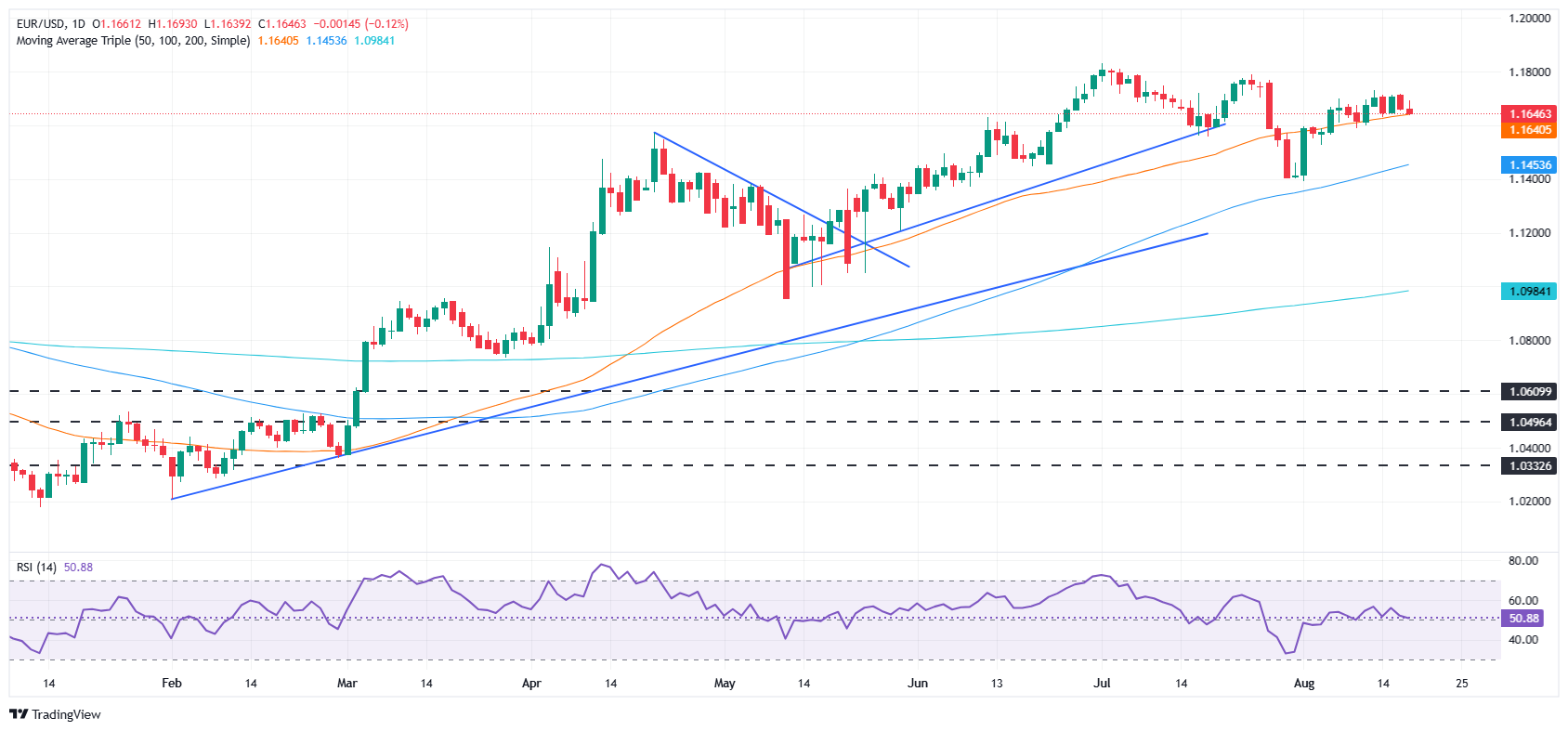
Euro’s technical outlook: EUR/USD tumbles below 1.1700, sellers eye 1.1600
EUR/USD seems to have peaked, having hit a low of 1.1646 over the past three trading days, which indicates that buyers are losing steam. From a momentum standpoint, the Relative Strength Index (RSI) remains bullish, but is approaching its neutral line. Once crossed, this would be an indication that sellers are overtaking buyers.
If EUR/USD reclaims 1.1700, the next resistance would be the July 24 high of 1.1788, the psychological 1.1800 handle, and the year-to-date peak of 1.1829. Conversely, a drop below the confluence of the 50- and 20-day Simple Moving Average (SMA) at 1.1639/27, sponsors a move towards 1.1600 ahead of the 100-day SMA at 1.1460.
Euro FAQs
The Euro is the currency for the 19 European Union countries that belong to the Eurozone. It is the second most heavily traded currency in the world behind the US Dollar. In 2022, it accounted for 31% of all foreign exchange transactions, with an average daily turnover of over $2.2 trillion a day. EUR/USD is the most heavily traded currency pair in the world, accounting for an estimated 30% off all transactions, followed by EUR/JPY (4%), EUR/GBP (3%) and EUR/AUD (2%).
The European Central Bank (ECB) in Frankfurt, Germany, is the reserve bank for the Eurozone. The ECB sets interest rates and manages monetary policy. The ECB’s primary mandate is to maintain price stability, which means either controlling inflation or stimulating growth. Its primary tool is the raising or lowering of interest rates. Relatively high interest rates – or the expectation of higher rates – will usually benefit the Euro and vice versa. The ECB Governing Council makes monetary policy decisions at meetings held eight times a year. Decisions are made by heads of the Eurozone national banks and six permanent members, including the President of the ECB, Christine Lagarde.
Eurozone inflation data, measured by the Harmonized Index of Consumer Prices (HICP), is an important econometric for the Euro. If inflation rises more than expected, especially if above the ECB’s 2% target, it obliges the ECB to raise interest rates to bring it back under control. Relatively high interest rates compared to its counterparts will usually benefit the Euro, as it makes the region more attractive as a place for global investors to park their money.
Data releases gauge the health of the economy and can impact on the Euro. Indicators such as GDP, Manufacturing and Services PMIs, employment, and consumer sentiment surveys can all influence the direction of the single currency. A strong economy is good for the Euro. Not only does it attract more foreign investment but it may encourage the ECB to put up interest rates, which will directly strengthen the Euro. Otherwise, if economic data is weak, the Euro is likely to fall. Economic data for the four largest economies in the euro area (Germany, France, Italy and Spain) are especially significant, as they account for 75% of the Eurozone’s economy.
Another significant data release for the Euro is the Trade Balance. This indicator measures the difference between what a country earns from its exports and what it spends on imports over a given period. If a country produces highly sought after exports then its currency will gain in value purely from the extra demand created from foreign buyers seeking to purchase these goods. Therefore, a positive net Trade Balance strengthens a currency and vice versa for a negative balance.
Author

Christian Borjon Valencia
FXStreet
Markets analyst, news editor, and trading instructor with over 14 years of experience across FX, commodities, US equity indices, and global macro markets.

















