EUR/USD stable near 1.1740 as Fed officials suggest a pause in easing
- Fed speakers stress inflation concerns, reinforcing a wait-and-see stance after Wednesday’s rate cut.
- Market focus turns to delayed US data as policymakers defend their split December decision.
- Eurozone inflation is mixed, yet technicals point toward further EUR/USD upside if 1.1762 breaks.


EUR/USD holds firm at around 1.1741 on Friday, virtually unchanged, amid a parade of Federal Reserve (Fed) officials crossing the wires, following last Wednesday's 25 basis points rate cut.
EUR/USD tilted to the upside despite hawkish Fed comments tempering dovish expectations
Despite cutting rates, the Fed hinted that it would pause its easing cycle, entering a wait-and-see period as it digests delayed economic data due to the US government shutdown.
In the meantime, Cleveland Fed Beth Hammack was hawkish, saying that “price pressures have been too high,” adding the Fed’s commitment to achieve inflation 2% goal. She added that the Fed decision was complicated and that policy is right around neutral.
At the same time, Chicago Fed Austan Goolsbee, one of the dissenters at the December meeting, justified his decision because he believed that they should wait for more information, particularly inflation. He commented that waiting until Q1 2026 for rate cuts would have allowed the Fed to be sure that inflation is falling
Kansas City Fed Jeffrey Schmid said that he dissented against the rate cut because not much has changed in the economy since October, when he also dissented. Schmid added that he hears concerns about inflation from the people in the district.
Philadelphia Fed Anna Paulson said that she doesn’t see tariffs translating into widespread price increases, adding that she’s more concerned about job risks than inflation.
In Europe, Germany’s Harmonized Index of Consumer Prices (HICP), the European Central Bank (ECB) inflation measure, dipped 0.5% MoM in November, as expected, aligned with October's print. On an annual basis, it remained at 2.6%, as estimated by analysts.
In Spain, the HICP for the same period rose by 3.2% YoY, up from estimates and October’s 3.1% print.
EUR/USD Price Forecast: Technical outlook
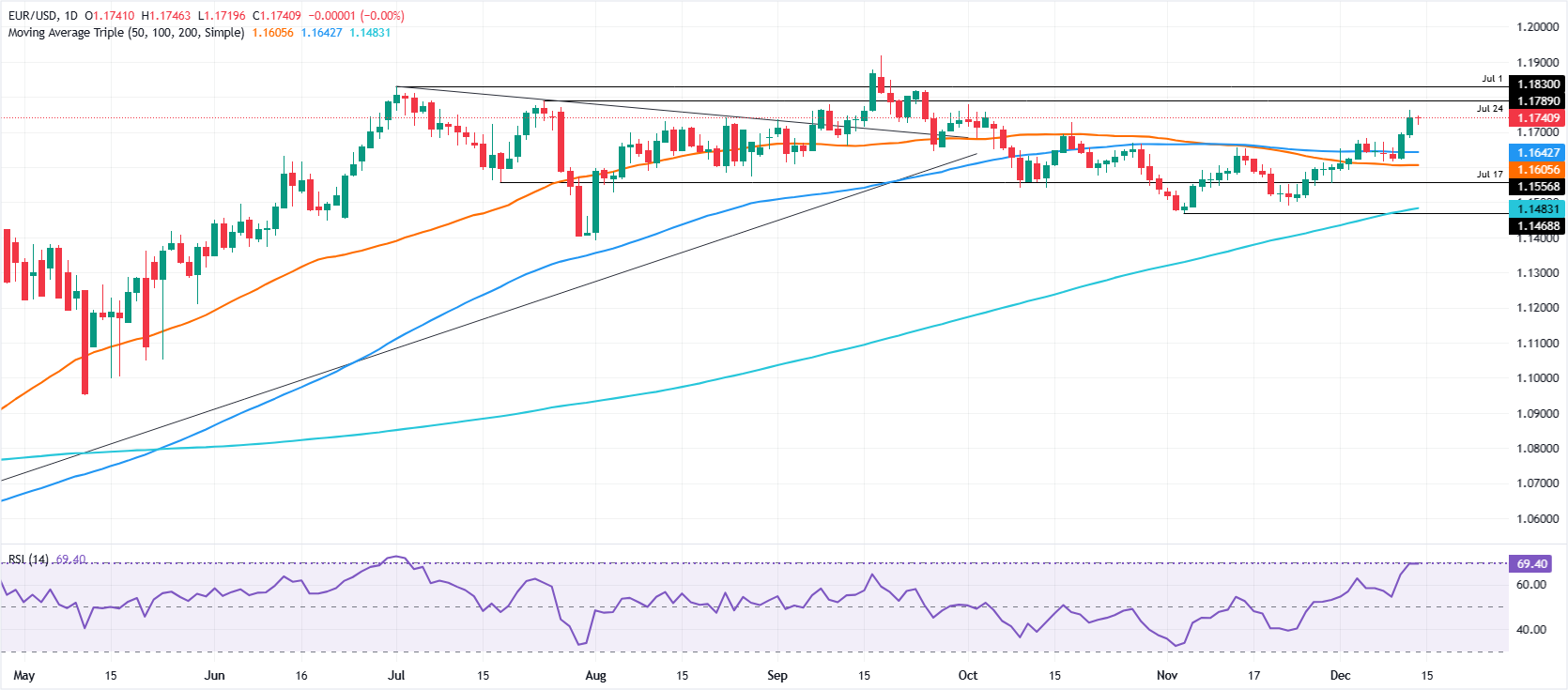
Given the fundamental backdrop, the ERU/USD technical picture suggests that the pair is neutral to upward-biased, which could be cemented if the pair finishes the week above 1.1700. The Relative Strength Index (RSI) shows that buyers are gathering momentum, so further upside lies ahead.
If EUR/USD clears the December 11 high of 1.1762, the next resistance would be 1.1800, followed by the 1.1850 area, ahead of the yearly peak of 1.1918. Conversely, if the pair tumbles below 1.1700, the first support would be the 100-day SMA at 1.1641 ahead of 1.1600.
Euro Price This week
The table below shows the percentage change of Euro (EUR) against listed major currencies this week. Euro was the strongest against the Japanese Yen.
| USD | EUR | GBP | JPY | CAD | AUD | NZD | CHF | |
|---|---|---|---|---|---|---|---|---|
| USD | -0.80% | -0.22% | 0.30% | -0.29% | -0.06% | -0.37% | -1.07% | |
| EUR | 0.80% | 0.61% | 1.17% | 0.56% | 0.80% | 0.47% | -0.23% | |
| GBP | 0.22% | -0.61% | 0.56% | -0.06% | 0.19% | -0.15% | -0.85% | |
| JPY | -0.30% | -1.17% | -0.56% | -0.58% | -0.35% | -0.66% | -1.35% | |
| CAD | 0.29% | -0.56% | 0.06% | 0.58% | 0.24% | -0.08% | -0.78% | |
| AUD | 0.06% | -0.80% | -0.19% | 0.35% | -0.24% | -0.34% | -1.03% | |
| NZD | 0.37% | -0.47% | 0.15% | 0.66% | 0.08% | 0.34% | -0.70% | |
| CHF | 1.07% | 0.23% | 0.85% | 1.35% | 0.78% | 1.03% | 0.70% |
The heat map shows percentage changes of major currencies against each other. The base currency is picked from the left column, while the quote currency is picked from the top row. For example, if you pick the Euro from the left column and move along the horizontal line to the US Dollar, the percentage change displayed in the box will represent EUR (base)/USD (quote).
Author
Christian Borjon Valencia
FXStreet
Markets analyst, news editor, and trading instructor with over 14 years of experience across FX, commodities, US equity indices, and global macro markets.