EUR/USD plummets as USD strengthens after US Trump tariff threats got real
- EUR/USD faces an intense sell-off as US President Donald Trump confirms that he will impose tariffs on the European Union.
- The US Dollar strengthens as investors rush to safe-haven fleet amid global trade war.
- Investors await the US NFP data for January.
EUR/USD nosedives over 1% to near 1.0240 at the start of the week. The major currency pair plummets as United States (US) President Donald Trump reiterates threats to impose tariffs on the European Union (EU). Over the weekend, Donald Trump slapped 25% tariffs on Canada and Mexico and 10% on China. Trump also warned that he will also raise levies on the trading bloc, but he didn’t provide much information.
"It will definitely happen with the European Union. I can tell you that because they've really taken advantage of us," Trump said. He also accused the old continent of not buying enough US cars and farm products. Trump added that the EU take “almost nothing and we take everything from them”.
The imposition of tariffs on the Eurozone will accelerate its troubles. The shared currency bloc is already facing risks of a slowdown. Preliminary Eurozone Gross Domestic Product (GDP) data for the fourth quarter of 2024 showed that the economy was flat after expanding 0.4% in the third quarter. The shrinking German economy remained the weak link to the Eurozone's flat GDP growth. Flash German GDP data showed that the economy contracted by 0.2% year-over-year in the last quarter of 2024.
Signs of further weakness in the Eurozone economy could force the European Central Bank (ECB) to continue reducing interest rates. The ECB reduced its Deposit Facility rate by 25 basis points (bps) to 2.75% on Thursday and guided that the monetary policy path is clear, which is expansionary. Traders have fully priced in three interest rate cuts and see them coming by the summer as ECB officials are confident that inflation will sustainably return to the desired rate of 2% this year.
On Monday, a flash Harmonized Index of Consumer Prices (HICP) report for January showed that price pressures deflated on a month-on-month basis. The core HICP – which excludes volatile food and energy prices – deflated by 1% after growing 0.5% in December. In the same period, the headline HICP also deflated by 0.4%. On year, the headline HICP rose steadily by 2.7%, faster than estimates of 2.6%. The core HICP rose expectedly by 2.5%, faster than expectations of 2.4%.
Euro PRICE Today
The table below shows the percentage change of Euro (EUR) against listed major currencies today. Euro was the strongest against the New Zealand Dollar.
| USD | EUR | GBP | JPY | CAD | AUD | NZD | CHF | |
|---|---|---|---|---|---|---|---|---|
| USD | 1.04% | 0.34% | -0.31% | -0.32% | 0.91% | 0.43% | 0.01% | |
| EUR | -1.04% | -0.30% | -0.05% | -0.05% | 0.34% | 0.69% | 0.28% | |
| GBP | -0.34% | 0.30% | -0.82% | 0.24% | 0.64% | 1.00% | 0.58% | |
| JPY | 0.31% | 0.05% | 0.82% | -0.00% | 1.38% | 1.66% | 0.97% | |
| CAD | 0.32% | 0.05% | -0.24% | 0.00% | 0.13% | 0.74% | 0.33% | |
| AUD | -0.91% | -0.34% | -0.64% | -1.38% | -0.13% | 0.35% | -0.08% | |
| NZD | -0.43% | -0.69% | -1.00% | -1.66% | -0.74% | -0.35% | -0.41% | |
| CHF | -0.01% | -0.28% | -0.58% | -0.97% | -0.33% | 0.08% | 0.41% |
The heat map shows percentage changes of major currencies against each other. The base currency is picked from the left column, while the quote currency is picked from the top row. For example, if you pick the Euro from the left column and move along the horizontal line to the US Dollar, the percentage change displayed in the box will represent EUR (base)/USD (quote).
Daily digest market movers: EUR/USD declines as US Trump starts global trade war
- EUR/USD faces an intense sell-off due to the strength of the US Dollar (USD). The safe-haven demand for the US Dollar has increased significantly as US President Trump has started a trade war. The US Dollar Index (DXY), which tracks the Greenback’s value against six major currencies, surges above 109.50.
- The US Dollar’s movement is mainly influenced by Trump’s comments on global trade. However, investors will also focus on a slew of US economic data, such as ISM Manufacturing and Services Purchasing Managers Index (PMI), ADP Employment Change and the Nonfarm Payrolls (NFP) for January, and JOLTS Job Openings for December, which will release this week.
- Investors will pay close attention to labor market-related data to know its current status. On Wednesday, the Fed kept interest rates at their current levels and guided that the central bank will stay in the waiting mode until it sees “real progress in inflation or some weakness in the labor market”.
Technical Analysis: EUR/USD retreats below 20-day EMA
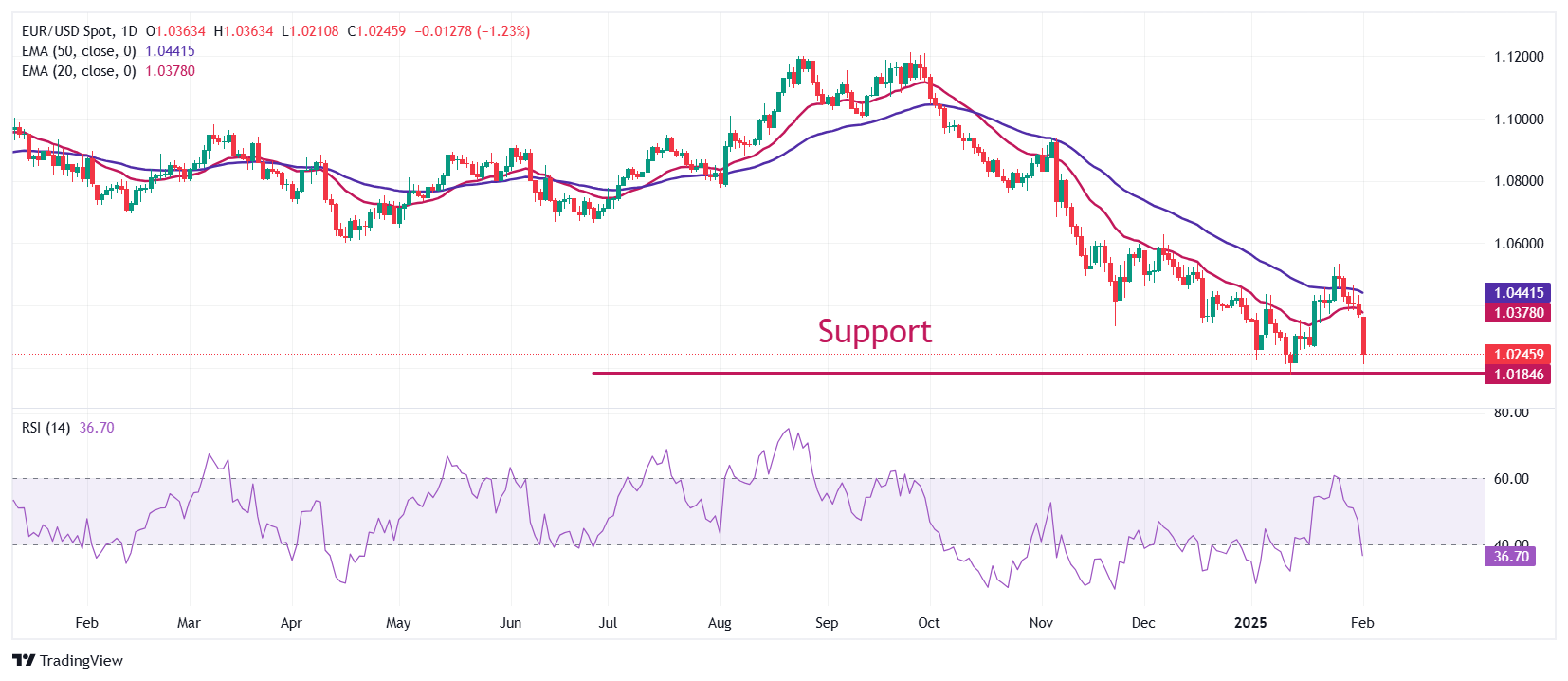
EUR/USD dives vertically to near 1.0200. Last week, the major currency pair started declining after a short-lived recovery move to 1.0533, which market participants capitalized for adding shorts. The pair has fallen below the 20- and 50-day Exponential Moving Averages (EMAs) around 1.0378 and 1.0440, respectively, suggesting a bearish trend.
The 14-day Relative Strength Index (RSI) slides below 40.00, suggesting a strong bearish momentum.
Looking down, the January 13 low of 1.0177 and the round-level support of 1.0100 will act as major support zones for the pair. Conversely, the psychological resistance of 1.0500 will be the key barrier for the Euro bulls.
Tariffs FAQs
Tariffs are customs duties levied on certain merchandise imports or a category of products. Tariffs are designed to help local producers and manufacturers be more competitive in the market by providing a price advantage over similar goods that can be imported. Tariffs are widely used as tools of protectionism, along with trade barriers and import quotas.
Although tariffs and taxes both generate government revenue to fund public goods and services, they have several distinctions. Tariffs are prepaid at the port of entry, while taxes are paid at the time of purchase. Taxes are imposed on individual taxpayers and businesses, while tariffs are paid by importers.
There are two schools of thought among economists regarding the usage of tariffs. While some argue that tariffs are necessary to protect domestic industries and address trade imbalances, others see them as a harmful tool that could potentially drive prices higher over the long term and lead to a damaging trade war by encouraging tit-for-tat tariffs.
During the run-up to the presidential election in November 2024, Donald Trump made it clear that he intends to use tariffs to support the US economy and American producers. In 2024, Mexico, China and Canada accounted for 42% of total US imports. In this period, Mexico stood out as the top exporter with $466.6 billion, according to the US Census Bureau. Hence, Trump wants to focus on these three nations when imposing tariffs. He also plans to use the revenue generated through tariffs to lower personal income taxes.
Author

Sagar Dua
FXStreet
Sagar Dua is associated with the financial markets from his college days. Along with pursuing post-graduation in Commerce in 2014, he started his markets training with chart analysis.

















