EUR/USD slips to 1.1640 as US labor woes boost Dollar ahead of NFPs
- The Euro falls from weekly high of 1.1736 as soft Eurozone retail sales and stronger Dollar weigh on momentum.
- US job cuts rise, ADP employment disappoints, and Jobless Claims climb, fueling near-full pricing of Fed cut.
- ECB’s Schnabel strikes hawkish tone, but traders await Friday’s NFPs for confirmation of labor market weakness.

The EUR/USD retreats after reaching a weekly high of 1.1736 on September 1, as economic data from the US drives the Dollar higher against the shared currency, which witnessed a soft Retail Sales report. The pair trades at 1.1640, down 0.12%.
Euro retreats on weak EU Retail Sales, while US jobs data and looming Fed cut dominate sentiment
A tranche of US economic data showed that the labor market is deteriorating. The August Challenger Job cuts showed that companies slashed close to 86K Americans from the labor force, while the ADP National Employment Change report in August, fell short of estimates. The number of people filling up for unemployment benefits rose, amid an environment in which jobs data has taken the center stage.
Market participants are near to fully price in a 25-basis points rate cut by the Fed. Nevertheless, the Nonfarm Payrolls report looming, suggests that EUR/USD traders should wait for the release, before opening fresh positions.
Other data showed that the Trade Balance witnessed an increase in the deficit in July as companies rushed to increase supplies and inventory ahead of tariffs becoming effective. At the same time, business activity in the services sector improved, according to the Institute for Supply Management (ISM).
Given the fundamental backdrop in the US, the scenario suggests that the economy is slowing down, but it remains solid. Nevertheless, the labor market seems to be taking its toll, justifying Fed Chair Jerome Powell pivot in Jackson Hole, where he opened the door to adjust interest rates.
Across the pond, softer than expected Retail Sales report, exerted pressure on the Euro. Despite this, further EUR/USD upside is seen, after Isabel Schnabel, member of the European Central Bank (ECB) was hawkish, calling for steady rates as the economy remains steady.
Traders’ eyes shift to Nonfarm Payroll figures on Friday, with economists expecting the economy to add 75K jobs in August.
Euro Price This week
The table below shows the percentage change of Euro (EUR) against listed major currencies this week. Euro was the strongest against the Japanese Yen.
| USD | EUR | GBP | JPY | CAD | AUD | NZD | CHF | |
|---|---|---|---|---|---|---|---|---|
| USD | 0.41% | 0.47% | 0.96% | 0.62% | 0.47% | 0.79% | 0.73% | |
| EUR | -0.41% | 0.06% | 0.50% | 0.20% | 0.05% | 0.36% | 0.33% | |
| GBP | -0.47% | -0.06% | 0.32% | 0.14% | -0.01% | 0.31% | 0.32% | |
| JPY | -0.96% | -0.50% | -0.32% | -0.29% | -0.49% | -0.15% | -0.19% | |
| CAD | -0.62% | -0.20% | -0.14% | 0.29% | -0.14% | 0.14% | 0.18% | |
| AUD | -0.47% | -0.05% | 0.00% | 0.49% | 0.14% | 0.32% | 0.32% | |
| NZD | -0.79% | -0.36% | -0.31% | 0.15% | -0.14% | -0.32% | 0.01% | |
| CHF | -0.73% | -0.33% | -0.32% | 0.19% | -0.18% | -0.32% | -0.01% |
The heat map shows percentage changes of major currencies against each other. The base currency is picked from the left column, while the quote currency is picked from the top row. For example, if you pick the Euro from the left column and move along the horizontal line to the US Dollar, the percentage change displayed in the box will represent EUR (base)/USD (quote).
Daily digest market movers: Euro treads water amid mixed US data
- EUR/USD edged slight lower as the ADP Employment Change in August rose by 54K, below forecasts of 65K, but July figures were upwardly revised from 104K to 106K. Fears that the US economy could slow down faster than foreseen increased Dollar’s demand.
- Weekly Initial Jobless Claims climbed to 237K in the period ending August 30, above the 230K consensus and higher than the previous 229K. Meanwhile, the US Department of Commerce reported that the July Trade Balance deficit widened to a four-month peak of $78.3 billion, exceeding forecasts of $75.7 billion and up from June’s $59.1 billion.
- The ISM Services PMI advanced to 52 in August from 50.1, beating expectations for 51. However, the prices-paid index remained elevated at 69.2—the second-highest reading since late 2022—highlighting the lingering impact of tariffs.
- Retail Sales in Europe were weaker than expected in July, plunged -0.5% MoM, below forecasts of -0.2%. In the twelve months to July, dupped from 3.5% to 2.2%, missing estimates for a 2.4% expansion. This and EZ inflation data indicate that the ECB would not cut rates throughout the remainder of 2025.
- Consequently, the US Dollar Index (DXY), which tracks the performance of the buck’s value against a basket of six currencies, surges 0.16% up at 98.26 as of writing.
- Expectations that the Fed will reduce rates at the September meeting continued to trend higher. The Prime Market Terminal interest rate probability tool had priced in an 97% chance of the Fed easing policy by 25 basis points (bps) to 4.00%-–4.25%. The ECB is likely to keep rates unchanged, with a 91% probability, and only a 9% chance of a 25-bps cut.
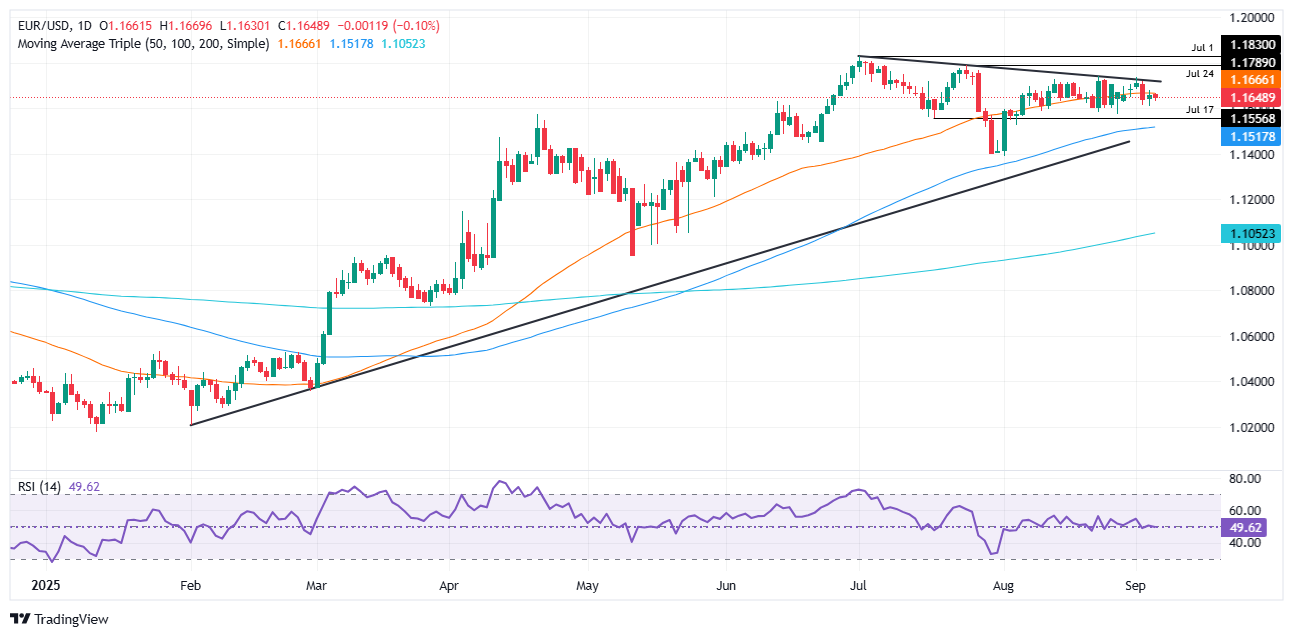
Technical outlook: EUR/USDpoised to remain within the 1.1650-1.1700 range
EUR/USD consolidated at around 1.1650, with traders unable to reach 1.1700. While the Relative Strength Index (RSI) signals a bullish bias, it has yet to surpass its recent peak, underscoring the pair’s consolidation over the past two weeks.
A break above 1.1700 paves the way toward the September 1 high at 1.1736. Once surpassed, the next stop would be 1.1800 and the year-to-date peak at 1.1829. Conversely, a daily close below 1.1650 would expose the 1.1600 handle, with further downside risk toward the 100-day SMA at 1.1520.
Euro FAQs
The Euro is the currency for the 19 European Union countries that belong to the Eurozone. It is the second most heavily traded currency in the world behind the US Dollar. In 2022, it accounted for 31% of all foreign exchange transactions, with an average daily turnover of over $2.2 trillion a day. EUR/USD is the most heavily traded currency pair in the world, accounting for an estimated 30% off all transactions, followed by EUR/JPY (4%), EUR/GBP (3%) and EUR/AUD (2%).
The European Central Bank (ECB) in Frankfurt, Germany, is the reserve bank for the Eurozone. The ECB sets interest rates and manages monetary policy. The ECB’s primary mandate is to maintain price stability, which means either controlling inflation or stimulating growth. Its primary tool is the raising or lowering of interest rates. Relatively high interest rates – or the expectation of higher rates – will usually benefit the Euro and vice versa. The ECB Governing Council makes monetary policy decisions at meetings held eight times a year. Decisions are made by heads of the Eurozone national banks and six permanent members, including the President of the ECB, Christine Lagarde.
Eurozone inflation data, measured by the Harmonized Index of Consumer Prices (HICP), is an important econometric for the Euro. If inflation rises more than expected, especially if above the ECB’s 2% target, it obliges the ECB to raise interest rates to bring it back under control. Relatively high interest rates compared to its counterparts will usually benefit the Euro, as it makes the region more attractive as a place for global investors to park their money.
Data releases gauge the health of the economy and can impact on the Euro. Indicators such as GDP, Manufacturing and Services PMIs, employment, and consumer sentiment surveys can all influence the direction of the single currency. A strong economy is good for the Euro. Not only does it attract more foreign investment but it may encourage the ECB to put up interest rates, which will directly strengthen the Euro. Otherwise, if economic data is weak, the Euro is likely to fall. Economic data for the four largest economies in the euro area (Germany, France, Italy and Spain) are especially significant, as they account for 75% of the Eurozone’s economy.
Another significant data release for the Euro is the Trade Balance. This indicator measures the difference between what a country earns from its exports and what it spends on imports over a given period. If a country produces highly sought after exports then its currency will gain in value purely from the extra demand created from foreign buyers seeking to purchase these goods. Therefore, a positive net Trade Balance strengthens a currency and vice versa for a negative balance.
Author

Christian Borjon Valencia
FXStreet
Markets analyst, news editor, and trading instructor with over 14 years of experience across FX, commodities, US equity indices, and global macro markets.















